Key Takeaways
- Yes — autism is formally classified as a neurodevelopmental disorder under the DSM-5, meaning it originates in the developmental period and reflects how the brain developed differently, not a disease process or acquired injury
- “Neurodevelopmental” and “neurological” are related but not identical terms — autism is more precisely described as neurodevelopmental, though the two categories overlap
- ADHD is also a neurodevelopmental disorder, classified in the same DSM-5 chapter as autism — and the two co-occur in an estimated 50–70% of cases
- Life as an autistic adult is genuinely harder than most neurotypical people realize — not because of autism alone, but because of a world built around neurotypical norms and a near-absence of adult support infrastructure
- Understanding the correct classification of autism matters because it shapes how clinicians, educators, and families approach intervention, accommodation, and long-term planning
The Direct Answer: Yes — With Important Nuance
Autism spectrum disorder (ASD) is classified as a neurodevelopmental disorder in the DSM-5, the diagnostic standard used by clinicians across the United States and much of the world.
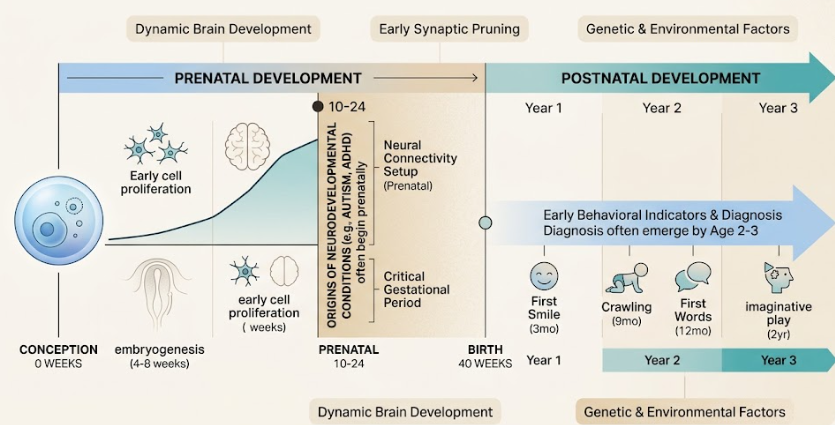
The DSM-5 chapter on Neurodevelopmental Disorders groups conditions that share a common defining feature: they originate during the developmental period — typically in early childhood, often prenatally — and produce lasting differences in brain organization, cognitive processing, social functioning, or behavior. Alongside autism, the neurodevelopmental disorders chapter includes intellectual disability, ADHD, specific learning disorders, communication disorders, and motor disorders such as developmental coordination disorder and Tourette’s syndrome.
This classification tells you something important about what autism fundamentally is: not a disease, not an acquired condition, not a psychological disorder arising from experience or environment, but a different developmental trajectory of the brain — present from the beginning and persistent across the lifespan.
That framing matters enormously for how families understand their child’s diagnosis and for how clinicians approach intervention. As the DSM-5 criteria for autism make clear, the defining features of autism — differences in social communication and restricted, repetitive behaviors — are not symptoms of something going wrong. They are characteristics of a brain organized differently from conception.
What a Neurodevelopmental Disorder Actually Is
The term neurodevelopmental disorder breaks down simply:
- Neuro — involving the nervous system, specifically the brain
- Developmental — arising during the developmental period and affecting how the brain grows and organizes itself
- Disorder — a classification indicating a condition that causes clinically significant functional impairment or distress
What distinguishes neurodevelopmental disorders as a category is their timing and mechanism. They do not appear after a period of typical neurological functioning — they are present from the developmental period itself. They do not arise from an external agent damaging a normal brain. They arise from how the brain develops: the genetic programs, cellular processes, and environmental interactions that shape the brain’s architecture before birth and in the earliest years of life.
This places neurodevelopmental disorders in a fundamentally different category from acquired conditions. A stroke is neurological — it damages a brain that was functioning normally. Depression is a psychiatric condition — arising from complex interactions of biology, experience, and environment. Autism is neurodevelopmental — a brain built differently from the start.
Neurodevelopmental vs. Neurological: The Distinction That Confuses Everyone
The terms neurodevelopmental and neurological are frequently used interchangeably in casual conversation — and the overlap between them is real enough that the distinction rarely causes clinical harm. But the terms are not identical, and understanding the difference produces a more accurate picture of what autism is.
Neurological is the broader category. It encompasses any condition involving the nervous system — including the brain, spinal cord, and peripheral nerves. Neurological conditions include epilepsy, multiple sclerosis, Parkinson’s disease, stroke, migraine, and traumatic brain injury. They also include, by extension, many neurodevelopmental conditions — since all neurodevelopmental disorders are, by definition, neurological in that they involve the brain.
Neurodevelopmental is the narrower, more specific category within neurology. It refers specifically to conditions arising from how the brain developed — not how it was damaged, not how it degenerated, not how it responded to disease. Autism, ADHD, intellectual disability, and specific learning disorders are all neurodevelopmental because their origins are in the developmental process itself.
When autistic people or their families describe autism as a “neurological condition,” they are not wrong — it is a condition of the brain, and therefore neurological in the broad sense. But the more precise term — the one that captures what makes autism distinct from a stroke or a tumor — is neurodevelopmental.
The distinction also carries clinical implications. The research base, intervention strategies, educational frameworks, and long-term planning considerations for neurodevelopmental conditions are different from those for acquired neurological conditions. Autism requires a neurodevelopmental lens, not a rehabilitation model designed for brain injury.
Are Autism and ADHD Both Neurodevelopmental Disorders?
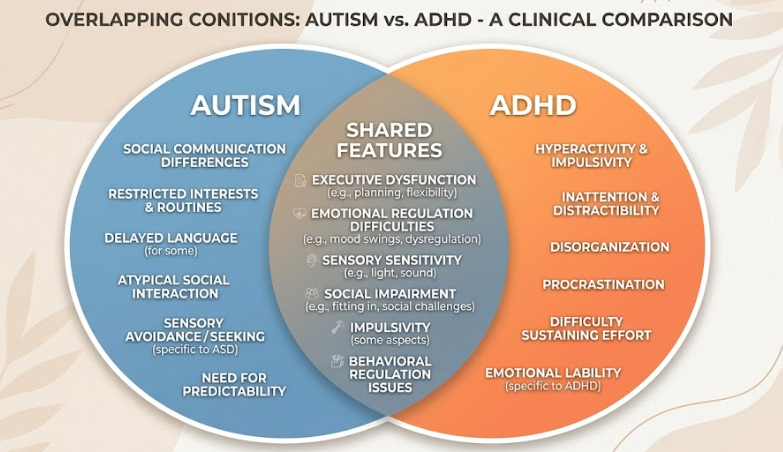
Yes — definitively. ADHD (Attention-Deficit/Hyperactivity Disorder) and autism spectrum disorder are both classified as neurodevelopmental disorders in the DSM-5’s same opening chapter. They share foundational characteristics: both originate in the developmental period, both involve differences in brain organization and connectivity, both are highly heritable, and both produce lasting patterns of behavior and cognition that require accommodation rather than simply treatment.
Beyond shared classification, autism and ADHD share something else: they co-occur at remarkably high rates. Research estimates suggest that 50–70% of autistic individuals also meet criteria for ADHD, and approximately 20–50% of individuals with ADHD also meet criteria for autism. This co-occurrence — once prohibited under older diagnostic rules that did not allow both diagnoses simultaneously — is now well-established and clinically recognized.
The cognitive and behavioral overlap between the two conditions is significant:
- Both involve executive functioning differences — challenges with planning, task initiation, cognitive flexibility, and working memory
- Both involve attention regulation differences, though the mechanisms differ: ADHD produces difficulty sustaining or directing attention; autism produces highly uneven attention — hyperfocus on areas of intense interest alongside difficulty attending to demands that feel irrelevant
- Both involve emotional regulation challenges — though autism’s emotional regulation difficulties are often tied to sensory overwhelm and social confusion, while ADHD’s are more tied to impulsivity and rejection sensitivity
- Both are associated with elevated rates of anxiety and depression in adults
When both conditions are present simultaneously, the support needs are additive — each condition requires its own targeted strategies, and interventions designed for one do not automatically address the other. For a deeper look at the executive functioning overlap, executive dysfunction and autism addresses how planning, flexibility, and self-regulation challenges manifest across the autism spectrum.
Why Is Life So Hard for Autistic Adults?
This question is asked with genuine pain behind it — by autistic adults themselves, by parents watching their children grow up, and by partners and family members who love autistic people and watch them struggle in ways that seem disproportionate to what others can see. It deserves a direct, honest answer.
Life is harder for autistic adults — not because autism is inherently tragic, but because the world in which autistic adults live was built almost entirely by and for neurotypical people. The mismatch between an autistic nervous system and a neurotypical world creates friction at almost every point of daily life.
The workplace is structurally hostile. Job interviews reward the precise social performance skills that autism makes difficult — sustained eye contact, small talk, reading unspoken expectations, projecting confidence through body language. Open-plan offices assault the sensory systems of those with auditory and visual hypersensitivity. Workplace culture relies heavily on unwritten social rules, informal hierarchies, and small-group politics — all areas where autistic adults are at a significant disadvantage. Unemployment and underemployment rates among autistic adults are extraordinarily high — even among those with university degrees.
Masking is exhausting and expensive. Many autistic adults spend enormous cognitive and emotional energy in every social interaction performing neurotypicality — making deliberate eye contact that feels uncomfortable, suppressing stimming behaviors, monitoring their vocal tone, scripting conversations in advance. This sustained performance — called masking or camouflaging — is depleting in a way that is invisible to observers but profoundly real in its effects. The end of a workday for a heavily masking autistic person is not the mild tiredness of a typical day — it can be genuine cognitive and emotional exhaustion. Rejection sensitive dysphoria and autism covers one of the specific emotional experiences that make social navigation particularly painful for many autistic adults.
Mental health challenges are pervasive and underserved. Approximately 70–80% of autistic adults experience clinically significant depression or anxiety across their lifetimes. Suicide risk in autistic adults is substantially elevated compared to the general population — a crisis that receives far less attention than it warrants. And the mental health system is poorly equipped to serve them: standard CBT protocols are often insufficiently adapted for autistic cognitive styles, wait times for autism-informed therapists are long, and many autistic adults have accumulated years of misdiagnosis before anyone recognized the underlying autism.
Adult services are essentially nonexistent. The infrastructure for autism support in childhood — early intervention, IEPs, school-based speech therapy, OT, and behavioral support — largely disappears at age 21. The transition from school-based support to adult life is often described by autistic people and their families as “falling off a cliff.” Adult autism services are a fraction of what exists for children, waiting lists are years long, and many autistic adults navigate adult life without any formal support whatsoever.
Autistic burnout is real and poorly recognized. Autistic burnout — distinct from general burnout — is a state of chronic exhaustion, loss of previously held skills, and reduced tolerance for sensory and social demands, typically resulting from sustained masking and insufficient accommodation. It can look like a sudden regression in functioning that bewilders families and clinicians who do not understand its mechanism. Recovery from autistic burnout requires reduced demands, increased accommodation, and genuine rest — not more intervention.
None of this means that autistic adults cannot build meaningful, fulfilling lives. Many do — with the right support, self-understanding, and environment. But the path there is genuinely harder than it needs to be, and understanding why is the first step toward building better systems.
What Is Finger Flicking in Autism?
Finger flicking is a form of stimming — self-stimulatory behavior — that involves rapidly moving individual fingers or fluttering the hand in front of the face or body, typically creating visual motion feedback in the person’s field of vision.
As a visual stim, finger flicking provides the autistic nervous system with a controlled, predictable source of sensory input — the flicker of fingers in motion, particularly against a light source, produces a rhythmic visual signal that many autistic individuals find regulating, calming, or simply pleasurable. It is neurologically similar in function to other visual stims such as spinning objects, watching moving water, or gazing at light through leaves.
Finger flicking is not random or purposeless. Its functions typically include:
- Regulation during sensory overwhelm — providing a controllable sensory anchor when the environment feels unpredictable or too intense
- Pleasure and enjoyment — stimming often intensifies during positive emotional states, not just distress
- Anxiety management — the rhythm of repetitive sensory input is inherently self-soothing
- Sensory-seeking — filling a sensory deficit when the environment is under-stimulating
Like all stimming behaviors, finger flicking is not harmful and should not be automatically suppressed. The behavior becomes a clinical consideration only when it is so frequent or intense that it consistently prevents a child from engaging with learning, communication, or social interaction — in which case, ABA-informed assessment can identify the function and develop alternative regulatory strategies. For related sensory-seeking behaviors that follow the same functional logic, is chewing clothes a sign of autism explores how oral sensory-seeking behaviors fit the same regulatory picture.

Common Misconceptions About Neurodevelopmental Classification
“Neurodevelopmental means it only affects children.” Neurodevelopmental disorders originate in childhood, but their effects extend across the entire lifespan. An autistic adult is not a recovered or resolved case — they are an autistic child who grew up. The classification describes the origin of the condition, not its duration.
“Autism and ADHD can’t both be present — they’re too different.” The DSM-5 now explicitly allows dual diagnosis of autism and ADHD — a change from the DSM-IV, which prohibited it. The research base demonstrating their high co-occurrence is robust. Clinicians who tell families that a child “can’t have both” are working from an outdated diagnostic framework.
“Neurological disorders are physical; neurodevelopmental disorders are behavioral.” Both are physical — both involve the brain as a physical organ and its structural and functional organization. The behaviors associated with neurodevelopmental disorders are products of neurological organization, not separable from it. The brain-behavior distinction is false.
“Early intervention fixes a neurodevelopmental disorder.” Early intervention produces meaningful and often dramatic improvements in functional skills. It does not fix or eliminate the neurodevelopmental profile. An autistic person who has made extraordinary progress through early intensive intervention remains autistic. What changes is their skill set and functional capacity — not the underlying neurodevelopmental organization of their brain.
“If someone functions well, their neurodevelopmental disorder must be mild.” High functional output often requires enormous effort that is invisible to observers. A highly functioning autistic adult may be spending all of their cognitive and emotional resources on managing their work and social presentation — leaving nothing for anything else. Functional appearance is not an accurate proxy for functional ease.

Conclusion
Autism is a neurodevelopmental disorder — a classification that tells us exactly what autism is at its foundation: a different trajectory of brain development, present from the beginning of life, producing a characteristic and lasting neurological profile. Not a disease. Not damage. Not a psychological condition arising from experience. A different kind of brain.
That classification matters because it shapes everything that follows: how autism is understood scientifically, how intervention is designed, how accommodation is built, and how autistic people deserve to be regarded across their entire lifespan — not just in childhood, and not only when their challenges are most visible.
The autistic adults navigating a world built for neurotypical people, the autistic children building their first communication skills, and the families trying to understand what their child’s diagnosis means — all of them benefit from an accurate, specific understanding of what autism actually is. A neurodevelopmental disorder. A different brain. A person deserving of support calibrated to their actual neurology.
Dream Bigger ABA delivers individualized, evidence-based ABA therapy for autistic children and their families across Northern Virginia — grounded in an accurate understanding of autism as a neurodevelopmental profile and a genuine commitment to each child’s best outcomes. Connect with our team to explore services in Vienna, VA and Gainesville, VA.
Frequently Asked Questions
Is autism a neurodevelopmental or neurological disorder?
Autism is most precisely classified as a neurodevelopmental disorder — the more specific term within the broader neurological category. All neurodevelopmental disorders are neurological in the sense that they involve the brain as a physical organ, so describing autism as “neurological” is not incorrect. But neurodevelopmental is the more precise term, capturing what is distinctive about autism’s classification: it arises from how the brain developed during the prenatal and early childhood period, rather than from an acquired injury, degenerative disease, or pathological process acting on a previously normal brain. The DSM-5 formally classifies autism under its Neurodevelopmental Disorders chapter, alongside ADHD, intellectual disability, specific learning disorders, and communication disorders.
Which billionaire has Asperger’s?
Elon Musk is the most prominent publicly known billionaire to have disclosed an Asperger’s diagnosis — doing so on Saturday Night Live in May 2021 in a manner that was notably matter-of-fact. Asperger’s syndrome was the diagnostic label used for autistic individuals without significant language or intellectual delays prior to 2013, when it was unified under the broader autism spectrum disorder (ASD) diagnosis in the DSM-5. Musk’s disclosure was significant partly because of its reach and partly because of its tone — he presented his diagnosis as an aspect of who he is, not as a limitation. The pattern of successful and prominent individuals identifying as autistic reflects something research supports: autism-associated cognitive traits — depth of systematic thinking, intense focus within specific domains, pattern recognition — can be significant functional assets in the right environment, even as they produce genuine social and sensory challenges.
Are autism and ADHD neurodevelopmental disorders?
Yes — both autism spectrum disorder and attention-deficit/hyperactivity disorder (ADHD) are classified as neurodevelopmental disorders in the DSM-5, appearing in the same opening chapter. Both originate in the developmental period, both involve differences in brain organization driven by genetics, and both produce lasting patterns of behavior and cognition. They co-occur at high rates — approximately 50–70% of autistic individuals also meet criteria for ADHD — and share meaningful overlap in executive functioning challenges, emotional regulation difficulties, and sensory sensitivity. They are, however, distinct conditions with different diagnostic criteria, different neurological mechanisms, and different primary intervention needs. When both are present simultaneously, each requires its own targeted support strategy rather than a single unified approach.
Why is life so hard for autistic adults?
Several intersecting factors make adult life significantly harder for autistic people than for neurotypical peers. The physical and social world — workplaces, public spaces, healthcare systems, social conventions — is designed around neurotypical norms, requiring autistic adults to constantly translate between their own neurology and a system that does not accommodate it. Masking — suppressing autistic behaviors to appear neurotypical — is cognitively and emotionally exhausting and is sustained by many autistic adults for entire workdays, social events, and healthcare appointments. Mental health challenges are pervasive: approximately 70–80% of autistic adults experience clinically significant depression or anxiety, and suicide risk is substantially elevated. Adult autism services are a fraction of what exists for autistic children, and the transition from school-based support to adult life leaves many autistic people without any formal support. Autistic burnout — a state of functional collapse following sustained masking and insufficient accommodation — affects a significant portion of autistic adults and is often misidentified as depression or laziness. None of this means a fulfilling life is out of reach — but it requires the right support, self-understanding, and environments, not simply effort.
What is finger flicking in autism?
Finger flicking is a form of self-stimulatory behavior — stimming — in which an autistic individual rapidly moves or flutters individual fingers, typically creating visual motion in their field of view. It is primarily a visual stim: the flickering movement of fingers, particularly near a light source, produces a rhythmic, predictable sensory signal that many autistic people find regulating, calming, or pleasurable. Like all stimming, it serves a genuine neurological function — helping the person’s nervous system reach a more comfortable state of arousal during sensory overwhelm, excitement, anxiety, or sensory under-stimulation. Finger flicking is not harmful and should not be automatically targeted for elimination. It becomes clinically relevant only when its frequency or intensity consistently prevents meaningful engagement with learning or daily activities — in which case ABA-informed intervention focuses on understanding the underlying sensory function and providing alternative means of meeting that need, rather than simply suppressing the behavior.