Key Takeaways
- Autism does not directly “cause” tics — but tics occur in an estimated 20–60% of autistic individuals, far exceeding rates in the general population
- The co-occurrence reflects shared neurological underpinnings between autism and tic disorders, particularly involving the basal ganglia and dopaminergic systems — not one condition producing the other
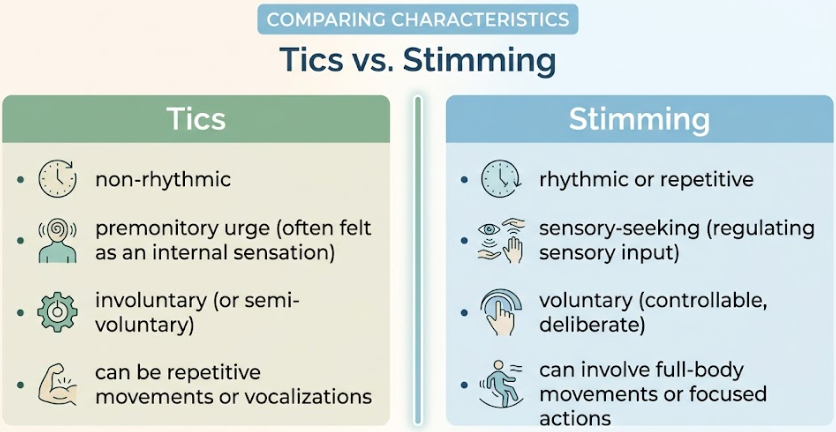
- The most clinically important distinction for families is between tics (involuntary, driven by a premonitory urge) and stimming (self-regulatory, purposeful, rhythmic) — they can look similar but have different neurological origins and require different responses
- Tourette’s syndrome co-occurs with autism at rates approximately 6–22 times higher than in the general population
- Tics in autistic individuals are commonly exacerbated by anxiety, stress, excitement, and fatigue — all of which autistic individuals experience at higher baseline rates
The Direct Answer: Autism Doesn’t Cause Tics — But the Two Are Closely Linked
The relationship between autism and tics is real, significant, and genuinely complex — but characterizing autism as causing tics is not quite accurate.
Autism is a neurodevelopmental condition defined by differences in social communication and restricted, repetitive behaviors. Tic disorders — including Tourette’s syndrome, persistent motor tic disorder, and provisional tic disorder — are separate neurological conditions characterized by sudden, involuntary or semi-voluntary motor movements or vocalizations.
What connects them is not causation but shared neurological architecture. Both autism and tic disorders involve differences in the basal ganglia — a set of brain structures involved in motor control, habit formation, and behavioral inhibition. Both have strong genetic components with partially overlapping genetic risk factors. Both are significantly more common in males. And when one is present, the probability of the other being present is dramatically elevated.
The result: an autistic child who develops tics is not showing a new complication of their autism. They are showing a co-occurring neurological condition that shares biological risk factors with autism and therefore co-occurs with it far more often than chance would predict.
For parents, this distinction matters because it shapes treatment. Tics and autistic behaviors that look like tics require different clinical approaches — and knowing which you are dealing with is the first step.
Tics vs. Stimming: The Most Important Distinction
The most clinically critical distinction in this topic is the one between tics and stimming (self-stimulatory behavior). They can look almost identical from the outside. They are neurologically and functionally different in ways that matter for intervention.
Tics:
- Sudden, rapid, non-rhythmic, repetitive
- Experienced as involuntary or semi-voluntary — the person feels a strong urge they struggle to suppress
- Typically preceded by a premonitory urge — a sensory discomfort, tension, pressure, or “incomplete” feeling that builds until the tic is performed, after which there is momentary relief
- Suppressing tics is possible for some people in some contexts but requires significant effort and often produces a “rebound” — the tic emerges more forcefully after sustained suppression
- Wax and wane in frequency and type over weeks and months
- Can shift locations and forms over time
Stimming:
- Repetitive but typically rhythmic and sustained
- Voluntary and purposeful — serves a regulatory function (self-soothing, sensory input, emotional expression)
- Not driven by a premonitory urge in the same way — the person seeks the sensory input rather than experiencing distress that is relieved by the movement
- Generally does not shift unpredictably in form or location
- Can typically be redirected without the same internal pressure that makes tic suppression difficult
In autistic individuals, this distinction is harder to make clinically because:
- Many autistic individuals have difficulty identifying and describing internal sensory states (interoception differences)
- Some behaviors can genuinely be on the boundary — oral behaviors, throat-clearing sounds, specific hand movements that have features of both
- The autism-related tendency toward repetitive behavior means that what might be a tic in a neurotypical person may be attributed to autism in an autistic person, potentially delaying appropriate treatment for the tic disorder
If a clinician, parent, or teacher is uncertain whether a behavior is a tic or stimming, referral to a pediatric neurologist or psychiatrist with expertise in movement disorders is the appropriate next step.
Why Tics Are More Common in Autistic People
The elevated co-occurrence of tics and autism is not coincidental. Several overlapping biological factors explain why the two conditions cluster together:
Shared basal ganglia involvement. The basal ganglia — a group of subcortical structures involved in motor control, habit formation, inhibitory control, and reward processing — show differences in both autism and tic disorders. Disruptions in basal ganglia circuitry, particularly in the cortico-striato-thalamo-cortical loops, are implicated in both repetitive autistic behaviors and in the production of tics. Two conditions affecting overlapping neural circuits would naturally co-occur at elevated rates.
Overlapping genetic architecture. Many of the genetic variants associated with autism are also found at elevated rates in individuals with Tourette’s syndrome and OCD — the three conditions form a well-recognized neurological cluster. Family studies show elevated rates of tic disorders in relatives of autistic individuals and elevated autism rates in relatives of individuals with Tourette’s. This clustering is a signature of shared genetic risk.
The OCD-autism-Tourette’s triad. OCD co-occurs with both autism and Tourette’s at high rates — approximately 17–37% of autistic individuals have co-occurring OCD, and approximately 50% of individuals with Tourette’s have co-occurring OCD. When all three conditions share genetic and neurological risk factors, and when each elevates the risk for the others, the expected co-occurrence rates are exactly what is observed.
Anxiety as an amplifier. Anxiety dramatically worsens tics. Autistic individuals have elevated rates of anxiety — estimated at 40–60% of autistic individuals have at least one anxiety disorder. Elevated baseline anxiety in autism creates more frequent and intense tic-triggering conditions in individuals who are already neurologically susceptible to tics.
What Causes Tics in Children With Autism Specifically
For an autistic child who has developed tics, several specific contributing factors are worth identifying and addressing:
Anxiety levels. The single most reliable tic trigger is anxiety. For autistic children, the sensory demands of school, the social complexity of peer interaction, and the unpredictability of new environments create chronic elevated anxiety that directly increases tic frequency. Addressing anxiety is often the most effective way to reduce tic burden — not targeting the tics directly.
Fatigue and sleep disruption. Sleep problems are extremely common in autism — affecting an estimated 50–80% of autistic children. Fatigue reliably worsens tics. Poor sleep drives both increased autism-related irritability and increased tic severity in a cycle that compounds quickly.
Excitement and positive emotional arousal. Tics are not only triggered by stress — they are also triggered by excitement, anticipation, and positive emotional peaks. Many parents notice that tics increase dramatically before a favorite event, during an exciting activity, or after something the child has been looking forward to. This can be confusing — the child is happy, not stressed — but high arousal in either direction triggers tics in predisposed individuals.
Attention to tics. Drawing attention to tics — asking the child to stop, calling them out, or expressing concern in front of the child — can temporarily increase tic frequency. Tics are partly driven by social learning and attention mechanisms; awareness of the tic can activate the premonitory urge cycle more frequently.
PANDAS/PANS. Sudden-onset or dramatically worsening tics in an autistic child — particularly following a streptococcal infection or other illness — warrant evaluation for PANDAS (Pediatric Autoimmune Neuropsychiatric Disorders Associated with Streptococcal Infections) or the broader PANS (Pediatric Acute-onset Neuropsychiatric Syndrome). These immune-mediated conditions can produce abrupt, severe tic escalation and should be ruled out medically before assuming tic increase is purely anxiety-driven.

What Do Autistic Tics Feel Like?
Understanding the subjective experience of tics — particularly in autistic individuals — helps parents, educators, and clinicians respond with appropriate empathy and clinical precision.
The defining sensory experience of a tic is the premonitory urge: an internal feeling — often described as a pressure, itch, tension, or incompleteness — that builds in a specific body region or more diffusely before the tic. Performing the tic provides momentary relief, which is then followed by the rebuilding of the urge. The cycle is uncomfortable and exhausting to manage.
Common descriptions from individuals who tic:
- “It feels like I have to do it or it won’t feel right”
- “Like an itch inside my body that I can’t scratch any other way”
- “A pressure that builds until I let it out”
- “Like holding your breath — eventually you have to breathe”
For autistic individuals, describing this internal experience can be more challenging because of interoception differences — the reduced ability to accurately perceive and describe internal body sensations that is common in autism. An autistic child who is ticcing may not be able to articulate the premonitory urge clearly, even when it is present. They may say “I don’t know why I do it” or “I can’t stop” — which is clinically different from the child who is stimming and who, if asked, can usually explain what the movement does for them.
This interoception barrier is one reason why tics in autistic individuals are sometimes missed, misattributed to autism behaviors, or inadequately treated — the child cannot report the diagnostic feature (the urge) clearly, so it is never elicited.
What Are Autistic Tics? Examples Across Categories
Tics are classified by type and complexity. In autistic individuals, the full range of tic types can be present — often alongside stimming behaviors that may or may not be clinically distinct.
Simple motor tics: Eye blinking, eye rolling, facial grimacing, nose wrinkling, lip licking, head jerking, shoulder shrugging, arm jerking, abdominal tensing, finger movements
Complex motor tics: Touching objects or body parts in specific sequences, hopping, squatting, bending, twisting, making specific gestures, touching the face or head repeatedly
Simple vocal tics: Throat clearing, sniffing, grunting, barking, clicking, humming, coughing, snorting
Complex vocal tics: Repeating specific words or phrases out of context, repeating what was just heard (echolalic tics, which can be particularly difficult to distinguish from autism-related echolalia), using single words abruptly, and — rarely and often overstated — coprolalia (involuntary obscene words, occurring in only approximately 10–15% of Tourette’s cases)
In autistic individuals specifically, throat clearing, eye behaviors, and certain vocalizations are among the most commonly reported tics — and are also among the behaviors most easily attributed to autism rather than tic disorder, leading to diagnostic delay.
When Do Autism Tics Start — and How Do They Evolve?
Tics in autistic individuals follow patterns broadly similar to those in the general population, with some important nuances.
Onset typically occurs between ages 4 and 8, with peak onset around age 6–7. Simple motor tics involving the head and face are most common at onset. Tics earlier than age 4 are less common but not unknown.
Progression follows a characteristic pattern in many individuals: tics often begin with simple motor tics, add more complex motor tics, and eventually may include vocal tics. The DSM-5 criteria for Tourette’s syndrome require both multiple motor tics and at least one vocal tic to be present — though they do not need to occur simultaneously — for more than 12 months.
Peak severity typically occurs between ages 10 and 12 — the period that coincides with the increased social and academic demands of middle school, which also happens to be a time of significant stress and anxiety for many autistic individuals. The convergence of peak tic severity with a high-demand, low-accommodation environment makes this period particularly challenging.
Natural trajectory: For many individuals, tic severity reduces significantly in late adolescence and early adulthood. Approximately 50% of individuals with Tourette’s experience meaningful reduction in tics by their mid-20s. However, for some — and particularly for autistic individuals with persistent high anxiety — tics remain a significant feature of adult life.
In autistic individuals, tic onset may be harder to date precisely because early tics can be indistinguishable from stimming behaviors that were already present. Parents often report that they noticed something was “different” about a particular behavior but could not identify it as a tic until it became more prominent or took a new form.

What Are the Three Main Symptoms of Autism in Adults?
While the DSM-5 criteria for autism apply across the lifespan, how autism presents in adults is shaped by years of masking, compensation, and accumulated life experience. The three core symptom areas manifest distinctively in adulthood:
1. Social communication differences — compounded by years of masking Adult autistic individuals often have developed sophisticated compensatory strategies that make their social differences less visible in brief encounters. Sustained social interaction — across a full workday, in complex group dynamics, or in intimate relationships over time — reveals the ongoing effort required and the persistent gaps in automatic social processing. Many autistic adults describe exhaustion from social performance, difficulty with the implicit rules of workplace culture, and relationships that take significantly more cognitive effort than their neurotypical counterparts report.
2. Restricted and repetitive behaviors — expressed through adult-shaped interests and routines In adults, highly focused interests often appear as deep professional expertise, extensive hobbyist knowledge, or consuming passion for specific domains. Insistence on routine may manifest as rigid scheduling, significant distress around travel or schedule disruption, or specific requirements in daily life that partners and colleagues find difficult to accommodate. Executive dysfunction and autism — particularly the challenges with flexible thinking and transition — is often among the most functionally impairing features of autism in adult workplaces and domestic life.
3. Sensory processing differences — filtered through adult environments Autistic adults navigate sensory demands in workplaces (open-plan offices, fluorescent lighting, noise), public spaces (crowds, transit, restaurants), and social events (gatherings with overlapping conversations, unpredictable sensory environments) that are rarely designed with sensory needs in mind. Sensory overwhelm contributes directly to social withdrawal, anxiety, and the autistic burnout pattern seen in many autistic adults.
Common Misconceptions About Autism and Tics
“If my autistic child tics, it’s just part of their autism — no separate evaluation needed.” Tic disorders are distinct clinical conditions that benefit from their own evaluation and treatment. Treating tics as merely autism-related behavior can lead to missed diagnosis of Tourette’s syndrome, delayed access to evidence-based tic treatments like CBIT (Comprehensive Behavioral Intervention for Tics), and unnecessary suppression of behaviors that are driven by a premonitory urge — which is clinically contraindicated without appropriate support.
“Telling a child to stop ticcing will help.” Tics are involuntary or semi-involuntary — the child is not choosing them. Instructing a child to stop produces shame and increased anxiety, both of which worsen tics. The appropriate response to observed tics in educational and home settings is accommodation and, when warranted, referral for specialized behavioral treatment.
“Coprolalia (involuntary swearing) is a common feature of Tourette’s.” Coprolalia — involuntary obscene vocalizations — affects approximately 10–15% of individuals with Tourette’s syndrome and is therefore present in a minority of cases. It is dramatically overrepresented in media depictions of Tourette’s, creating a misconception that makes many families dismiss a Tourette’s diagnosis because their child does not swear involuntarily.
“Tics always get worse over time.” For many individuals, tics significantly reduce in severity in late adolescence and early adulthood. This is not universal, and tics in autistic individuals with persistent high anxiety may remain more stable — but the assumption that tics are a progressively worsening condition is not supported by the natural history research.
“Stimming should be stopped; tics should be suppressed.” Modern clinical guidance opposes the suppression of stimming in autistic individuals when the stimming is not harmful — stimming serves a regulatory function, and suppressing it removes a coping mechanism without addressing the underlying need. For tics, behavioral intervention (CBIT) focuses on competing responses and awareness training — not suppression, which rebounds and is counterproductive. Both behaviors deserve clinical responses that are calibrated to their function.
What to Do When an Autistic Child Develops Tics
Step 1: Distinguish tics from stimming with clinical support If you are uncertain whether a new repetitive behavior is a tic or stimming, consult a clinician experienced with both autism and tic disorders — ideally a developmental pediatrician, pediatric neurologist, or child psychiatrist. The distinction shapes what comes next.
Step 2: Rule out PANDAS/PANS for sudden-onset tics If tics appeared suddenly or escalated dramatically following illness, request evaluation for PANDAS/PANS. A pediatric neurologist or psychiatrist familiar with these conditions can guide the workup.
Step 3: Address anxiety as a priority Since anxiety is the most modifiable tic trigger in autistic individuals, reducing anxiety directly reduces tic burden. ABA-informed support, adapted cognitive-behavioral approaches, sensory accommodations, and environmental modifications all contribute to anxiety reduction.
Step 4: Pursue CBIT if tics are causing functional impairment CBIT (Comprehensive Behavioral Intervention for Tics) is the evidence-based first-line behavioral treatment for tic disorders. It involves habit reversal training — building awareness of the premonitory urge and developing a competing response — combined with functional analysis of tic triggers. CBIT has been adapted for use with autistic individuals, and autism-experienced CBIT therapists are the appropriate provider for this population.
Step 5: Coordinate care across providers An autistic child with tics may be working with a BCBA for autism-related goals, a speech therapist for communication, an OT for sensory needs, and a neurologist or psychiatrist for tic management. Coordination across these providers — with shared understanding of the child’s full profile — produces better outcomes than siloed treatment of each condition separately. Families in Northern Virginia can explore coordinated ABA support through Dream Bigger ABA in Vienna, VA and ABA therapy in Gainesville, VA.

Conclusion
Autism does not directly cause tics — but the two conditions are neurologically intertwined in ways that make their co-occurrence far more common than chance. Shared basal ganglia differences, overlapping genetic architecture, and the anxiety that so frequently accompanies autism all create conditions in which tic disorders emerge at dramatically elevated rates in autistic individuals.
For families navigating both conditions simultaneously, the most important steps are clinical clarity — distinguishing tics from stimming, ruling out PANDAS/PANS when onset is sudden, and accessing appropriate behavioral treatment when tics produce functional impairment — and anxiety reduction, which is the most modifiable lever in the whole system.
An autistic child with tics deserves care that addresses both conditions as what they are: distinct neurological profiles that share biological real estate and that both deserve expert, coordinated clinical attention.
Dream Bigger ABA works with autistic children and their families across Northern Virginia — including those navigating complex co-occurring presentations like tic disorders — with individualized, evidence-based ABA therapy that accounts for the full clinical picture. Connect with our team to explore services in Vienna, VA and Gainesville, VA.
Frequently Asked Questions
What do autistic tics feel like?
Tics — whether in autistic or neurotypical individuals — are typically preceded by a premonitory urge: an internal sensory sensation that builds in a specific body part or diffusely and is relieved, at least temporarily, by performing the tic. Individuals commonly describe this as a pressure, tension, itch, or a feeling that something is “incomplete” until the tic occurs. After the tic is performed, there is a brief period of relief before the urge begins to build again. For autistic individuals, describing this internal experience can be more difficult because of interoception differences — reduced awareness of and ability to articulate internal body sensations. An autistic person who tics may say they “can’t help it” or “don’t know why” without being able to identify the premonitory urge clearly, even when it is genuinely present. This reporting difficulty is one reason tics are sometimes missed or misattributed to autism behaviors in autistic individuals.
What causes tics in children with autism?
Tics in autistic children arise from the same neurological vulnerability that causes tic disorders generally — differences in basal ganglia circuitry and dopaminergic signaling — but several factors specific to autism increase their frequency and severity. Anxiety is the most significant modifier: autistic children experience elevated baseline anxiety, and anxiety directly increases tic frequency and intensity. Fatigue and sleep disruption — both of which are extremely common in autism — reliably worsen tics. High arousal states, including excitement and anticipation (not just stress), trigger tics in predisposed individuals. The elevated co-occurrence of tics and autism reflects shared genetic and neurological risk factors rather than autism causing tics through a direct mechanism. When tic onset is sudden or dramatic following illness, PANDAS/PANS should be evaluated.
What are the three main symptoms of autism in adults?
The three core symptom domains of autism — present throughout life but expressed distinctively in adulthood — are: (1) Social communication differences, which in adults often manifest as difficulty navigating the implicit rules of workplace culture and relationships, exhaustion from sustained social performance (masking), and challenges with the pace and reciprocity of adult social interaction; (2) Restricted and repetitive behaviors and routines, which in adults appear as intense professional or hobbyist interests, rigid scheduling and distress around changes in routine, and executive functioning difficulties that affect daily planning, transitions, and cognitive flexibility; and (3) Sensory processing differences, which in adults produce ongoing challenges in workplaces, public spaces, and social environments that are designed for neurotypical sensory profiles. Most autistic adults also experience significant anxiety — not a core autism feature but an almost universal accompaniment — that compounds challenges across all three domains.
What are autistic tics examples?
Tics in autistic individuals follow the same classification as tic disorders generally. Simple motor tics include eye blinking, eye rolling, facial grimacing, nose wrinkling, head jerking, shoulder shrugging, and finger movements. Complex motor tics include touching objects or body parts in specific sequences, hopping, squatting, or making particular gestures. Simple vocal tics include throat clearing, sniffing, grunting, humming, barking, and coughing. Complex vocal tics include repeating words or phrases out of context, abruptly inserting single words into speech, and — in a minority of Tourette’s cases — involuntary obscene vocalizations. In autistic individuals, vocal tics can be particularly difficult to distinguish from echolalia or other autism-related vocalizations. Throat clearing, eye-related behaviors, and specific vocalizations are among the most commonly reported tics in autistic populations and are also among the behaviors most likely to be attributed entirely to autism, potentially delaying evaluation and treatment for an underlying tic disorder.
When do autism tics start?
Tics in autistic individuals typically follow patterns similar to the general population, emerging most commonly between ages 4 and 8, with peak onset around ages 6–7. Simple motor tics involving the face and head area are usually the first to appear. Tic severity typically peaks between ages 10 and 12, a period that coincides with increased academic and social demands and often with elevated anxiety in autistic individuals — creating conditions that compound tic severity. For many individuals, tics reduce in severity through late adolescence and early adulthood; approximately half of individuals with Tourette’s experience significant improvement by their mid-20s. In autistic children, early tic onset can be difficult to date precisely because initial tics may be indistinguishable from stimming behaviors already present. A new behavior that appears more abrupt, non-rhythmic, and accompanied by apparent distress — or that the child reports feeling compelled to perform — warrants clinical evaluation to determine whether a tic disorder is emerging alongside the autism diagnosis.