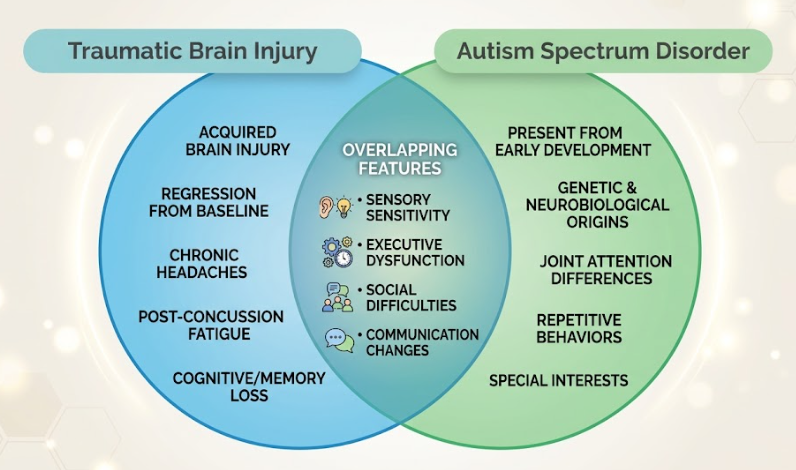
Key Takeaways
- Head trauma does not cause autism — autism is a neurodevelopmental condition rooted in prenatal brain development and genetics, not a postnatal injury event
- Traumatic brain injury (TBI) can produce behavioral and cognitive symptoms that closely resemble autism — social withdrawal, communication difficulties, sensory sensitivity, and rigid thinking — through entirely different neurological mechanisms
- The key clinical distinction: autism features are present from early development; TBI symptoms represent a change from a prior baseline after injury
- Some researchers have explored whether TBI can “unmask” pre-existing but undiagnosed autism — removing the compensatory strategies a person had developed — rather than causing new autism
- MRI can detect many types of old brain injuries, but standard clinical MRI may miss subtle damage, particularly from mild-to-moderate concussive events
The Direct Answer: Head Trauma Does Not Cause Autism
Traumatic brain injury — whether from a fall, car accident, sports collision, assault, or any other mechanism — does not cause autism spectrum disorder in the clinical, neurodevelopmental sense.
Autism’s neurological foundations are established during prenatal brain development. The genetic variants, altered connectivity patterns, and different developmental trajectories that define autism are present from the earliest stages of fetal brain formation — organized into the brain’s architecture before birth, and present long before any postnatal injury could occur. A postnatal event cannot restructure a prenatal developmental history.
This is the same answer, from the same fundamental biology, as the vaccine-autism question and the TV-autism question: autism is not acquired through postnatal exposure or injury. It develops differently from the beginning.
What is true — and what makes this question genuinely worth exploring in depth — is that the symptoms produced by significant brain injury can overlap substantially with autism features. The social difficulties, communication changes, sensory sensitivities, and behavioral rigidity that follow TBI can look remarkably like autism to observers who do not know the person’s history. Understanding both what is similar and what is fundamentally different between these two conditions serves families, clinicians, and injured individuals far better than a simple yes or no.
Why This Confusion Exists: The Symptom Overlap
The reason so many people search whether head trauma causes autism is not confused thinking — it is an accurate observation that the behavioral consequences of significant brain injury can closely resemble the behavioral profile of autism.
Both conditions can produce:
- Social withdrawal and reduced social engagement — TBI through personality change, emotional dysregulation, and reduced social motivation; autism through different social processing from the beginning
- Communication difficulties — TBI through word-finding problems, processing speed reduction, and verbal fluency changes; autism through different social communication development
- Sensory sensitivity — TBI very commonly produces hypersensitivity to light and sound; autism frequently involves sensory hypersensitivity across multiple modalities
- Rigid, inflexible thinking — TBI through executive function damage; autism through characteristic cognitive style and need for predictability
- Emotional dysregulation — TBI through damage to frontal-limbic circuits; autism through sensory overwhelm and regulation differences
- Executive functioning challenges — TBI and autism both produce difficulties with planning, task initiation, cognitive flexibility, and working memory
When a child who experienced significant head trauma begins showing these features, the surface presentation can be diagnostically confusing — particularly if the autism-specific features (the social and communicative differences) were not prominent or recognized before the injury.
What Happens in the Brain: TBI vs. Autism
Understanding the neurological distinction between TBI and autism clarifies why they are fundamentally different conditions even when they produce overlapping behavioral features.
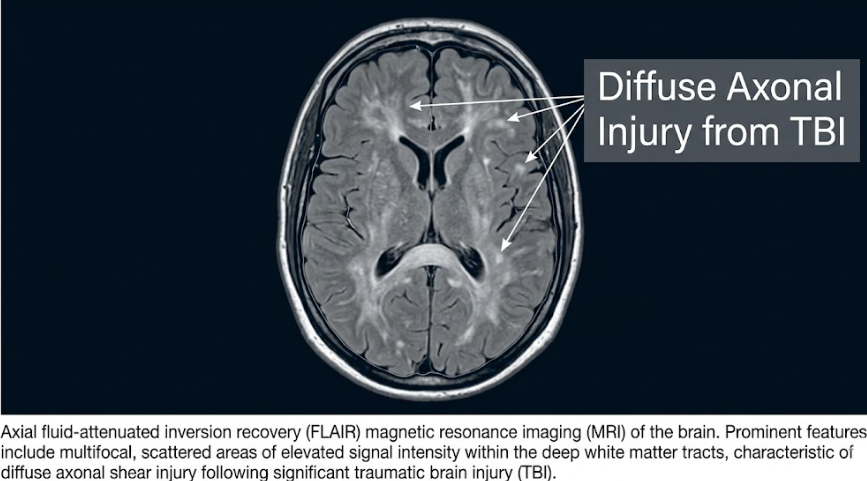
Traumatic brain injury involves physical damage to brain tissue from a mechanical force. The specific injury patterns vary by mechanism — focal damage from contusion at the site of impact and countercoup injury on the opposite side, diffuse axonal injury from the rotational forces that stretch and shear axons throughout white matter, hemorrhage from blood vessel damage, and secondary injury from swelling, inflammation, and oxidative stress in the hours and days following the initial trauma. What all TBI has in common is that it damages a brain that was previously developing or functioning differently — it produces a loss of function from an established baseline.
Autism involves a brain that developed differently from the earliest stages of prenatal formation. The connectivity differences, altered cortical organization, and different processing patterns that characterize autism are not the result of damage to normal architecture — they are the result of a different developmental trajectory. As explored in autism brain vs. neurotypical brain, the autistic brain shows characteristic differences in neural connectivity and regional development that reflect how it organized from the beginning, not how it was subsequently altered.
The behavioral consequence of this neurological distinction: TBI produces regression — loss of capacities the person previously had. Autism represents different development — a brain that never followed the neurotypical trajectory in the first place.
This distinction is most visible in memory. TBI, particularly to the medial temporal lobe structures, frequently produces significant memory impairment — difficulty forming new memories, loss of episodic memories around the injury, and fragmented autobiographical recall. Autism’s relationship with memory is different — certain memory systems (pattern recognition, procedural memory, episodic memory for detail) may be enhanced while others (memory for social information, emotional context) show different patterns. Autism and memory explores this distinction in depth. A family member who notices memory changes after a head injury is observing TBI effects — not autism.
Can You Actually Develop Autism After a Head Injury?
This question is where the science gets genuinely nuanced — and where honest engagement requires going beyond a simple “no.”
The mainstream clinical answer is that postnatal head trauma does not cause new-onset autism in individuals who were neurotypical before the injury. This is supported by the understanding of autism’s prenatal neurodevelopmental origins and the lack of any established biological mechanism through which a postnatal injury could produce an autistic neurodevelopmental profile where none existed previously.
The “acquired autism” debate. Some researchers — particularly in the 1990s and early 2000s — used the term “acquired autism” to describe cases where autism-like features appeared to emerge following brain injury. This terminology is not mainstream and is not recognized in the DSM-5. What those cases most likely represent is one or more of the following:
Unmasking of pre-existing autism. Many autistic individuals — particularly those with Level 1 presentations — develop sophisticated compensatory strategies over years of development that allow them to function in neurotypical environments without detection. A brain injury that affects executive function, reduces cognitive reserves, and eliminates those compensatory strategies can make the underlying autistic profile suddenly visible. The injury did not cause autism; it removed the learned overlay that was concealing it. This is a well-documented phenomenon in neuropsychological literature on “premorbid” vs. “post-injury” functioning.
TBI producing autism-like features through different mechanisms. The behavioral overlap between significant TBI and autism is sufficient that clinicians unfamiliar with both conditions may apply an autism diagnosis to a post-TBI presentation. The features are real — but they are produced by tissue damage, not by the neurodevelopmental differences that define autism.
Prenatal brain injury as a distinct consideration. Early prenatal brain injury — occurring during critical windows of fetal brain development — can genuinely affect the neurodevelopmental trajectory in ways that produce autism or autism features. This is categorically different from postnatal TBI. Prenatal hypoxia, early fetal infection, or other events affecting the developing fetal brain during sensitive periods can alter the neurodevelopmental outcome. These are prenatal, not postnatal, events.
Behavioral Symptoms of Traumatic Brain Injury
Because TBI and autism share behavioral overlap, understanding what TBI-specific symptoms look like — beyond the shared features — helps families and clinicians distinguish the two conditions.
Cognitive symptoms specific to TBI:
- Memory impairment: Particularly short-term and working memory — difficulty retaining new information, forgetting recent conversations, losing track of where objects are placed
- Processing speed reduction: Thinking and responding more slowly than before injury; needing more time to complete tasks that were previously effortless
- Attention and concentration difficulty: Shortened attention span, difficulty filtering distractions, mental fatigue after cognitive effort
- Word-finding difficulty (anomia): Knowing what you want to say but being unable to retrieve the word — “tip of the tongue” experiences that are more frequent and persistent than before
- Impaired reasoning and judgment: Difficulty with complex problem-solving, multistep planning, and abstract reasoning
Behavioral and emotional symptoms specific to TBI:
- Personality change noted by family members who knew the person before: more irritable, more impulsive, less socially inhibited, or more flat and withdrawn than before
- Emotional lability: Rapid, sometimes unpredictable emotional shifts — laughing or crying more easily than before, sometimes in contexts that do not match the emotional content
- Depression and anxiety: Both are very common after TBI — occurring in approximately 25–50% of individuals, driven by neurological changes as well as psychological response to injury and loss
- Fatigue: Disproportionate cognitive and physical exhaustion from activities that were not tiring before
Physical symptoms less common in autism than TBI:
- Persistent headaches or pressure sensations
- Balance and coordination difficulties
- Sleep disruption beyond the sleep challenges common in autism
- Vision changes (diplopia, light sensitivity)
- Nausea in the acute period
The most diagnostically useful indicator when differentiating TBI from autism is always history: were social communication differences, restricted interests, or sensory sensitivities present before the injury? Skill regression in autism covers how apparent developmental regression is evaluated — the distinction between autism-related regression and TBI-produced regression requires careful developmental history that tracks when features first appeared.
Can MRI Show Old Brain Injury?
Yes — but with important caveats about what standard clinical MRI can and cannot detect.
What MRI can detect from old brain injuries:
Hemosiderin deposition: When old hemorrhages occurred — whether small microhemorrhages or larger bleeds — the iron from blood breakdown products remains in brain tissue as hemosiderin. This is detectable on gradient echo sequences (GRE) and the more sensitive susceptibility-weighted imaging (SWI) as dark “blooming” artifacts. Old sports-related microhemorrhages, old coup-countercoup hemorrhagic contusions, and old traumatic subarachnoid blood can all leave these signatures years or decades after the injury.
Encephalomalacia: Brain tissue that was damaged and then died and was reabsorbed is replaced by a combination of gliosis (reactive scar tissue) and fluid-filled cavities. On MRI, this appears as areas of signal abnormality — typically bright on FLAIR sequences — with local volume loss. Old cortical contusions frequently leave this pattern.
White matter changes from diffuse axonal injury: The stretching and shearing of axons throughout white matter — the signature injury of rotational TBI — produces white matter signal changes visible on FLAIR and diffusion-weighted imaging. These may persist and are often most sensitively detected on diffusion tensor imaging (DTI), which is more sensitive than standard sequences for axonal pathway disruption.
Cerebral atrophy: In significant TBI, global or regional brain volume loss can develop over months and years after the injury and is visible on standard MRI as increased sulcal and ventricular space.
What standard MRI may miss:
This is the important caveat. Many mild-to-moderate concussive injuries — including many that produce significant and lasting functional impairment — leave no detectable findings on standard clinical MRI. Standard 1.5T or even 3T clinical MRI with standard protocols is not sensitive enough to detect the microstructural white matter disruption or subtle focal damage that can follow concussion without macrostructural hemorrhage or contusion.
More specialized techniques — DTI, fMRI, PET — can reveal functional and microstructural abnormalities even when structural MRI appears normal. These are available in research settings and in specialized clinical programs for TBI evaluation; they are not part of routine clinical brain MRI.
The practical implication: a normal MRI result does not mean no brain injury occurred and does not explain a person’s symptoms away. Conversely, finding old injury markers on MRI confirms past injury but does not fully characterize its functional impact.

Common Misconceptions About Head Trauma and Autism
“My child’s autism started after they fell and hit their head.” What more likely occurred is one of two things: either the child’s autism was already present but not yet recognized, and the injury coincided temporally with the age at which autism features typically become most visible — or the injury’s effects produced autism-like symptoms through TBI mechanisms rather than through autism development. Autism’s developmental origins predate any postnatal injury. The timing of recognition is not the timing of origin.
“If I can prove the brain injury caused the autism, I have a legal claim.” Legal causation and neurological causation are different frameworks. Postnatal head trauma does not cause autism in the neurodevelopmental sense recognized by current science — which creates significant challenges for any legal claim premised on this theory. Anyone navigating this territory should consult both a neurological specialist and a qualified attorney with relevant experience.
“TBI and autism need the same treatment.” They do not. TBI rehabilitation focuses on cognitive remediation, compensatory strategy development for memory and attention, vestibular therapy, and psychological support for mood and adjustment. Autism intervention — including ABA therapy — addresses social communication, behavioral, and adaptive functioning goals through evidence-based behavioral approaches. The behavioral overlap between the two conditions does not mean the interventions are interchangeable. A person with TBI who has autism-like features needs TBI-specific rehabilitation; an autistic person who has experienced TBI needs both.
“Autism that appeared after head injury is milder or more treatable because it has a known cause.” This conflates autism (neurodevelopmental) with autism-like features from TBI (acquired behavioral symptoms). If true autism was present before the injury, the injury did not change its nature or treatability. If the features are TBI-related rather than autistic in origin, they are not autism and should be treated as TBI.
“Helmets and safety equipment can prevent autism.” Helmet use is an important injury prevention measure with well-established benefits for preventing TBI. It has no relationship to autism prevention, because head trauma does not cause autism.

Conclusion
Head trauma does not cause autism. Autism is a neurodevelopmental condition established in prenatal brain development through genetic and intrauterine factors — not an acquired consequence of any postnatal event or injury. No head injury, however severe, can produce the neurodevelopmental profile that defines autism in a brain that was neurotypically developing before the impact.
What significant brain injury can produce is a behavioral and cognitive syndrome that overlaps meaningfully with autism in some of its features — social withdrawal, communication changes, sensory sensitivity, rigid thinking, executive dysfunction. These features are real and deserve appropriate clinical attention. They require TBI-specific evaluation and rehabilitation, not autism intervention — because their underlying neurology is fundamentally different from autism’s, even when the surface presentation looks similar.
For families navigating both TBI and autism — either in a child who experienced injury, or in an autistic individual who has also sustained TBI — the most important step is accurate clinical characterization of what each condition is contributing to the full picture, and care that addresses both with the evidence-based approaches appropriate to each.
Dream Bigger ABA provides individualized ABA therapy for autistic children and their families across Northern Virginia — grounded in accurate understanding of autism’s neurodevelopmental nature and genuine care for each child’s specific profile. Connect with our team to explore services in Vienna, VA and Gainesville, VA.
Frequently Asked Questions
What are the three main causes of autism?
The most consistently supported contributors to autism, based on current research, are: (1) Genetic variants — autism is primarily genetic, with heritability estimates of 64–91% from twin studies. Hundreds of genetic variants — most individually small in effect but significant in combination — shape the neurodevelopmental trajectory that produces autism. No single gene explains the majority of cases; the genetic architecture is polygenic and complex. (2) Prenatal environmental factors — factors that modify the expression of genetic risk during fetal brain development, including advanced parental age (both maternal and paternal), certain prenatal infections during the first trimester, extreme prematurity, and possibly prenatal air pollution exposure. These are modifying factors rather than primary drivers, but they meaningfully affect outcome. (3) Stochastic and epigenetic developmental variation — the fact that even identical twins are discordant for autism in 10–40% of cases demonstrates that factors beyond shared genetics influence the outcome, including epigenetic differences, de novo mutations arising after twinning, and random variation in prenatal developmental processes. Head trauma, vaccines, diet, and screen time are not among the established causes.
Can you develop autism after a head injury?
Not in the classical neurodevelopmental sense — autism’s origins are prenatal and genetic, and a postnatal injury cannot restructure a developmental history that was established before birth. What can occur after significant head injury is the development of autism-like behavioral symptoms through TBI mechanisms — social withdrawal, communication difficulties, sensory sensitivity, rigid thinking — that can be clinically confused with autism but are produced by tissue damage rather than neurodevelopmental difference. Additionally, significant brain injury can unmask pre-existing but undiagnosed autism by eliminating the compensatory strategies a person had developed over years — making the underlying autistic profile visible when it was previously concealed. In this scenario, the injury did not cause autism; it removed the layer of learned adaptation covering it. Careful developmental history — documenting whether social, communicative, or behavioral differences existed before the injury — is the most important tool for distinguishing these scenarios.
What is the 6-second rule for autism?
The 6-second rule is a practical communication guideline used by educators, therapists, and parents of autistic individuals. It means waiting at least six full seconds after giving a direction, asking a question, or delivering a prompt — before repeating, adding language, or assuming the person did not respond because they did not understand. Many autistic people require longer than typical auditory processing time to fully receive, decode, and translate spoken language into a planned response. When an adult speaks and then immediately repeats or adds to an instruction within two or three seconds, they layer new auditory input on top of language the autistic person is still processing — a pattern that commonly produces confusion or apparent non-compliance. The 6-second guideline is simple to implement, free, and produces meaningful improvements in response rates when applied consistently. It functions differently from the same strategy used with TBI — in TBI, the processing delay reflects cognitive slowing from neuronal damage rather than the developmental processing differences of autism, though the practical strategy of allowing adequate response time is beneficial in both contexts.
What are the behavioral symptoms of traumatic brain injury?
TBI produces a characteristic cluster of behavioral, cognitive, physical, and emotional symptoms that varies by injury severity and location. Cognitive symptoms include impaired short-term memory (difficulty retaining new information), slowed processing speed, reduced attention and concentration, word-finding difficulty, and impaired executive function — the same planning, flexibility, and task-initiation challenges seen in autism, but acquired through injury rather than present developmentally. Behavioral and emotional symptoms include irritability, impulsivity, emotional lability (rapid mood shifts), personality change noted by others, depression, anxiety, and social withdrawal. Physical symptoms include headaches, fatigue disproportionate to activity level, sleep disruption, balance difficulties, and sensory hypersensitivity — particularly to light and sound. The critical distinguishing feature from autism in all of these domains is their acquired, regressive nature: they represent a change from a prior functional baseline rather than a different developmental trajectory from the start.
Can MRI show old brain injury?
Yes — MRI can detect many types of old brain injuries, though with important limitations. Old hemorrhages leave hemosiderin deposits detectable as dark signals on gradient echo and susceptibility-weighted imaging (SWI) sequences — these can persist for decades and are commonly found in individuals with histories of sports-related concussions, falls, or assaults. Old cortical contusions produce encephalomalacia — focal areas of gliosis and tissue loss visible on FLAIR sequences as bright signal changes with local volume loss. Diffuse axonal injury from rotational TBI produces white matter changes visible on FLAIR and most sensitively on diffusion tensor imaging (DTI), which can detect disrupted axonal pathways invisible to standard sequences. Global cerebral atrophy from significant TBI — volume loss beyond what age would explain — is detectable on standard MRI. The important caveat: standard clinical MRI misses many mild-to-moderate concussive injuries entirely, even when significant functional impairment exists. A normal MRI does not rule out TBI. More specialized techniques including DTI, functional MRI, and PET scanning are more sensitive and are available in specialized TBI evaluation programs.