Key Takeaways
- The evaluation itself — the actual testing and assessment — typically takes 3 to 6 hours total, often spread across one to three separate sessions
- The full process from first concern to final diagnosis routinely takes 6 months to 2 years in the United States, with wait times for evaluation appointments being the biggest bottleneck by far
- A comprehensive autism evaluation includes a structured parent interview, direct observation of the child, cognitive testing, adaptive behavior assessment, and a feedback session — each component adds time
- School-based evaluations under IDEA must be completed within 60 days of parental consent, but are often narrower in scope than private or hospital-based assessments
- The most important thing to do while waiting: do not wait to pursue developmental support — services can and should begin before a formal diagnosis is confirmed
How Long Does the Evaluation Actually Take?
The honest answer is: it depends — and separating the evaluation time from the wait time is the most important distinction families need to make.
The assessment itself — the hours spent in a room with an evaluator — typically runs between 3 and 6 hours for a child, and sometimes longer for adults or complex presentations. This time is almost never delivered in a single continuous sitting. Most comprehensive autism evaluations span two to three separate appointments scheduled days or weeks apart.
The wait for an appointment is an entirely different story. In most areas of the United States, families are waiting 6 months to 2 years from the moment a referral is placed to the moment they sit down for their first evaluation session. Developmental pediatricians, pediatric neuropsychologists, and child psychiatrists who conduct comprehensive autism evaluations typically have long appointment backlogs — demand has increased dramatically as awareness has grown, and the specialist workforce has not kept pace.
After the evaluation is complete, the evaluator needs time to score assessments, write the report, and schedule a feedback session. This process typically takes two to four weeks. The written report is what makes the diagnosis official and actionable — it is the document that schools, insurers, and service providers will request.
So when a family asks “how long does an autism evaluation take,” the complete honest answer is: the testing takes a few hours, but the full journey from first concern to holding a written report in your hands can easily take one to two years if wait times are long in your area.
The Full Timeline: From First Concern to Formal Diagnosis
Understanding each stage of the process helps families plan, advocate, and avoid the paralysis that sometimes comes from not knowing what to expect.
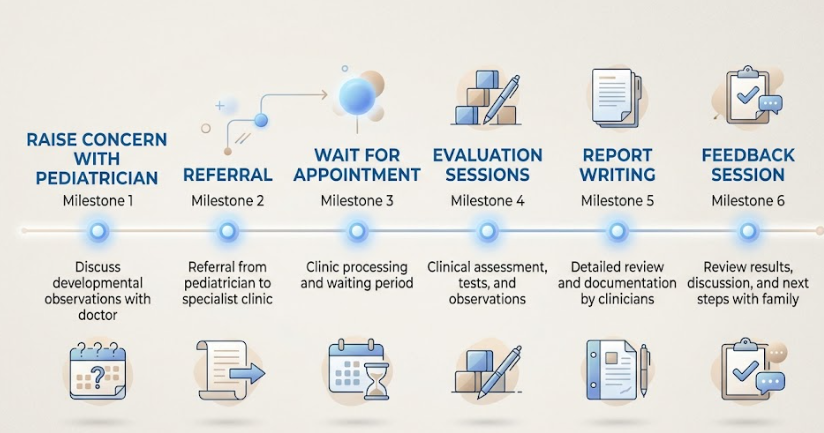
Stage 1: Raising the concern (immediate to weeks) Most autism diagnostic journeys begin at a pediatric well-visit — a parent raising a concern about language development, social engagement, or behavior — or through a developmental screening tool like the M-CHAT-R/F administered at the 18- and 24-month visits. A positive screen or a clinician’s concern triggers a referral. This stage can be immediate, or it can take weeks if the pediatrician takes a “wait and see” approach.
Stage 2: Referral to evaluation (days to weeks) Once a referral is generated, families are typically directed to a developmental pediatrician, pediatric neuropsychologist, child psychiatrist, or autism specialty clinic. At this point, the wait time clock starts.
Stage 3: Waiting for the appointment (the longest stage — 6 months to 2 years) This is where most families lose time they cannot recover. The specialist appointment backlog in autism evaluation is a genuine public health problem. Families in major metropolitan areas with large academic medical centers may wait 12 to 24 months. Families in rural areas may have no local specialist at all and face both geographic and logistical barriers.
Stage 4: The evaluation itself (3–6 hours over 1–3 sessions) When the appointment finally arrives, the assessment unfolds across multiple components described in the next section. Sessions are often scheduled a week or two apart.
Stage 5: Scoring, report writing, and feedback (2–4 weeks) After the final assessment session, the evaluator scores all instruments, integrates findings from all sources, writes a comprehensive diagnostic report, and schedules a feedback appointment to review findings with the family.
Stage 6: Feedback and report delivery The feedback session — typically 45–90 minutes — is where the clinician presents their conclusions, explains what the assessment found, answers questions, and provides recommendations. The written report is either delivered at this session or shortly after.
What Happens During Each Part of the Evaluation
Understanding the components of a comprehensive evaluation helps families arrive prepared — and helps them understand why the process takes as long as it does.
Parent Interview: Developmental History
The longest single component is often the structured parent interview, most commonly the ADI-R (Autism Diagnostic Interview-Revised) or a similar developmental history tool. This is a clinician-administered interview with the parent or caregiver covering the child’s developmental history in three domains: social development, communication, and repetitive/restricted behaviors. It typically takes 1.5 to 2.5 hours and covers development from early infancy through the present.
Parents are asked to recall detailed early developmental milestones — first words, first gestures, social smiling, response to name — and to describe current functioning across many contexts. Bringing notes, videos, and prior evaluations to this session is among the most useful things a parent can do.
Direct Assessment of the Child: ADOS-2
The ADOS-2 (Autism Diagnostic Observation Schedule, Second Edition) is the gold-standard direct assessment instrument. A trained clinician administers a series of structured and semi-structured activities designed to elicit social communication behaviors — opportunities for joint attention, conversational reciprocity, imaginative play, and emotional sharing. The evaluator observes and codes the child’s responses in real time.
The ADOS-2 takes approximately 45 to 75 minutes depending on the module used. Modules are selected based on language level — from a nonverbal toddler to a fluent adult — so the session looks very different across different presentations.
Cognitive Testing
A standardized measure of intellectual ability — typically the WISC-V (Wechsler Intelligence Scale for Children) for school-age children, or the WPPSI-IV for younger children — establishes the child’s cognitive profile across verbal comprehension, visual-spatial reasoning, fluid reasoning, working memory, and processing speed. This component takes 60 to 90 minutes and is crucial both for diagnostic clarity and for educational planning.
As discussed in the DSM-5 criteria for autism, the cognitive profile is not part of the autism diagnosis itself — but it informs the support level designation and reveals the characteristic uneven profile that often accompanies autism.
Adaptive Behavior Assessment
The Vineland Adaptive Behavior Scales or a similar instrument measures how the child functions in daily life — communication, daily living skills, socialization, and motor skills — relative to age expectations. This is typically administered as a structured interview with a parent or caregiver and takes approximately 45 to 60 minutes.
Additional Assessments
Depending on the clinical picture, the evaluation may also include a speech-language assessment, an occupational therapy sensory evaluation, behavioral rating scales completed by parents and teachers, and a review of prior records including early intervention evaluations, school reports, and medical history.
Feedback Session
After scoring and report writing, the clinician meets with the family to review findings, explain the diagnosis (or absence of diagnosis), discuss severity and support needs, and provide specific recommendations for next steps — including school-based services, private therapy, and genetic testing for autism where indicated.

What Does Level 1 Autism Look Like?
Level 1 ASD — the designation used in the DSM-5 for individuals who “require support” rather than “substantial support” or “very substantial support” — is the presentation most likely to be missed, most likely to be diagnosed late, and most likely to produce the “they don’t look autistic” response from family members or educators who encounter a child before any assessment.
Level 1 autism frequently looks like:
A child who speaks well but struggles socially in ways they cannot explain. Language milestones were met on time or even early. The child has strong vocabulary and can hold a detailed conversation about their interests. But group play is confusing, peer relationships are precarious, and the child often finds themselves at the edge of social situations they cannot quite navigate — not because they don’t want to, but because the implicit rules are opaque.
A child who masks so effectively at school that teachers are surprised by the diagnosis. At home, after a school day of sustained social performance, the child is emotionally depleted, dysregulated, and frequently melts down over seemingly minor triggers. The school sees the controlled, high-functioning presentation; the home sees the aftermath of six hours of neurological overload.
A child with intensely focused interests that are qualitatively different from typical childhood enthusiasm. The depth of knowledge, the amount of time spent, and the difficulty redirecting away from the interest distinguish it from typical preference. These interests are not a problem — they are often a significant cognitive strength — but they shape the child’s daily life in ways that affect peer relationships and classroom functioning.
A teenager whose challenges only become visible as social demands escalate. Level 1 autism is frequently first identified in adolescence, when the informal social complexity of middle and high school exceeds the child’s compensatory strategies. A child who navigated elementary school adequately may hit a wall at 11 or 12 that cannot be explained by anything other than a neurodevelopmental evaluation.
For a comprehensive look at the Level 1 presentation across the lifespan, what is mild autism covers the profile in depth — including why “mild” is a misleading descriptor for a condition that creates significant daily challenges.
What to Do While You Wait for the Evaluation
The most consequential mistake families make after entering the evaluation waitlist is waiting passively. The wait for an autism evaluation should be an active period, not a dormant one.
Talk to your pediatrician about Early Intervention (for children under 3). In the United States, children under 36 months who have developmental delays are eligible for Early Intervention services under IDEA — and eligibility does not require a formal autism diagnosis. A developmental delay in communication, social skills, or motor skills is sufficient for referral. Early Intervention evaluations typically happen within a few weeks of referral, and services can begin before the comprehensive autism evaluation occurs.
Request a school-based evaluation (for children 3 and older). Under IDEA, parents can submit a written request to their school district for an educational evaluation. The school district has 60 days from parental consent to complete the evaluation. School-based evaluations are narrower in scope than private evaluations — they assess eligibility for educational services, not clinical diagnosis — but they can unlock IEP services while the clinical evaluation is pending.
Document everything. Keep a running log of observations — specific behaviors, contexts, frequencies, and examples. Record video of behaviors that occur at home, since evaluation settings may not elicit the same presentation. Compile developmental history — baby books, well-visit notes, daycare reports — since the ADI-R will ask questions about early development in detail.
Pursue speech therapy and occupational therapy if your child has communication or sensory concerns. Neither requires an autism diagnosis. If a child has language delays, a speech-language evaluation can happen through Early Intervention or private referral. If sensory concerns are significant, an OT evaluation and treatment can begin immediately. These services provide real functional benefit during the wait and do not interfere with the eventual autism evaluation.

Common Misconceptions About Autism Evaluations
“The pediatrician’s developmental screening is enough.” Developmental screening tools like the M-CHAT-R/F are effective at flagging children who need further evaluation — they are not diagnostic. A positive screen means “pursue evaluation.” A negative screen means the child did not trigger concern on this particular tool at this particular time — it does not rule out autism, particularly in children who mask effectively or whose presentation becomes more apparent with age.
“My child won’t cooperate, so the evaluation won’t be accurate.” Experienced evaluators are trained to work with children across a wide range of behavioral presentations — including those who are highly active, minimally verbal, or resistant to structured tasks. The ADOS-2 and similar instruments are designed to be engaging and naturalistic. A child who is “difficult” during the evaluation provides clinical information through their behavior — it is not wasted time.
“We need to wait until the child is older to get a clearer picture.” Research consistently shows that autism can be reliably diagnosed in children as young as 18–24 months by experienced evaluators. Waiting for a clearer picture means delaying intervention. The earliest intervention produces the most significant outcomes — and that early window is not recovered by waiting.
“A school evaluation will give us the same diagnosis as a private evaluation.” School-based evaluations determine educational eligibility, not clinical diagnosis. A school evaluator may conclude that a child does or does not qualify for special education services — but that conclusion is not equivalent to a DSM-5 diagnostic determination. Families who want a clinical diagnosis should pursue a private evaluation regardless of what a school evaluation concludes.
“One evaluation is enough for a lifetime.” Autism presentations change with development. A child who receives an evaluation at age three and begins intervention may present very differently at age eight — and the support needs, strategies, and educational recommendations appropriate at eight are different from those at three. Re-evaluation at key transition points (starting school, moving to middle school, transitioning to adulthood) provides updated clinical information that should inform ongoing planning.

Conclusion
A comprehensive autism evaluation takes between three and six hours of actual assessment time — but the full process from first concern to written report routinely takes six months to two years when appointment wait times are included. Understanding that timeline before you enter the process allows you to plan, advocate, and act rather than simply wait.
The most important lesson from the families who navigate this process most effectively: do not allow the wait for a diagnosis to be a wait for support. Developmental therapy can begin before a diagnosis is confirmed. School-based evaluations have their own timeline and can unlock services independently. Early Intervention does not require autism to be named. The diagnostic label opens doors — but those doors can be approached while the label is still being determined.
If you are in the evaluation process, approaching it, or wondering whether to start — you are doing the right thing. The earlier autism is identified and the earlier evidence-based intervention begins, the better the outcomes that follow.
Dream Bigger ABA works with families across Northern Virginia at every stage of the autism journey — from families awaiting evaluation to those years into their child’s intervention program. Our clinicians understand that the process is long and the stakes are high. Connect with our team to explore services in Vienna, VA and Gainesville, VA.
Frequently Asked Questions
What should I expect during an autism evaluation?
A comprehensive autism evaluation typically unfolds across multiple components, often scheduled across two to three appointments. Expect a structured parent interview lasting one to two hours covering your child’s developmental history from infancy through the present — bring notes, early photos, and video if you have them. Expect a direct observation session in which a trained clinician conducts structured activities with your child to observe social communication, play, and behavior using instruments like the ADOS-2. Expect cognitive testing that assesses intellectual abilities across multiple domains — this looks like a series of tasks and puzzles administered by the evaluator. Expect an adaptive behavior interview covering how your child functions in daily life. After all sessions are complete, expect a wait of two to four weeks for the written report, followed by a feedback appointment where the evaluator reviews findings, explains the diagnosis, and provides recommendations. Throughout the process, be as specific and detailed as possible in your responses — the quality of the developmental history you provide directly affects the quality of the evaluation.
What is the 6-second rule in autism?
The 6-second rule is a practical communication guideline used by educators, therapists, and parents of autistic individuals. It refers to the practice of waiting at least six full seconds after giving a direction, asking a question, or delivering a prompt — before repeating, adding language, or assuming the person has not understood. Many autistic people require more time to process incoming spoken language than neurotypical people do — not because they are inattentive or non-compliant, but because auditory processing speed differences mean that language takes longer to fully receive, decode, and translate into a planned response. When adults repeat an instruction within two or three seconds, they layer new auditory input on top of language still being processed, often producing confusion or shutdown. Implementing consistent wait time — counting silently to six before speaking again — is one of the simplest, most cost-free, and most consistently effective communication accommodations available. Parents and teachers who implement it report meaningful improvements in response rates.
What does Level 1 autism look like?
Level 1 autism — the DSM-5 designation for individuals who require support but not substantial or very substantial support — is the presentation most frequently missed or diagnosed late. It typically looks like a child with age-appropriate or advanced language who nonetheless struggles significantly in social situations, finds peer relationships confusing or exhausting, has one or more intensely focused interests that dominate their attention, and may experience significant sensory sensitivities. Many Level 1 autistic children mask their differences effectively at school — appearing to manage adequately — but experience significant exhaustion and emotional dysregulation at home after sustained social performance. Executive functioning challenges affecting planning, task initiation, and flexibility are common and often more impairing than the social differences in daily life. Level 1 autism frequently goes undiagnosed until adolescence, when increasing social complexity outpaces the child’s compensatory strategies. The “mild” label is often misleading — the daily challenges are real and significant, even when they are not visible to casual observers.
What are the top 3 signs of autism?
The three core areas most reliably indicating autism are: (1) Social communication differences — persistent difficulties with reciprocal interaction, including reduced joint attention, atypical eye contact in social contexts, difficulty reading implicit social cues, and challenges sustaining the natural rhythm of conversation; (2) Restricted and repetitive behaviors — including motor mannerisms such as hand-flapping or rocking, intense insistence on sameness and distress when routines are disrupted, highly focused and persistent interests that exceed typical childhood enthusiasm, and unusual sensory responses to sounds, textures, lights, or smells; and (3) Sensory processing differences — hyper or hyposensitivity to sensory input that meaningfully interferes with daily functioning and comfort. These features must be present across multiple settings, not limited to one context, and must not be better explained by another condition. Importantly, all three domains are present even in Level 1 autism — they may be less visibly obvious, but they are present and functionally significant.
What is the biggest red flag for autism?
The single most clinically reliable early red flag for autism is the absence of joint attention by 12–14 months — specifically, a child who does not point to share interest with others, does not follow a caregiver’s pointing finger to look at what they are pointing to, and does not alternate gaze between a person and an object to share an experience. Joint attention is one of the foundational building blocks of social communication and language development — its consistent absence in the first 12–18 months is the most predictive early marker of autism identified in the research literature. Additional major red flags warranting immediate evaluation include no babbling by 12 months, no single meaningful words by 16 months, no spontaneous two-word phrases by 24 months, failure to consistently respond to their own name despite normal hearing, and loss of previously acquired language or social skills at any age. On that last point — skill regression in autism is a specific pattern that should never be attributed to a developmental phase and always warrants prompt clinical attention.