Key Takeaways
- Stress does not change the underlying neurodevelopmental profile of autism — but it dramatically intensifies the functional challenges associated with autism in real and measurable ways
- Autistic individuals have a more reactive stress response system that activates more easily, produces higher cortisol levels, and takes longer to return to baseline than in neurotypical people
- Autistic burnout — a distinct clinical phenomenon resulting from chronic stress and sustained masking — can produce loss of previously held skills, severe fatigue, and reduced functional capacity that can persist for months or years
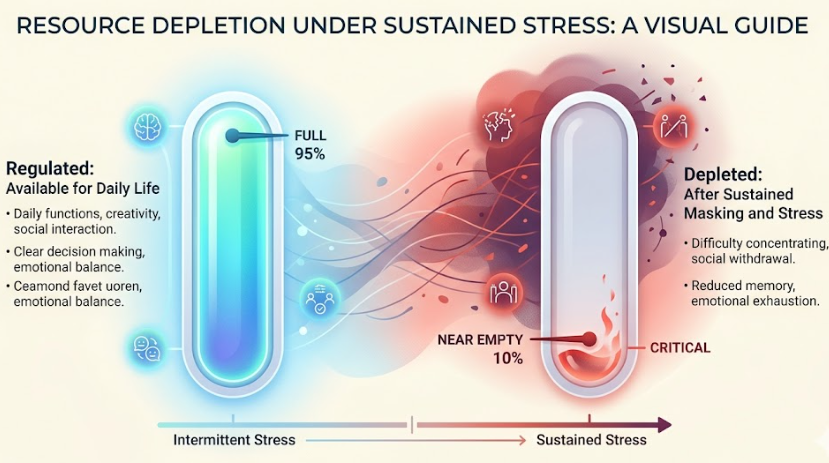
- Chronic sustained stress depletes the executive and regulatory resources autistic people rely on to navigate neurotypical environments — the depletion accumulates over time and has real long-term consequences
- Recovery from stress-related functional decline in autism requires genuine rest, reduced demands, and increased accommodation — not more intervention or pushing through
The Direct Answer: Autism Doesn’t “Get Worse” — But Stress Changes Everything About How It’s Expressed
The neurological profile that defines autism — the different connectivity patterns, the sensory processing differences, the social communication characteristics — does not change because a person is under stress. Stress does not alter the underlying neurodevelopmental architecture.
What stress does, however, is dramatically affect how much of that profile’s challenges are experienced and expressed at any given moment. The difference between an autistic person navigating a calm, predictable, accommodating environment and the same person navigating a high-demand, chaotic, unaccommodating one is not a difference in their autism. It is a difference in how much of their available cognitive, emotional, and sensory resources are consumed by the environment — leaving less for everything else.
For many autistic individuals, the subjective experience of being under sustained stress feels like autism “getting worse.” Skills that were manageable become inaccessible. Social interactions that were effortful become impossible. Sensory environments that were tolerable become overwhelming. Communication that was functional becomes limited or lost.
These experiences are real. The underlying mechanism is not a worsening condition — it is a depleted system.
Why Autistic People Are More Vulnerable to Stress
Understanding the physiology of stress in autism explains why this vulnerability is not a matter of attitude or resilience but of neurological architecture.
Elevated baseline arousal. Research consistently finds that autistic individuals have higher baseline activation of the hypothalamic-pituitary-adrenal (HPA) axis — the primary physiological stress response system. Studies measuring cortisol (the primary stress hormone) find elevated morning cortisol levels in autistic individuals compared to neurotypical controls, suggesting a stress response system that is chronically running hotter even in the absence of specific stressors.
Hyperreactivity to stressors. When a stressor occurs, the autistic stress response activates more rapidly and to a greater magnitude. Social situations — even brief, relatively low-demand social interactions — are physiologically stressful for many autistic individuals in ways that are not visible on the surface. The casual conversation that costs a neurotypical person nothing can activate the same physiological stress response as a demanding work presentation.
Slower return to baseline. After the stressor has passed, the autistic nervous system takes longer to return to baseline arousal levels. Where a neurotypical person might fully de-escalate within minutes of a stressful event, an autistic person may remain physiologically activated for hours or longer. This extended recovery time means that stressors compound — the second difficult thing of the day arrives before recovery from the first is complete.
Masking is physiologically costly. Many autistic people — particularly those with Level 1 presentations — engage in sustained masking: consciously suppressing visible autistic behaviors, monitoring social performance, and maintaining a neurotypical presentation throughout the workday or school day. This is not automatic behavior; it requires active cognitive effort. Each hour of masking consumes executive resources that then are unavailable for other purposes. By the end of a heavily masked day, the system is depleted — and behavioral, emotional, and sensory regulation all suffer as a result.
Rejection sensitive dysphoria and autism explores one dimension of how the autistic stress system responds to social threat — the intense, sometimes destabilizing emotional response to perceived criticism or rejection that is far more common in autism than is widely recognized. This, too, is a product of a stress response system that is more reactive and slower to recover.
Autistic Burnout: The Most Serious Stress-Related Phenomenon
Autistic burnout is the most important clinical concept for understanding what happens when the stress-depletion cycle in autism goes on too long. It is distinct from general occupational burnout and from clinical depression — though it shares features with both and is frequently misdiagnosed as one or the other.
What autistic burnout is: A state of profound exhaustion — cognitive, emotional, and physical — resulting from sustained stress, chronic masking, insufficient accommodation, and the accumulated cost of navigating environments not designed for the autistic nervous system. It is not a one-bad-week phenomenon; it develops over months to years of sustained overextension.
What it looks like:
- Loss of previously held skills — an autistic adult who was managing independent living, employment, and social relationships may lose the ability to perform tasks they previously handled with effort. This skill loss is one of the most alarming features and is frequently mistaken for rapid psychological deterioration.
- Extreme fatigue — a level of exhaustion disproportionate to activity that does not improve with normal rest. Everything feels like it requires enormous effort.
- Reduced communication capacity — previously verbal autistic people may lose fluent language under burnout. Those who were communicating effectively may revert to simpler or more limited communication.
- Heightened sensory sensitivity — sensory tolerances that were manageable before burnout may become dramatically reduced. Previously tolerable environments become genuinely unbearable.
- Social withdrawal — not a choice but a necessity. The capacity for social interaction — always effortful for autistic individuals — is simply gone.
- Inability to mask — the compensatory strategies that kept the autism invisible to others stop functioning. The autistic person can no longer maintain the performance.
What triggers it: Major life transitions (college entry, new job, relationship changes, loss), sustained high-demand environments without adequate accommodation, years of masking without safe spaces to unmask, chronic sensory overload without escape, and lack of genuine understanding from those around the person.
What it is NOT: Autistic burnout is not the same as depression, though depression may co-occur. It is not a mental health crisis in the conventional sense, though it may require crisis-level support. It is not a sign that the autistic person is lazy or giving up. And critically — it is not resolved by pushing through, intensifying intervention, or increasing demands. Skill regression in autism addresses how to distinguish regression from burnout and what the appropriate clinical response is.
Recovery: Genuine recovery from autistic burnout requires three things: significantly reduced demands, significantly increased accommodation, and genuine rest — defined as time spent in low-stimulation environments engaging in self-directed activities of personal comfort and interest. Recovery takes months to years, not days. Pushing a burned-out autistic person back into the conditions that produced the burnout prolongs the recovery indefinitely.
Does Stress Make Autistic Symptoms Worse Over Time?
The short answer is yes — and the mechanism is cumulative.
Chronic stress in autism does not produce a single episode of increased difficulty and then return to baseline. The depletion of executive and regulatory resources accumulates:
- Each day of sustained masking without recovery adds to the deficit
- Each week of chronic sensory overload lowers the threshold at which the system becomes overwhelmed
- Each month of sustained above-baseline cortisol affects memory consolidation, executive functioning, and emotional processing
- Each year of unaccommodated chronic stress raises the probability of autistic burnout
Executive dysfunction and autism explains how the planning, flexibility, and self-regulation challenges associated with autism are already more demanding of cognitive resources than in neurotypical individuals. When those resources are chronically depleted by stress, the executive functioning challenges that were already significant become severe.
The long-term consequence of chronic unmanaged stress in autism is not simply “difficult periods.” It is cumulative functional decline that, in its most severe form, produces burnout states that take years to recover from — if they are recovered from at all within a sustained high-demand environment.
This is why stress management is not a secondary concern in autism care — it is a primary clinical priority.
How to Calm Down as an Autistic Person
Regulation strategies for autistic individuals are most effective when they match the sensory and neurological profile of the specific person — not when they follow generic relaxation advice. Here are the most consistently effective approaches:
Allow and engage stimming. Self-stimulatory behavior is the autistic nervous system’s built-in regulation tool. In moments of overwhelm, allowing stimming — rocking, hand movements, humming, pressure application — directly reduces physiological arousal. Suppressing stimming during a regulation crisis prolongs dysregulation.
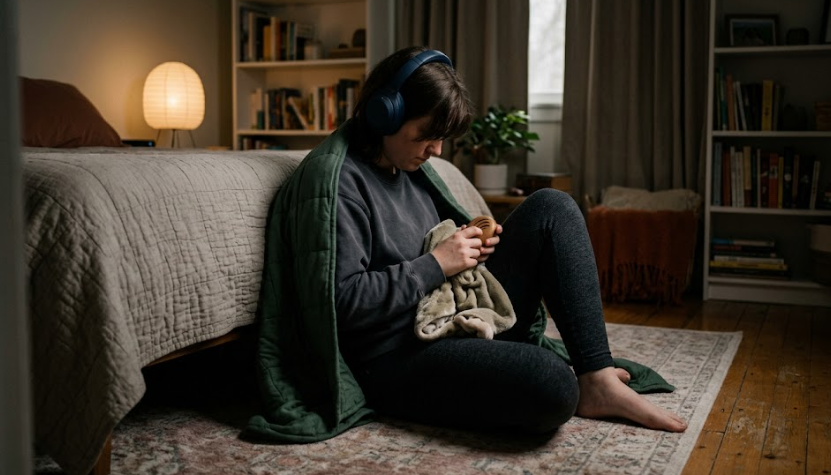
Sensory retreat. Reducing incoming sensory input is the most immediate regulation lever for many autistic people. A dark room, noise-canceling headphones, a weighted blanket, familiar smells — removing unpredictable sensory input allows the nervous system to stop processing threat signals and begin returning to baseline.
Deep pressure and proprioceptive input. Weighted blankets, compression clothing, firm joint compression, or physically demanding activities (carrying heavy objects, resistance exercise, swimming) provide proprioceptive input that has a measurable calming effect on the autistic nervous system. This is not a relaxation technique; it is a neurological intervention that directly modulates arousal.
Engagement with special interests. Time spent in the focused engagement of an intensely interesting topic or activity is not avoidance — it is a genuine regulation activity. The predictable, rewarding, low-social-demand nature of special interest engagement provides exactly the conditions the stressed autistic nervous system needs to de-escalate.
Concrete breathing techniques. Abstract instructions to “breathe deeply” or “relax” are often unhelpful for autistic individuals. Specific, structured breathing patterns — box breathing (four counts in, four hold, four out, four hold), counted exhales, paced breathing with a visual or tactile anchor — are more accessible. Concrete structure makes the technique doable.
Time — longer than expected. The autistic de-escalation timeline is longer than neurotypical de-escalation. Expecting or demanding rapid recovery worsens outcomes. Building in recovery time — hours, not minutes — after significant stress events produces better results than pressing for quick return to function.
Safe person presence without expectation. The presence of a known, trusted, low-demand person who does not require social performance and does not interpret withdrawal as rejection can be profoundly regulating. The key is “without expectation” — the person is there, not demanding engagement.
What State Has the Best Autism Services?
Parents and families frequently search this question when considering where to live, or when frustrated with access to services in their current state. The answer depends significantly on what type of services matter most — early intervention, school-based services, insurance coverage for therapy, or adult waiver programs.
States consistently cited for strong autism services:
Massachusetts frequently appears at the top of rankings for comprehensive autism services — strong insurance mandate laws requiring commercial coverage for ABA therapy, a robust early intervention system, and access to major research and clinical centers.
New Jersey was among the first states to pass autism insurance mandates and maintains strong legislative protections for autism services coverage, along with well-developed school-based services.
California has the California Department of Developmental Services regional center system — one of the most comprehensive lifelong support systems in the country — providing services from diagnosis through adulthood, though waitlists can be long.
New York offers comprehensive Medicaid coverage and strong early intervention, though access varies significantly by borough and county.
Virginia — where Dream Bigger ABA serves families — has autism insurance mandate laws requiring that commercial health insurance plans cover ABA therapy and other autism services, making coverage for evidence-based intervention accessible for most commercially insured families. Virginia’s early intervention system under Part C of IDEA is well-established, and the state has continued expanding Medicaid waiver programs for autistic adults.
Important caveat: state-level rankings mask enormous within-state variation. A family in rural western Virginia may face very different access barriers than a family in Northern Virginia’s suburban corridor. Access to qualified providers — particularly BCBA-level clinicians — is consistently more limited in rural areas of every state, regardless of how strong a state’s policy framework is.

Common Misconceptions About Stress and Autism
“If stress makes symptoms worse, avoiding all stress is the goal.” Total stress avoidance is not possible and not the clinical goal. The goal is appropriate stress load management — calibrating environmental demands to the individual’s current regulatory capacity, building recovery time into routines, and developing regulation strategies that increase stress tolerance over time. Some manageable stress is necessary for skill development.
“Behavioral regression under stress means autism is getting worse.” Skill loss under significant stress — or in the early stages of autistic burnout — does not indicate that autism is progressing or deteriorating. The skills are typically recoverable when the stressor is reduced and recovery is allowed. What it indicates is that current demand exceeds current capacity.
“An autistic person who was managing before should be able to manage now.” Life circumstances, accumulated stress, and changed environments alter what is manageable. An autistic adult who managed a demanding job for years may lose that capacity after a major life change, a health crisis, or the accumulated cost of years of unsupported masking. Prior functioning is not a reliable predictor of current capacity under changed conditions.
“If they can control it in one setting, they’re choosing not to in another.” The ability to maintain function in one context — often a low-demand, highly familiar, or highly motivating one — does not mean the person is choosing not to function in another. Autistic regulation is context-dependent and resource-dependent. The child who manages three hours in a familiar therapy session may be completely dysregulated by the noise of the school cafeteria immediately after.
“Better stress management will reduce their autism.” Stress management reduces the functional expression of autism-related challenges under difficult conditions. It does not change the autism. The goal of stress management in autism is a life that is more manageable, more joyful, and more self-determined — not a reduction in the autistic neurology itself.
Conclusion
Stress does not make autism worse in the neurological sense — the underlying condition does not change. What stress does is dramatically and measurably intensify the challenges associated with autism, deplete the resources autistic individuals rely on to navigate neurotypical environments, and — when chronic and sustained without adequate recovery — produce autistic burnout that can take months or years to recover from.
This is not a minor consideration. It is one of the central clinical realities of autism across the lifespan. Managing the stress load, building recovery into routines, creating environments that do not require constant masking, and understanding regulation as a primary support priority — not an afterthought — is the difference between an autistic life characterized by chronic depletion and one characterized by genuine capacity and wellbeing.
For autistic children, this means that the environments and approaches surrounding them matter enormously — not just in what skills are taught, but in how much stress the teaching environment produces and how much recovery time is built in. Evidence-based ABA therapy, delivered in a way that is sensitive to regulatory capacity and individual stress response, is a core component of sustainable skill-building that does not come at the cost of autistic wellbeing.
Dream Bigger ABA provides individualized, stress-informed ABA therapy for autistic children and their families across Northern Virginia — built on the understanding that sustainable progress requires a foundation of regulatory safety, not chronic overextension. Connect with our team to explore services in Vienna, VA and Gainesville, VA.
Frequently Asked Questions
Does stress make autistic symptoms worse over time?
Yes — chronically. Stress in autism does not produce a temporary spike and return to baseline in the same way it might in a neurotypical person. The autistic stress response system is more reactive, produces higher cortisol levels, and takes longer to recover. Sustained chronic stress depletes the executive and regulatory resources autistic people rely on to navigate neurotypical environments, and this depletion accumulates over time. An autistic person managing a high-demand environment may do so adequately for months or years — until the accumulated deficit crosses a threshold and autistic burnout occurs. At that point, skills that were functional may become inaccessible, sensory tolerances may dramatically narrow, and communication capacity may reduce. The progression is cumulative: each sustained stressor adds to the deficit. Managing stress proactively — building in recovery, reducing unnecessary demands, and ensuring adequate accommodation — prevents this accumulation from reaching crisis point.
What state has the best autism services?
There is no single best state for all autism services, since different families need different types of support — early intervention, school services, insurance coverage for ABA therapy, or adult waiver programs. States consistently ranked highly include Massachusetts (strong insurance mandate, robust early intervention, research hub access), New Jersey (early autism insurance mandate laws, strong school services), California (lifelong regional center support system), and New York (comprehensive Medicaid coverage). Virginia has autism insurance mandate laws requiring commercial insurance coverage for ABA therapy and other autism services, a solid early intervention system, and expanding adult Medicaid waiver programs — making it one of the stronger Mid-Atlantic states for autism services access. Within any state, however, access varies dramatically by geography: families in urban and suburban corridors typically have far better provider access than those in rural areas, regardless of state-level policy strength.
How do you calm down as an autistic person?
The most effective regulation strategies for autistic individuals address the sensory and neurological drivers of dysregulation rather than relying on generic relaxation advice. Allowing and engaging in stimming — rocking, hand movements, pressure — is the built-in regulation tool of the autistic nervous system and should not be suppressed during a crisis. Sensory retreat — reducing incoming sensory input through darkness, quiet, or noise-canceling headphones — removes the environmental load driving activation. Deep pressure and proprioceptive input — weighted blankets, compression clothing, heavy physical activity — directly modulates arousal through a neurological pathway. Engagement with special interests provides the predictable, low-social-demand, rewarding input that de-escalates the system. Structured breathing techniques with concrete counting provide more accessible regulation than abstract relaxation instructions. And critically — allowing more time than expected for de-escalation, since the autistic nervous system returns to baseline more slowly than neurotypical expectation assumes.
Can mild autism live a normal life?
Many autistic individuals — including those with Level 1 ASD, formerly called Asperger’s syndrome — live independently, build careers, sustain relationships, and report genuine satisfaction in their lives. The term “mild” describes what is visible to outside observers, not the internal functional experience: many Level 1 autistic people work very hard to maintain functioning that appears effortless from the outside, at significant personal cost in stress and fatigue. What enables a fulfilling life most reliably is not the severity level of the diagnosis but the quality of self-understanding (knowing one’s own neurological needs and limits), access to appropriate supports and accommodations, and the fit between the person’s neurology and their environment. For what is mild autism in practical daily terms, the profile includes real and often significant challenges — particularly in anxiety, executive function, and social navigation — that deserve ongoing support rather than dismissal because the autism appears “mild.”
Can autism get better with age?
Yes — for many autistic people, functional capacity and quality of life improve meaningfully with age, particularly in adulthood. This is not because the autism changes; it is because the person accumulates self-knowledge, develops more sophisticated coping strategies, and often finds environments and careers better suited to their neurology. Many autistic adults report that understanding their own diagnosis — even when it came late — was transformative in reducing the chronic stress of not knowing why the world felt so different and so effortful. Social navigation often becomes more manageable with practice and self-understanding, even when it remains effortful. Sensory sensitivities may become more manageable with developed coping strategies and environmental control. The periods that are most difficult for many autistic people — puberty, early adulthood, major life transitions — are often followed by greater stability when life circumstances align better with autistic strengths and needs. Ongoing support, rather than assuming adulthood means no further need for help, sustains and builds on these gains.