Autism spectrum disorder (ASD) affects an estimated 1 in 36 children in the United States, according to the CDC’s most recent data. Yet despite growing awareness, many parents and caregivers still struggle to understand what autism actually looks like in daily life.
If you’re searching for clear, trustworthy information about autism’s core characteristics, you’re in the right place. This guide breaks down the three main characteristics of autism based on the official DSM-5-TR diagnostic criteria (the gold standard used by clinicians worldwide), explains how they show up across different ages, and answers the questions parents ask most.
Understanding the Three Core Characteristics of Autism
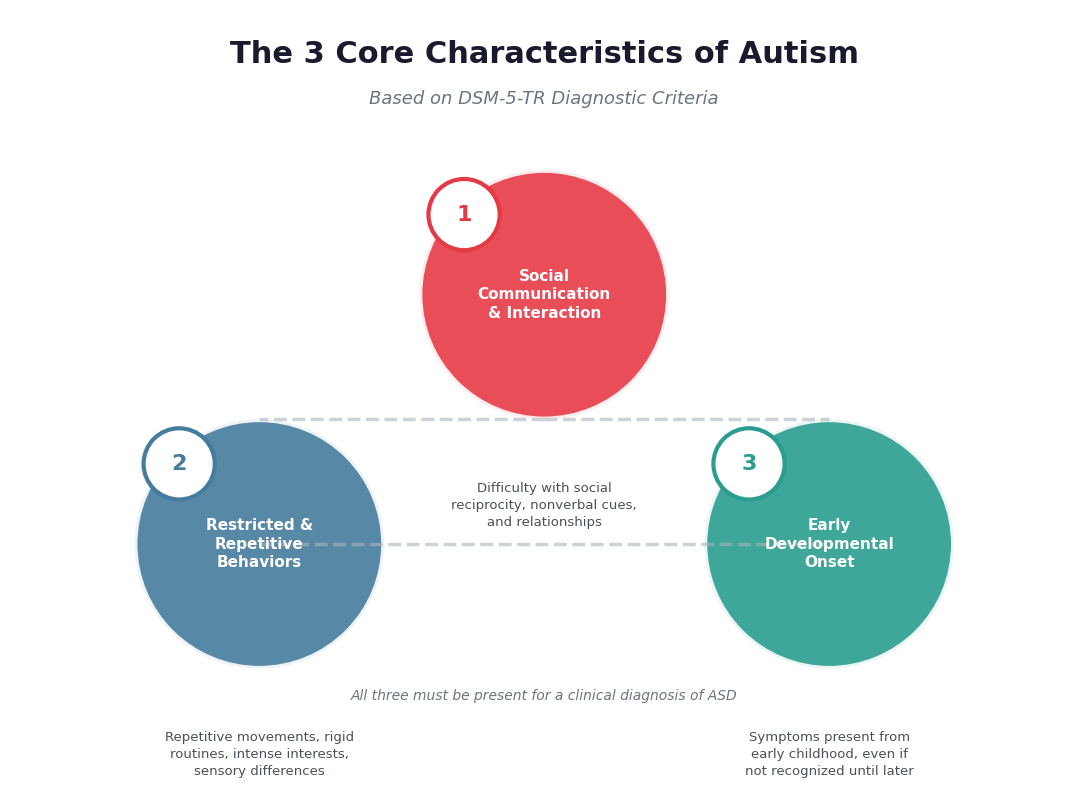
Under the current DSM-5-TR (Diagnostic and Statistical Manual of Mental Disorders, 5th Edition, Text Revision), autism is defined by two broad categories of characteristics, which together encompass three core areas that clinicians evaluate:
| Core Area | What It Means | DSM-5-TR Category |
| 1. Social Communication & Interaction | Difficulty with back-and-forth communication, reading social cues, and building relationships | Criterion A |
| 2. Restricted & Repetitive Behaviors | Repeated movements, strict routines, intense interests, or unusual sensory responses | Criterion B |
| 3. Early Developmental Onset | Symptoms present from early childhood (even if not recognized until later) | Criterion C |
These three areas work together to form a complete clinical picture. Let’s examine each one in detail.
Characteristic 1: Social Communication and Interaction Differences
This is the first and most defining characteristic of autism. According to the DSM-5-TR, a person must show persistent deficits across all three of the following sub-areas to meet the diagnostic criteria for autism.
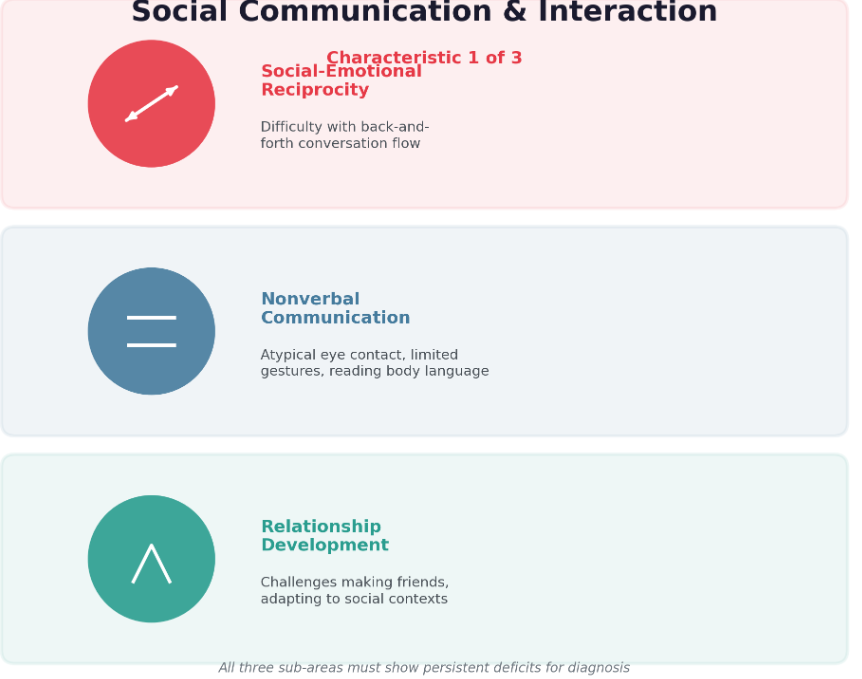
A. Social-Emotional Reciprocity
This refers to the natural back-and-forth flow of social interaction. People with autism may:
- Struggle with conversation turn-taking — talking at length about their own interests without noticing the other person’s disinterest
- Show reduced sharing of emotions or interests — not pointing out exciting things or seeking emotional comfort from others
- Have difficulty initiating social interactions — appearing “standoffish” or preferring solitary activities
Real-world example: A child might talk for 20 minutes about dinosaur facts without asking what the other person thinks, or an adult might miss social cues that a conversation partner wants to change topics.
B. Nonverbal Communicative Behaviors
Autistic individuals often have difficulty with the unspoken language of social interaction, including:
- Atypical eye contact — avoiding eye contact entirely, or staring too intensely
- Limited use of gestures — not waving, pointing, or using facial expressions to communicate
- Difficulty reading body language — not understanding when someone is bored, angry, or sarcastic
Real-world example: An autistic teenager might stand too close to peers without realizing it, or speak in a monotone voice that doesn’t match the emotional content of their words.
C. Developing and Maintaining Relationships
This includes challenges with:
- Making and keeping friends — often preferring the company of younger children or adults
- Adjusting behavior to social contexts — using the same communication style with a teacher as with a sibling
- Understanding personal boundaries — difficulty with concepts like personal space or appropriate topics of conversation
Important note: The DSM-5-TR (2022) specifically recognizes that girls and women often “mask” these traits by learning to mimic neurotypical behavior, which can lead to misdiagnosis as anxiety or depression. Clinicians are now trained to look beneath the surface for signs of social exhaustion.
Characteristic 2: Restricted, Repetitive Patterns of Behavior, Interests, or Activities
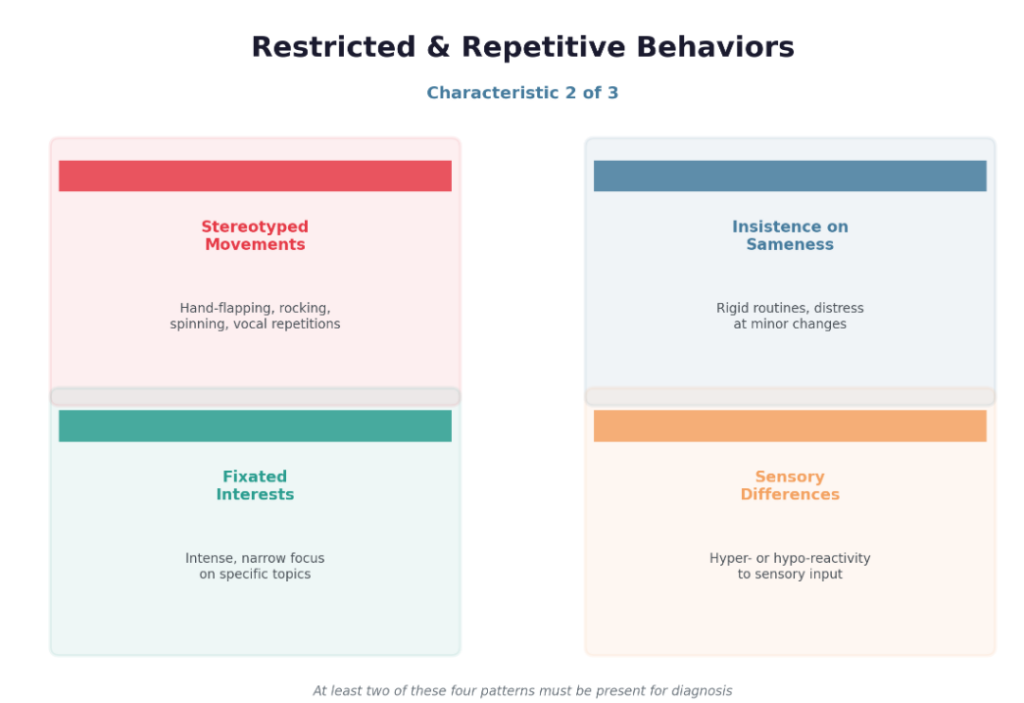
The second core characteristic of autism involves at least two of the following four patterns, according to DSM-5-TR criteria:
A. Stereotyped or Repetitive Movements, Speech, or Use of Objects
Often called “stimming” (self-stimulatory behavior), these include:
- Motor movements: Hand-flapping, rocking, spinning, or finger-flicking
- Vocal behaviors: Repeating words or phrases (echolalia), making repetitive sounds
- Object use: Lining up toys, spinning wheels on cars, flipping light switches repeatedly
Why it happens: These behaviors are not random — they serve important self-regulation functions, helping manage sensory input, anxiety, or emotional states. The CDC notes that stimming often increases when a person is stressed or overwhelmed.
B. Insistence on Sameness and Rigid Routines
Many autistic individuals thrive on predictability and struggle with change. This can manifest as:
- Following strict daily routines — needing to take the same route to school, eat the same foods, or wear similar clothing
- Extreme distress at minor changes — a substitute teacher, rearranged furniture, or a cancelled plan can cause significant anxiety
- Ritualized patterns — specific greeting rituals, bedtime sequences, or ways of organizing belongings
Real-world example: A child might become extremely upset if their sandwich is cut into triangles instead of squares, not out of defiance, but because the unexpected change feels genuinely distressing.
C. Highly Restricted, Fixated Interests
Autistic individuals often develop intense, focused interests that are:
- Abnormal in intensity — knowing every detail about a narrow topic (e.g., all 800+ Pokémon, subway maps of every city)
- Unusual in focus — interests in things like vacuum cleaners, traffic lights, or license plates
- All-consuming — talking, reading, or thinking about the interest for hours at a time
These interests are not just hobbies — they’re a core part of how autistic people engage with the world, and when supported, can become genuine areas of expertise.
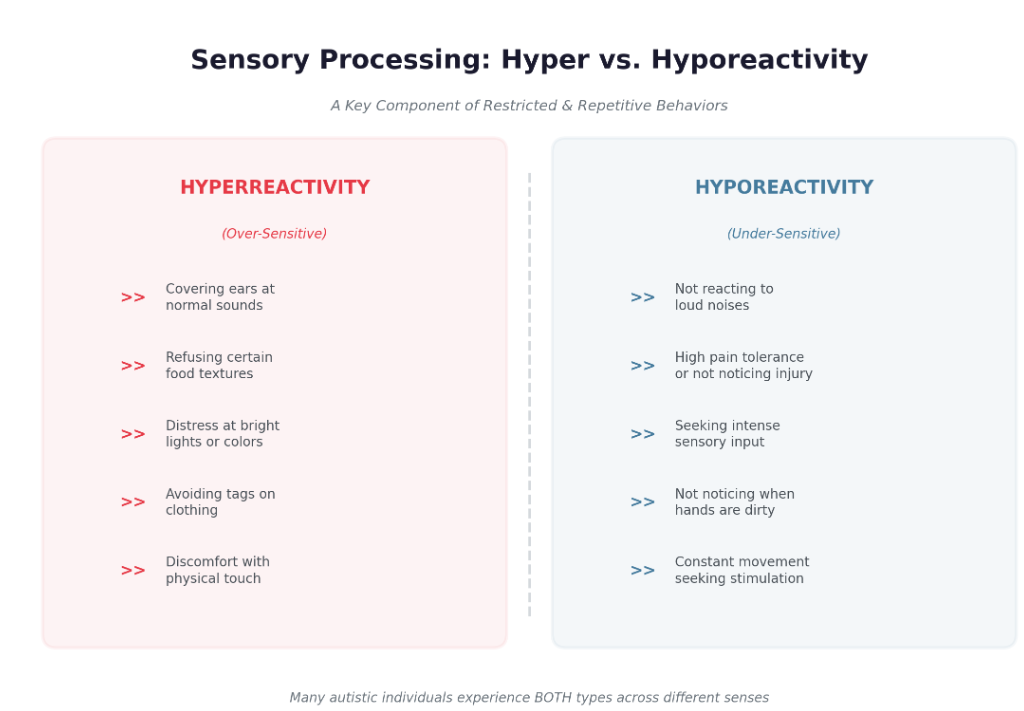
D. Hyper- or Hyporeactivity to Sensory Input
This is one of the most significant updates in the DSM-5 (and retained in DSM-5-TR) — the formal recognition of sensory processing differences as a core autism characteristic. This includes:
Table
| Hyperreactivity (Over-Sensitive) | Hyporeactivity (Under-Sensitive) |
| Covering ears at normal sounds | Not reacting to loud noises |
| Refusing certain food textures | High pain tolerance |
| Distress at bright lights | Seeking intense sensory input (spinning, crashing) |
| Avoiding tags on clothing | Not noticing when hands are dirty |
Characteristic 3: Early Developmental Onset
The third essential characteristic is that symptoms must be present in the early developmental period, even if they aren’t recognized until later in life. This is a critical distinction — autism is a neurodevelopmental condition, not something that develops in adulthood.
What “Early Onset” Means
- Symptoms typically appear before age 3, though they may be subtle
- In some cases, especially with masking, traits may not become fully apparent until social demands exceed the person’s coping capacity (e.g., starting school, entering the workforce)
- The DSM-5-TR acknowledges that learned strategies in later life can hide early symptoms, but they were still present developmentally
Red Flags by Age
The CDC provides a helpful developmental timeline of early signs:
Table
| Age | Potential Red Flags |
| 9 months | Not responding to name; limited facial expressions |
| 12 months | No gestures (pointing, waving); no back-and-forth sounds |
| 15 months | Not sharing interests by showing objects |
| 18 months | No pointing to show interest; no pretend play |
| 24 months | Doesn’t notice when others are hurt or upset |
| 36 months | Doesn’t notice other children or join play |
How These Three Characteristics Work Together
A diagnosis of autism requires that all three characteristics are present:
- Social communication deficits (all three sub-areas)
- Restricted/repetitive behaviors (at least two of four sub-areas)
- Early developmental onset
Additionally, the DSM-5-TR requires that:
- Symptoms cause clinically significant impairment in daily functioning (school, work, relationships)
- Symptoms are not better explained by intellectual disability alone
Severity Levels: Understanding the Spectrum
The DSM-5-TR uses three severity levels to describe how much support a person needs:
Table
| Level | Description | Support Needed |
| Level 1 | Noticeable social challenges; can function independently with support | Requiring support |
| Level 2 | Marked deficits in verbal/nonverbal communication; limited social interactions | Requiring substantial support |
| Level 3 | Severe deficits in communication; very limited social engagement; extreme distress with change | Requiring very substantial support |
Important: These levels can fluctuate based on environment, stress, and life stage. A person might be Level 1 in a familiar setting but need Level 2 support during transitions.
Frequently Asked Questions
Are there really “three main characteristics” or just two?
Clinically, the DSM-5-TR groups autism into two broad categories (social communication + restricted/repetitive behaviors). However, the social communication category itself contains three distinct sub-characteristics (reciprocity, nonverbal communication, relationships), and the early developmental onset is a third essential criterion for diagnosis. Many educational and training resources therefore describe autism as having three main characteristics.
Can someone have autism without repetitive behaviors?
Under current DSM-5-TR criteria, no — restricted/repetitive behaviors are required for diagnosis. However, these behaviors can be subtle in adults (e.g., internal mental routines rather than visible stimming), which is why professional assessment is important.
Do all autistic people have intellectual disabilities?
No. Autism occurs across the full range of intellectual ability. Many autistic individuals have average or above-average intelligence. The DSM-5-TR explicitly notes that intellectual disability and autism are separate conditions that can co-occur but don’t always.
What’s the difference between DSM-5 and DSM-5-TR for autism?
The DSM-5-TR (2022) retained the same core structure but made important clarifications:
- Added explicit guidance on masking and gender differences
- Updated language to be more culturally sensitive
- Provided clearer examples of how traits present across the lifespan
When to Seek Professional Evaluation
If you recognize these three characteristics in yourself or a loved one, consider seeking an evaluation from a qualified professional (developmental pediatrician, clinical psychologist, or neurologist). Early intervention — especially before age 5 — is associated with significantly better long-term outcomes.
Key resources:
Final Thoughts
Understanding the three main characteristics of autism — social communication differences, restricted and repetitive behaviors, and early developmental onset — is the first step toward recognizing, accepting, and supporting autistic individuals. Every person’s experience of autism is unique, and these characteristics exist on a wide spectrum.
If this article helped you better understand autism, consider sharing it with someone who might benefit. For more in-depth resources, explore our related guides on early intervention strategies and supporting autistic adults in the workplace.
This article was reviewed for medical accuracy against the DSM-5-TR diagnostic criteria and CDC guidelines. It is intended for educational purposes and does not replace professional medical advice.