Key Takeaways
- Echolalia — the repetition of words, phrases, or sounds heard from others — is not exclusively associated with autism, though it is very common in autistic children
- Echolalia is a normal developmental phase in typically developing toddlers between approximately 18 months and 3 years; its presence alone does not indicate autism
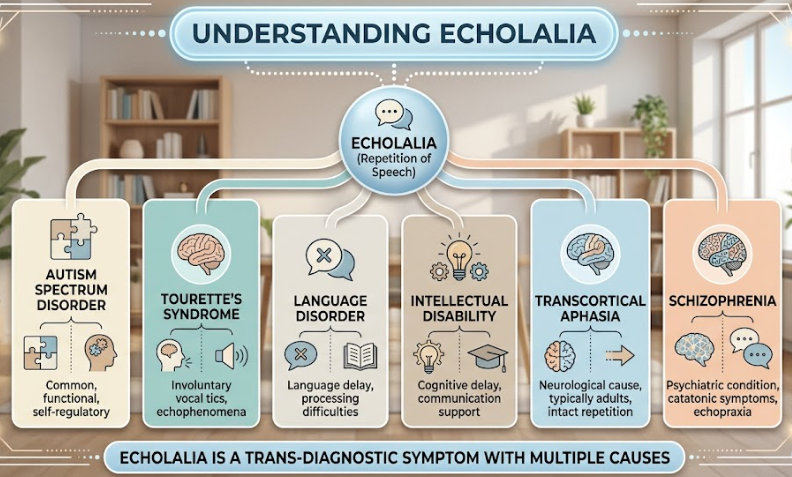
- Other conditions associated with echolalia include Tourette’s syndrome, developmental language disorders, intellectual disability, traumatic brain injury, schizophrenia, and certain aphasias
- In autism, modern clinical understanding treats echolalia as functional communication — not empty repetition — and speech-language therapy aims to build on it rather than eliminate it
- Palilalia (repeating one’s own words) and echopraxia (repeating others’ movements) are related but distinct phenomena that parents and clinicians often confuse with echolalia
The Direct Answer: Echolalia Is Not Always Autism
Echolalia — from the Greek echo (repetition) and lalia (speech) — is the repetition of words or phrases heard from another person or from media, used outside of the original context or in immediate response to what was just heard.
It is one of the most recognized features of autism. It is also a normal stage of language development, a symptom of several other neurological and psychiatric conditions, and a behavior found in individuals with no developmental diagnosis whatsoever under certain circumstances.
The association between echolalia and autism is real — studies suggest approximately 75–85% of autistic children who develop verbal language go through an echolalic phase. But the relationship does not run the other direction with the same reliability: echolalia does not mean autism. Many children who echo speech do not have autism, and many autistic individuals do not have prominent echolalia.
Understanding what echolalia is, how it functions, what else causes it, and what it does and does not indicate is more useful for families than a simple yes-or-no answer about its relationship to autism.
What Echolalia Is and How It Works
Echolalia takes two primary forms that have different clinical implications:
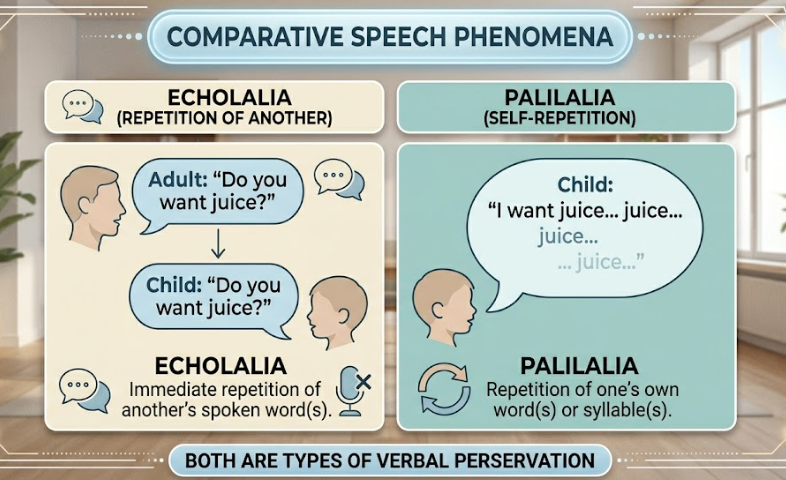
Immediate echolalia involves repeating what was just heard, within seconds or a short time. A parent asks “Do you want juice?” and the child responds “Do you want juice?” rather than answering. A teacher gives an instruction and the child repeats the instruction verbatim rather than following it. Immediate echolalia can function as a processing behavior — the child’s verbal system activating language it has heard as a response while the cognitive processing of the question or instruction continues.
Delayed echolalia involves repeating something heard at a previous time — a phrase from a favorite TV show, a line from a book, a sentence from a previous conversation — in a new context, sometimes immediately recognizable as a quote and sometimes not. A child who repeats “To infinity and beyond!” when they want to go outside is using delayed echolalia from Toy Story. A child who says “Time to clean up, time to clean up” at the end of an activity is using a scripted phrase from a preschool routine.
Delayed echolalia, in particular, is often functional — the child is communicating something real using a memorized phrase rather than generating novel language. Barry Prizant’s foundational research on echolalia established that what appears to be “meaningless” repetition frequently serves genuine communicative purposes: requesting, protesting, expressing emotion, commenting, and participating in social exchange.
When Echolalia Is Developmentally Normal
The most important context for evaluating echolalia in a young child is that it is a normal phase of language development — one that virtually all children pass through to some degree.
Between approximately 18 months and 3 years, typically developing children use echolalia extensively as a language-learning strategy. They echo adult speech to practice sound patterns, to maintain conversational turn-taking they cannot yet fill with spontaneous language, to signal agreement or acknowledgment, and to try out new vocabulary before fully integrating it. This is not a failure of communication — it is language acquisition in progress.
The key diagnostic question is not whether echolalia is present but whether it is resolving and giving way to spontaneous generative language on a typical timeline.
In typically developing children, echolalia decreases substantially between ages 2 and 3, progressively replaced by spontaneous novel sentences as the child’s language system matures. By age 3 to 3.5, most neurotypical children are producing primarily spontaneous language, with echolalia appearing mainly in stressed or excited moments rather than as the primary communication mode.
In autistic children, echolalia frequently:
- Persists longer and with greater prominence beyond the typical resolution window
- Does not follow the same trajectory toward spontaneous generative language
- Becomes increasingly sophisticated in function (more clearly communicative) rather than diminishing
This divergence in trajectory — not the presence of echolalia at age 2 — is what distinguishes autism-related echolalia from developmentally typical echoing.
Echolalia in Autism: Understanding Its Functional Role
For autistic children who use echolalia, modern clinical understanding has shifted from viewing it as meaningless or pathological to recognizing it as a genuine communicative strategy that deserves to be built upon, not eliminated.
What echolalia communicates in autism:
A child who echoes “Do you want a cookie?” in a context where they want a cookie is functionally requesting — using the closest available verbal form to express their desire. A child who says “Time to go bye-bye” as they move toward the door is using scripted language to communicate a transition. A child who whispers phrases from their favorite show during a stressful medical appointment is using familiar language as a self-regulation strategy — the predictable, known phrases provide a calming anchor in an unpredictable environment.
The scripting continuum: Many autistic individuals use a range of language from purely echoed phrases to partly modified scripts to fully spontaneous language — often depending on context, emotional state, and the familiarity of the situation. A child who produces primarily spontaneous language in familiar, calm environments may shift to echolalia under stress, in unfamiliar settings, or when processing demands are high.
The relationship to language development: Echolalia in autism is not simply a failed attempt at communication — it is often the child’s most sophisticated available communicative tool. For children who have the motor and cognitive capacity to produce speech but have not yet developed the underlying language system for novel sentence construction, echolalia allows participation in verbal exchange. Building on echolalia — gradually scaffolding toward modified and eventually spontaneous language — is more effective clinically than trying to extinguish it.
For families trying to understand how echolalia relates to language disorder diagnoses, mixed receptive-expressive language disorder vs autism covers how language differences in autism compare to primary language disorders and how clinicians distinguish between them.
Other Conditions Associated With Echolalia
Echolalia’s presence in autism is the most widely known association — but several other conditions produce echolalia through different neurological mechanisms:
Tourette’s syndrome: Echolalia is recognized as a complex vocal tic in Tourette’s syndrome, estimated to occur in approximately 10–15% of individuals with Tourette’s. Unlike autism-related echolalia, which often has communicative function, tic-related echolalia is typically involuntary, stereotyped, and not contextually communicative.
Developmental language disorders (DLD): Children with significant language difficulties may rely on echolalia as a compensatory communication strategy when spontaneous language production is too difficult. This echolalia is driven by language system limitations rather than by the social-communicative differences that characterize autism.
Intellectual disability: Individuals with intellectual disability across various etiologies may use echolalia, particularly when language development is significantly delayed. Fragile X syndrome, Down syndrome, and other genetic conditions associated with intellectual disability may each produce echolalia as part of their characteristic language profiles.
Schizophrenia and psychosis: Echolalia can appear as a symptom in psychotic disorders, particularly in disorganized schizophrenia. In this context, it typically occurs alongside other disorganized speech and thought patterns.
Transcortical aphasias (following stroke or brain injury): Certain patterns of acquired aphasia — specifically transcortical sensory aphasia and mixed transcortical aphasia — produce echolalia as a characteristic feature. The ability to repeat what is heard is preserved even when spontaneous speech and comprehension are severely impaired.
Landau-Kleffner syndrome (acquired epileptic aphasia): This rare childhood epilepsy syndrome affects language areas of the brain and can produce regression of language skills including appearance of echolalia as spontaneous language is lost.
Anxiety and PTSD: Some individuals use scripted or repetitive language as a grounding or anxiety management strategy under acute stress — a context-specific echoing phenomenon rather than a persistent language pattern.
What Is the Difference Between Echopraxia and Echolalia?
These two terms are frequently confused — understandably, since they share the same neurological “echo” phenomenon applied to different behavioral domains.
Echolalia is the automatic or involuntary repetition of speech — words, phrases, or sounds heard from others.
Echopraxia is the automatic or involuntary repetition of movements or actions observed in others. Where echolalia echoes language, echopraxia echoes motor behavior.
A child with echopraxia might automatically mirror a hand gesture, facial expression, or physical action performed by someone in front of them — not as intentional imitation, but as an automatic motor response. This distinguishes echopraxia from deliberate imitation, which is a normal and important social learning behavior.
Both echolalia and echopraxia can occur in:
- Autism spectrum disorder
- Tourette’s syndrome (as complex tics)
- Schizophrenia
- Some dementias and neurological conditions
In autism, both phenomena reflect the automatic mirroring tendency that appears in the autistic nervous system — though the mechanisms are debated. Some researchers connect both to differences in the mirror neuron system; others attribute them to broader differences in motor inhibition and social processing.
In Tourette’s syndrome, both echolalia and echopraxia are classified as complex tics — involuntary, repetitive behaviors driven by the tic neurophysiology rather than by communicative or social processing differences.
The practical distinction for parents: echolalia is about your child’s speech, echopraxia is about their movements. Both may coexist in the same child, and both deserve clinical attention if they are persistent, involuntary, and affecting daily functioning.
What Is Palilalia vs. Echolalia?
This distinction is important and often collapsed in popular discussion of autism-related speech patterns.
Echolalia: Repeating words or phrases heard from other people — the echo comes from outside.
Palilalia: Repeating one’s own recently spoken words or phrases — the echo comes from within.
A child with echolalia says back what you just said. A child with palilalia says back what they just said — often the last word or phrase of their own utterance, sometimes multiple times.
Classic palilalia example: “I want to go outside, outside, outside” — the child generating the phrase and then repeating their own final words involuntarily.
Palilalia is associated with:
- Autism spectrum disorder
- Tourette’s syndrome (as a complex vocal tic)
- Parkinson’s disease (in later stages)
- Certain dementias
- Some traumatic brain injuries affecting the basal ganglia
The neurological mechanism for palilalia is thought to involve basal ganglia dysfunction — the same circuits implicated in tic disorders — producing a loop in the motor speech system that causes the self-repetition.
In practice, a child may have echolalia (echoing others), palilalia (echoing themselves), both, or neither — and each pattern provides different clinical information. Echolalia is more consistently associated with language development differences and autism. Palilalia, particularly when it appears alongside motor tics, is more associated with Tourette’s and basal ganglia-related conditions. Their co-occurrence in autism reflects the neurological complexity of the autism brain.
Is Echolalia Normal for a 3-Year-Old?
Some echolalia at age 3 falls within the typical range — but the answer depends significantly on the proportion and pattern.
At age 3, a typically developing child should be producing primarily spontaneous, generative language — creating novel sentences to communicate rather than relying predominantly on echoed speech. Social conversation should involve genuine reciprocal exchange, question answering with relevant novel responses, and narration of events and experiences.
If a 3-year-old’s communication is predominantly echolalic — if most of what they say is echoed rather than spontaneous — this is a clinical concern warranting evaluation. A child who echoes most questions directed to them, who uses scripted phrases from TV in lieu of spontaneous communication, and who has not transitioned to primarily novel language production by age 3 should be evaluated by a speech-language pathologist and a developmental specialist.
If echolalia appears situationally in a 3-year-old who otherwise communicates spontaneously — echoing when stressed or excited, repeating a phrase from a show they find funny, echoing when a question is confusing — this is far less concerning and may still fall within the typical range.
The DSM-5 criteria for autism do not specify echolalia as a required autism feature, but unusual speech patterns including echolalia are listed as examples of communication differences that can accompany autism. The critical contextual information is always the full developmental picture: is the echolalia occurring alongside social communication differences, restricted interests, and sensory sensitivities — or is it occurring in a child who is otherwise developing typically?
Can Echolalia Be Cured?
“Cured” is not the right frame for understanding what happens with echolalia in autism — and using that frame leads to clinical approaches that often make things worse.
What actually happens with echolalia over time:
For many autistic children, echolalia evolves and decreases naturally as language develops, particularly with appropriate speech-language therapy. The clinical goal is not to eliminate echoing but to build spontaneous language capacity alongside it — scaffolding the child toward generating novel utterances while honoring the communicative function that echolalia currently serves.
For some autistic individuals, echolalia remains a lifelong feature of their language — present to varying degrees depending on context, stress, and demand level. In these cases, the goal shifts to maximizing the functional use of echolalia (using it effectively to communicate), reducing any negative consequences when it appears in social or academic contexts, and ensuring the person has the full range of communication tools available to them.
Why attempting to eliminate echolalia is counterproductive:
Approaches that focus on suppressing echolalia — prompting the child to be quiet, correcting echoed responses, or applying consequences for echoing — remove the child’s primary available communication strategy without replacing it. Research and clinical experience consistently show that children who are prevented from echoing without being provided with functional alternatives may become less communicative overall, develop greater anxiety, and show increased behavioral challenges as a result of the communicative void.
Modern evidence-based speech-language therapy for echolalia focuses on:
- Understanding what the child is communicating through their specific echolalia patterns
- Gradually expanding the child’s spontaneous language by building on the echolalic foundation
- Teaching partners how to interpret and respond to echolalia in ways that support communication development
- Providing AAC (Augmentative and Alternative Communication) tools where echolalia alone is insufficient for the child’s communicative needs
Common Misconceptions About Echolalia
“Echolalia means the child doesn’t understand language.” Many echolalic children have significantly better language comprehension than their verbal output suggests. The ability to produce spontaneous speech and the ability to understand language are different capacities. Echolalia reflects a production strategy, not necessarily a comprehension deficit.
“If my child echoes, it’s definitely autism.” As covered throughout this article, echolalia has multiple causes and is a normal developmental phase in toddlers. A child who echoes at age 2 and is meeting all their social-communicative milestones — pointing, joint attention, response to name, social smiling — is most likely in a typical developmental phase rather than showing autism.
“Echolalia should be stopped as soon as possible.” The clinical consensus has moved decisively away from echolalia suppression. Functional echolalia serves the child’s communication needs; eliminating it without replacing it with equivalent communicative tools is clinically counterproductive.
“Delayed echolalia from TV means my child watches too much TV.” Delayed echolalia involving TV or media content reflects the child’s remarkable auditory memory and language processing — not excess screen exposure. The phrases they echo are the content they find compelling, predictable, or emotionally significant. The source of the scripted language is less important than understanding what the child is communicating through it.
“Palilalia is the same as echolalia.” They are related phenomena with different sources — echolalia echoes other people’s speech, palilalia echoes one’s own. Both may appear in the same individual, but they have different underlying mechanisms and different clinical implications.

Conclusion
Echolalia is not always autism — and understanding that clearly serves both the families who are worried and the children whose speech patterns deserve accurate clinical interpretation.
Echolalia is a normal developmental phase in toddlers, a symptom of multiple neurological and psychiatric conditions, and a genuine communication strategy in many autistic individuals. When present in autism, modern clinical understanding treats it not as empty repetition to be eliminated but as functional communication to be built upon — a foundation for the spontaneous language that speech-language therapy can help develop.
For families whose child echoes, the most important clinical questions are not “does this mean autism” but rather: is the echolalia evolving toward more spontaneous language on a typical trajectory? Is it accompanied by social-communicative differences — limited pointing, reduced response to name, absent joint attention? Is the child communicating effectively, by whatever means available?
Those questions lead to accurate evaluation, appropriate intervention, and ultimately better outcomes — regardless of which label, if any, applies to the child’s echolalia.
Dream Bigger ABA works with autistic children across Northern Virginia to build communication, adaptive behavior, and independence through individualized, evidence-based ABA therapy — treating every child’s existing communication strategies, including echolalia, as a foundation rather than a problem. Connect with our team to explore services in Vienna, VA and Gainesville, VA.
Frequently Asked Questions
Can you have echolalia and not have autism?
Yes — absolutely and commonly. Echolalia is associated with autism at high rates, but it is not exclusive to autism. Typically developing toddlers between 18 months and 3 years regularly use echolalia as part of normal language development. Echolalia is also associated with Tourette’s syndrome (as a complex vocal tic), developmental language disorders, intellectual disability, schizophrenia, certain stroke-related aphasias, Landau-Kleffner syndrome, and anxiety-driven speech patterns under stress. Additionally, many people use repetitive or scripted speech as a conversational strategy — quoting media, repeating catchphrases, finishing familiar phrases — without any neurodevelopmental diagnosis. Echolalia in isolation is not diagnostic of autism; what matters is the full developmental context, particularly the social-communicative milestones that autism specifically affects.
Can echolalia be cured?
Echolalia is not a disease with a cure — it is a speech pattern that serves communicative and regulatory functions and responds to appropriate speech-language therapy in terms of evolving and expanding, rather than being eliminated. For many autistic children, echolalia decreases substantially as spontaneous language develops through targeted therapy. For others, it remains a feature of their language use across the lifespan — more or less prominent depending on context, stress level, and communicative demands. The clinical goal is not elimination of echolalia but development of full communicative capacity alongside it: building spontaneous language that expands the child’s communicative repertoire while honoring the function that echolalia currently serves. Approaches that attempt to suppress echolalia without providing functional alternatives consistently produce worse outcomes than approaches that build on it.
Is echolalia normal for a 3-year-old?
Some echolalia in a 3-year-old can fall within the typical range — particularly situational echoing during stress or excitement — but predominantly echolalic communication at age 3 is a clinical concern. By age 3, typically developing children should be producing primarily spontaneous, novel language: creating new sentences, answering questions with relevant original responses, and engaging in genuine reciprocal conversation. If most of a 3-year-old’s communication consists of echoed speech — repeating questions back rather than answering, using scripted phrases in lieu of spontaneous communication — a speech-language evaluation is warranted. The evaluation should assess both the echolalia pattern and the full communication profile to determine whether this reflects a typical developmental variation, a language disorder, autism, or another condition.
What is the difference between echopraxia and echolalia?
Echolalia and echopraxia are both “echo” phenomena — automatic mirroring — but they apply to different behavioral domains. Echolalia is the involuntary or automatic repetition of speech heard from others. Echopraxia is the involuntary or automatic repetition of physical movements or actions observed in others — automatically mirroring a gesture, action, or physical behavior without deliberate intent. Both can occur in autism, Tourette’s syndrome, and certain other neurological conditions. The key distinction from deliberate imitation — which is a normal social learning behavior — is the automatic, involuntary quality of both echolalia and echopraxia. Deliberate imitation is purposeful and under voluntary control; echoing phenomena occur automatically in response to observed speech or movement.
What is palilalia vs echolalia?
Echolalia and palilalia are both repetition phenomena — but with different sources. Echolalia is repetition of words or phrases heard from other people — echoing speech that came from outside. Palilalia is repetition of one’s own recently spoken words or phrases — echoing speech that came from within. A child with echolalia repeats what you just said; a child with palilalia repeats what they just said, often the final word or phrase of their own utterance, sometimes multiple times: “I want to go home, home, home.” Palilalia is associated with autism, Tourette’s syndrome, Parkinson’s disease, and certain dementias — conditions involving basal ganglia differences that produce loops in the motor speech system. In clinical practice, the two phenomena may co-occur in the same individual, and distinguishing between them helps clarify the underlying mechanisms and inform the most appropriate intervention approach.