Positive reinforcement in ABA is a teaching principle: when something meaningful is added immediately after a skill or behavior, and that behavior becomes more likely to happen again, the consequence has functioned as a reinforcer. It is not simply handing out prizes. The important part is whether the child actually finds the experience rewarding and whether the skill improves over time.
Parents may see this during play, communication practice, dressing, or learning routines. A well-designed plan helps a child communicate needs, build independence, and enjoy success without using pressure or taking away essential needs. This guide focuses on positive reinforcement itself; other ABA strategies have separate purposes and should not be confused with it.
Key Takeaways
- Positive reinforcement means adding a preferred consequence after a skill; it is confirmed by a later increase in that skill, not by the adult’s intention alone.
- Useful reinforcers can be attention, a chosen activity, a toy, a sensory experience, or specific praise, depending on the child’s preferences.
- Build practical goals such as requesting help, choosing an activity, or completing a self-care step rather than rewarding forced eye contact or suppressing harmless stimming.
- Timing, consistency, personal choice, and eventual use of a skill in everyday settings matter more than a complicated reward chart.
- A BCBA should review goals and progress, honor assent and requests for breaks, and revise reinforcement that no longer helps.
Offering meaningful choices during play can help a child show what they enjoy.
What Is Positive Reinforcement in ABA?
Positive reinforcement has a specific behavioral definition. An action occurs, something is added afterward, and the action becomes more likely in the future. “Positive” means added, not automatically pleasant; “reinforcement” describes the increase in behavior. For example, if a child asks for a ball using speech, a gesture, or a communication device and receives the ball, their requesting may become more frequent.
Adults sometimes call any sticker, compliment, or toy a reward. But if the child does not care about it, or the target behavior does not increase, that event is not functioning as reinforcement. A practitioner checks what the child values, observes real results, and adjusts the plan. The University of North Carolina’s implementation guide describes identifying a target skill, collecting baseline data, choosing reinforcers, and monitoring progress.
Positive Reinforcement vs. Negative Reinforcement vs. Punishment
| Term | What changes after the behavior? | Teaching example |
| Positive reinforcement | Something preferred is added and the skill increases. | A child requests a book and gets story time. |
| Negative reinforcement | Something unpleasant is removed and the skill increases. | A planned break follows a functional “break please” request. |
| Punishment | A consequence reduces future behavior. | Not the same process as reinforcement; requires separate ethical analysis. |
Negative reinforcement is often mistaken for criticism or punishment. In fact, it means removing something after a response so that the response increases. Neither approach justifies creating distress or withholding safety, food, rest, or communication access.
Examples of Positive Reinforcement in Everyday Life
The strongest examples begin with a useful skill the child can realistically perform and a consequence the child appreciates. Examples below are illustrative, not individualized therapy plans.
| Practical goal | Child’s response | Meaningful consequence |
| Functional communication | Child points to a snack or uses AAC. | Adult honors the request when appropriate. |
| Asking for help | Child says or signals “help.” | Adult responds promptly and assists. |
| Play and sharing | Child invites someone to join a game. | Adult follows the child’s idea and plays. |
| Getting dressed | Child independently pulls on one sock. | Caregiver acknowledges the effort and offers a preferred next activity. |
| Transitions | Child uses a visual schedule to choose the next task. | Adult gives encouragement and time for a preferred transition item. |
Specific praise may be useful: “You told me which toy you wanted” is clearer than “Good job.” Yet praise is not universally reinforcing; some children prefer a quiet nod, a favorite item, or simply being given space. The child’s reaction should guide the response.
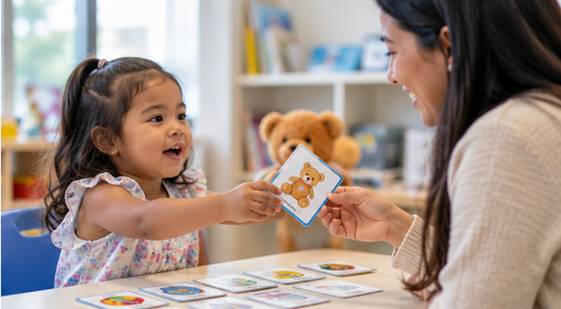
A child using a picture to communicate a preference provides a practical opportunity for positive feedback.
Are Stickers, Tokens, and Reward Charts Necessary?
No. Token boards are optional tools, not the definition of positive reinforcement. A simple choice, a meaningful activity, or natural access to what the child requested may be more practical. Token systems can be confusing if goals are unclear, rewards are delayed, or the child has limited control over the exchange. They should not be used to make children earn basic rights or care.
How to Use Positive Reinforcement Thoughtfully
A family-friendly sequence keeps the method understandable without turning home life into constant drills:
- Choose a functional goal. Define one clear skill, such as requesting “break,” putting an item away, or selecting a toothbrush.
- Check that the learner can access the skill. Provide modeling, visual supports, or AAC as needed; do not reward only spoken language.
- Find what is genuinely preferred. Offer choices and allow preferences to change. What works on Monday may not work on Thursday.
- Respond promptly after success. Make the connection clear and pleasant. If the child requests a toy appropriately, receiving that toy is an especially natural consequence.
- Track change and fade adult prompts. As independence grows, shift toward naturally occurring outcomes and practice in different settings.
Children also need non-contingent attention, play, affection, sensory breaks, and access to necessities. Reinforcement should add an opportunity to learn, not make ordinary caregiving conditional on performance.

Daily routines, such as putting on shoes, can be broken into manageable skills and celebrated without pressure.
What If a Child Does Not Respond to the Reinforcer?
Check whether the target skill is too difficult, the task feels uncomfortable, the preferred item has lost value, or a sensory or communication need is being missed. Change the plan instead of increasing pressure. A pause or a request to stop is information that a supportive adult should respect.
Common Mistakes to Avoid
Some reinforcement plans appear successful on a data sheet but do not help daily life. Families can watch for several warning signs.
- Rewarding compliance without checking whether the activity is meaningful, accessible, or comfortable.
- Trying to extinguish harmless self-regulation, such as safe stimming, purely because it looks different.
- Using the same reward for every learner instead of measuring individual preferences.
- Waiting too long before reinforcing an emerging skill, making the connection unclear.
- Using food, water, toileting, rest, or social connection as things a child must earn.
- Failing to plan for generalization, so the skill only appears in the clinic.
The BACB ethics materials emphasize client welfare, involving stakeholders in goals, and obtaining informed consent with assent when applicable. Parents should expect providers to explain how they respect the child’s choices and respond to distress.
How Do You Measure Whether It Is Working?
A good measurement plan tracks more than token counts. Start with a brief baseline: how often does the child request help independently, or how many steps of a routine can they complete? Then review the same measures after the support is introduced. Progress should be visible in routines that matter to the family.
| Measure | Useful question | What improvement looks like |
| Independence | Does the child need fewer hints? | More self-initiated requests and actions. |
| Generalization | Can the skill happen elsewhere? | The child uses it at home or with another adult. |
| Well-being | Is participation comfortable? | Less frustration and more willing engagement. |
| Caregiver practicality | Is the approach sustainable? | Family can follow it without constant prompts or charts. |
When the data are flat, the answer is not always “more rewards.” The goal might need to be easier, the child may require an accessible communication tool, or the setting may need to change. Discuss revisions with the supervising professional.
Positive Reinforcement at Home, School, and in Therapy
In everyday settings, the most durable reinforcement usually follows naturally from the skill. If a child requests water, give water; if they ask a parent to play, join the game; if they put on shoes to go outside, the result is a preferred outdoor activity. Adults can help the child notice successes without demanding a scripted response or perfect behavior.
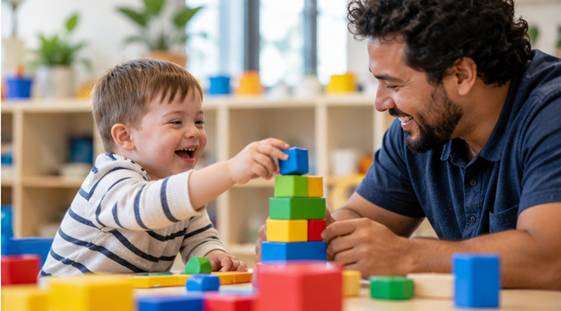
Shared play often creates natural opportunities for positive attention and encouragement.
In a clinical setting, reinforcement may be planned alongside prompting, modeling, and other teaching methods. But a strategy is only one part of individualized ABA. Families comparing programs should ask how goals are chosen, how progress is shared, and how real-life independence is prioritized.
Questions to Ask an ABA Provider in Texas
Whether you are just starting services or reviewing a current plan, ask for concrete examples rather than a generic promise that rewards will “fix behavior.” A qualified team should be able to show you why a goal matters and how they will support communication and choice.
- What does my child get to choose, and how will you know whether the reinforcement is meaningful?
- How do you respond when my child refuses, needs a break, or becomes overwhelmed?
- How are prompts reduced and skills practiced outside a therapy session?
- What metrics will we review together, and when will the plan be changed?
Families exploring ABA therapy in Houston, TX can ask how reinforcement is used in home and community routines.
For southwest Houston communities, the ABA therapy in Sugar Land, TX page offers a local starting point for asking about services.
North Texas families can compare ABA therapy in Dallas, TX and ask whether caregivers receive practical training.
Those near Plano, TX can request examples of progress reports that show independent communication.
Parents considering ABA therapy in Austin, TX can ask how teaching is balanced with choice-led play.
These links identify regional information pages, not a guarantee of current openings, insurance acceptance, or a specific treatment modality. Confirm directly with the provider.
Frequently Asked Questions
What is a simple example of positive reinforcement in ABA?
A child asks for help using a gesture or AAC device, and an adult helps right away. If that makes help-seeking more likely in the future, the response was positively reinforced.
Is positive reinforcement the same as bribery?
No. Effective reinforcement is planned around learning and delivered after a useful response. Bribery usually refers to an improvised offer made to stop a problem in the moment. In both cases, families should evaluate the child’s well-being and autonomy rather than rely on labels.
Does positive reinforcement mean giving candy or toys?
No. Preferred activities, play, smiles, time with a favorite person, and naturally receiving what was requested may all function as reinforcement. A child’s preferences matter.
Can positive reinforcement be used for an autistic toddler?
It can be part of age-appropriate, play-based teaching when goals are individualized. Toddlers learn through meaningful routines, connection, and accessible communication.
What if praise makes my child uncomfortable?
You can choose a quieter form of acknowledgement, a preferred activity, or another consequence that respects the child’s wishes. Praise is not universally preferred.
How quickly does positive reinforcement work?
There is no universal timeline. The target skill, learner, setting, timing, and choice of consequence all influence results. Track meaningful gains rather than expecting immediate change.
Final Thoughts
Positive reinforcement in ABA works best when it helps a child do more of something useful, such as communicating a need, asking for support, or joining a preferred activity. The technique should be adapted to the child, not used to demand that the child conform to an adult’s idea of “normal.”
For families, the most important questions are practical: Does the child have more ways to communicate? Are routines easier? Does the child feel safe and respected? Those outcomes are worth more than any sticker count.
Research & Further Reading
The following resources informed the article’s descriptions. They are linked for readers and clinical reviewers; they are not endorsements of any specific provider.
- University of North Carolina, National Professional Development Center on ASD: Steps for Implementation: Positive Reinforcement (Neitzel, 2009/2010)
- Vanderbilt University, IRIS Center: Reinforcement: Positive Versus Negative
- University of North Carolina, AFIRM: Differential Reinforcement: Evidence-Based Practice Brief Packet
- Behavior Analyst Certification Board: Ethics Codes: Ethics Code for Behavior Analysts
Editorial Note
Reviewed in draft form for SEO structure and source alignment on October 12, 2026. Before publication, a qualified BCBA or appropriate licensed clinician should check all descriptions, examples, assent safeguards, and relevance to Dream Bigger ABA’s actual services. This is educational information, not individualized treatment guidance. All four accompanying images are AI-generated illustrations of fictional scenarios; they do not depict actual clients, clinicians, or documented outcomes. Confirm local coverage, availability, and insurance information before publishing.