
Key Takeaways
- The most recent CDC surveillance data shows approximately 1 in 31 children aged 8 in the United States have autism — up from 1 in 36 in the 2023 report based on 2020 data
- At the 1 in 31 rate, approximately 2.4 million children in the United States currently have autism
- The global WHO estimate remains approximately 1 in 100 children worldwide — a figure that reflects the dramatically lower diagnostic detection capacity in most countries, not lower actual prevalence
- Rising autism prevalence figures are driven primarily by diagnostic expansion, improved awareness, and better surveillance — not a biological epidemic; the autism was always there
- Autism affects every IQ level — the majority of autistic people today do not have intellectual disability — and the spectrum is far broader and more diverse than earlier clinical descriptions suggested
How Many Children Have Autism in 2026?
The most current figure from the United States Centers for Disease Control and Prevention (CDC) Autism and Developmental Disabilities Monitoring (ADDM) Network shows that approximately 1 in 31 children aged 8 in the United States have autism spectrum disorder — representing approximately 3.2% of all 8-year-olds.
With approximately 74 million children under age 18 in the United States, that translates to an estimated 2.3 to 2.5 million autistic children in the US as of 2026.
This figure is drawn from the ADDM Network’s surveillance of 2022 data, released in 2025. It represents the most comprehensive active surveillance of autism prevalence anywhere in the world and is the most reliable current estimate for the US population.
A note on the numbers: ADDM data reports on 8-year-olds specifically because this age group captures children who have had sufficient time to be diagnosed through the healthcare and educational systems, while still being young enough to represent an active birth cohort. Autism prevalence in the full 0–18 age range would produce slightly different numbers — younger children are underidentified relative to their likely true prevalence.
The Trend Line: How Autism Rates Have Changed
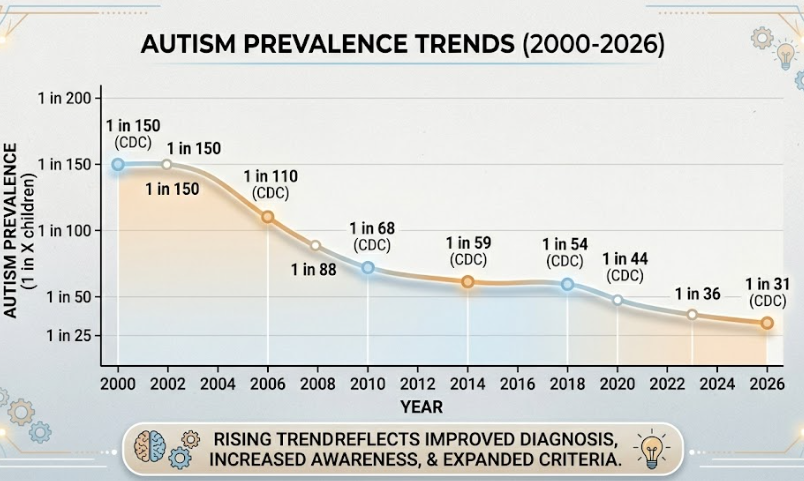
The trajectory of autism prevalence figures over time is striking — and understanding what drove that trajectory is essential for interpreting the current numbers accurately.
1980: DSM-III introduces autism as a formal diagnosis with very narrow criteria. Estimated prevalence: 1–4 per 10,000 children (0.01–0.04%).
2000: CDC begins systematic ADDM surveillance. First report shows approximately 1 in 150 children (0.67%).
2004: 1 in 125 (0.8%)
2006: 1 in 110 (0.91%)
2012: 1 in 68 (1.47%)
2014: 1 in 59 (1.69%)
2016: 1 in 54 (1.85%)
2018: 1 in 44 (2.27%)
2020: 1 in 36 (2.76%)
2022: 1 in 31 (3.2%)
What this trend line shows is not a biological epidemic unfolding over 40 years. It shows a diagnostic category that progressively expanded — capturing more of the real autistic population that always existed — combined with surveillance systems that became increasingly sophisticated at finding autism across its full range of presentations. Why autism rates are increasing covers the specific mechanisms behind this trend in detail.
Is It True That 1 in 36 Kids Have Autism?
The 1 in 36 figure is accurate — but it reflects 2020 surveillance data published in the CDC’s March 2023 ADDM report. It was the most widely cited autism prevalence figure for two years and continues to appear in media coverage, advocacy materials, and educational resources.
The more current figure — based on 2022 surveillance data published in 2025 — is 1 in 31, indicating that the upward trend in identified prevalence continued through the early 2020s.
Both figures are accurate representations of the data at their respective time points. The difference between them reflects:
- Continued expansion of diagnostic capacity — more clinicians trained to identify autism across a broader range of presentations
- Reduced diagnostic delays — children being identified earlier, bringing more of any given birth cohort into the identified count by the age-8 surveillance window
- Reduced stigma — more families pursuing evaluation rather than attributing their child’s differences to other causes
- Possible modest true prevalence increase — factors like increasing average parental age may be contributing a real biological component to the trend, though this is a smaller contributor than the diagnostic and surveillance factors
For families navigating this landscape: the number that matters most is not the national rate but whether their specific child’s developmental profile warrants evaluation. A parent who notices the signs of autism in their child should pursue evaluation regardless of whether the national rate is 1 in 36, 1 in 31, or any other figure.
The Global Picture: Why Rates Vary So Dramatically
The WHO estimate of 1 in 100 children globally having autism creates apparent paradox alongside the US rate of 1 in 31. The resolution to that paradox is the same one that explains within-country variation: detection capacity and access, not true prevalence, drive reported rates.
Countries with the highest reported autism rates — the United States, South Korea, parts of northern Europe, Australia — are those with the most developed diagnostic infrastructure, the highest clinician training rates, the most public awareness, and the least stigma around seeking mental health evaluation.
Countries with the lowest reported autism rates — across much of sub-Saharan Africa, South Asia, and parts of Southeast Asia — are those where autism-trained specialists are scarce, where developmental differences are attributed to other causes, and where the social infrastructure for diagnosis simply does not exist at scale.
The 1 in 100 global estimate is the WHO’s attempt to produce a number that accounts for this variation — but it is itself a significant undercount of the truly autistic global population, because it averages together high-detection and low-detection environments. The epidemiological consensus is that autism’s true global prevalence is substantially higher than what current detection systems identify.
Who Autism Affects: Demographics in 2026
Sex and gender: ADDM surveillance consistently finds autism diagnosed approximately 4 times more often in male than female children. The mechanisms behind this disparity are debated — some reflects genuine sex-linked biological differences in autism expression, but a significant portion reflects diagnostic bias: autistic females are more likely to mask their autism, more likely to be misdiagnosed with anxiety or ADHD, and less likely to be identified by clinicians trained on predominantly male autism presentations. True prevalence estimates that account for masked autism suggest the sex ratio is probably closer to 2:1 or 3:1 than 4:1.
Race and ethnicity: Earlier ADDM data showed significant disparities in autism identification rates by race and ethnicity, with Black and Hispanic children identified less frequently than white children — likely reflecting access to diagnostic services rather than true prevalence differences. More recent data shows these gaps have narrowed substantially as awareness and access have improved, though disparities persist, particularly in rural and lower-income communities.
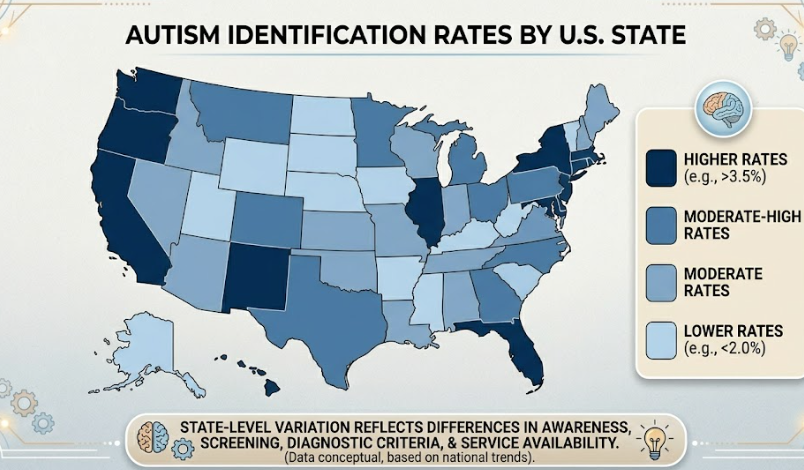
Geographic variation: Within the United States, autism identification rates vary significantly by state — from significantly above the national average to below it. These differences largely reflect state-level variation in surveillance infrastructure, school district resources, and access to diagnostic specialists rather than true differences in autism prevalence across geographies.
Socioeconomic patterns: Higher-income families historically received autism diagnoses earlier and at higher rates than lower-income families — reflecting differential access to evaluation services. As Medicaid and school-based evaluation access has expanded, income-related disparities have decreased, though they have not disappeared.
What the Numbers Mean for Families and Communities
The practical implications of autism affecting 1 in 31 children are significant — and often unmet.
Service demand: With approximately 2.4 million autistic children in the US, the demand for ABA therapy, speech-language therapy, occupational therapy, and educational support services significantly exceeds current provider capacity in most communities. Wait times for both diagnosis and services remain long in most areas.
Educational systems: At a rate of 1 in 31, every classroom in the United States statistically contains at least one autistic student. Teacher training in autism recognition and accommodation remains insufficient in most school systems relative to this prevalence.
Healthcare systems: Autistic children and adults use healthcare at higher rates than the general population, yet healthcare providers’ training in autism-informed care lags significantly behind the prevalence figures that make such training essential.
Economic impact: Autism across the lifespan carries substantial economic costs — in treatment, in educational support, in lost productivity when autistic adults cannot access appropriate employment support. These costs scale with prevalence, and policy investment in early intervention is measurably more cost-effective than later intervention.
Do Autistic People Have Normal Life Expectancy?
Research consistently finds that autistic people have a shorter average life expectancy than the general population — with estimates from peer-reviewed studies suggesting a gap of approximately 16–20 years on average across the full autism population. For autistic individuals without co-occurring intellectual disability (approximately 60% of the current autistic population), the primary contributors are mental health related: elevated rates of depression, anxiety, eating disorders, and suicide risk that substantially exceed population averages. The life expectancy gap for this group is smaller than for the full population but remains meaningful and is largely preventable with appropriate mental health support.
For autistic individuals with co-occurring intellectual disability and higher support needs, the primary contributors to reduced life expectancy are medical: epilepsy (affecting approximately 30% of this group, carrying significant mortality risk), aspiration and swallowing difficulties, undertreated medical conditions due to communication barriers, and accident-related injuries.
These findings underscore that mental health support is not optional for autistic individuals — it is clinically urgent and directly affects lifespan.

Do Autistic People Have High IQ?
The relationship between autism and intelligence is one of the most misunderstood aspects of the condition — in both directions. The answer is: autism spans the full intellectual spectrum, with no reliable directional association in either direction.
The historical picture: Earlier autism prevalence estimates, drawn from an era of narrow diagnostic criteria, found that approximately 70–75% of autistic individuals had co-occurring intellectual disability (IQ below 70). This figure dominated public and clinical understanding for decades and shaped the stereotypes of autism as a condition of severe cognitive limitation.
The current picture: As the diagnostic criteria expanded and autism identification improved across the full spectrum, the intellectual profile of the identified autistic population shifted dramatically. Current ADDM surveillance finds that approximately 44% of autistic children have average or above-average intellectual ability (IQ 70 or above), with another substantial group in the borderline range. The proportion with intellectual disability has dropped significantly as the higher-functioning end of the spectrum was captured by diagnosis.
Uneven cognitive profiles: What autism reliably produces is not low IQ but uneven cognitive profiles — dramatic discrepancies between different intellectual domains. An autistic person might score in the 99th percentile on nonverbal reasoning and visual-spatial tasks while scoring significantly lower on processing speed and working memory, producing a composite IQ score that understates their actual intellectual capacity in their strongest domains.
The giftedness question: Autism is found at elevated rates in populations identified as intellectually gifted, and some research finds that autistic individuals are overrepresented among people with extraordinary domain-specific abilities. Whether this reflects a genuine biological association or the visibility of autism in high-achieving populations is still studied. For more on intelligence and autism, are people with autism smart covers the research comprehensively.
The answer to “do autistic people have high IQ” is: some do, some don’t, and the distribution is far more spread toward average and above-average intelligence than historical clinical pictures suggested — partly because those historical pictures were drawn from the most severely affected individuals who represented only a fraction of the autistic population.
Common Misconceptions About Autism Prevalence
“Autism has become an epidemic.” An epidemic implies a rapidly spreading disease with an identifiable causal agent. Autism’s rising prevalence figures reflect an expanding diagnostic category applied to a condition that was always present in the population at broadly similar rates — not a new disease spreading through the population. The causal agents driving the numbers up are diagnostic and surveillance factors, not biological contagion.
“The 1 in 31 figure means autism is overtaking other developmental conditions.” Autism’s rising numbers are partly a product of diagnostic substitution — children who previously received diagnoses of intellectual disability, language disorder, or no diagnosis at all are now correctly identified as autistic. The total population of children with neurodevelopmental differences has not necessarily increased proportionally to the autism numbers.
“Because rates are so high, we’re missing something important in the water/food/environment.” The trend in autism prevalence tracks diagnostic and surveillance changes, not any environmental exposure with the pattern required to explain the trend. Rising rates preceded, accompanied, and followed changes in multiple environmental exposures without a consistent pattern linking any specific exposure to the prevalence trend.
“Most autistic people have intellectual disability.” This was more accurate when only the most severely affected individuals were being diagnosed. With the full spectrum identified, the majority of currently diagnosed autistic individuals do not have co-occurring intellectual disability. The 44% with average or above-average IQ represents a minimum — intellectual disability assessments themselves are complicated in autistic populations by motor, communication, and anxiety factors that can depress scores.
“Since 1 in 31 kids have autism, it’s not really a disability anymore.” Prevalence does not determine severity or the appropriateness of calling something a disability. Autism is a disability for many of the people who have it — affecting major life activities in ways that require accommodation, support, and clinical intervention. The higher the prevalence, the more important adequate services become, not the less.
Conclusion
The number of children with autism in 2026 — approximately 1 in 31, representing roughly 2.4 million US children — reflects decades of improving diagnostic capacity, expanding clinical awareness, and reducing barriers to evaluation. It reflects autism’s true prevalence becoming progressively more visible, not a new epidemic created by anything in the modern environment.
What the numbers mean practically is that autism is not rare, not clustered in any particular demographic, and not defined by any single intellectual or functional profile. It is common. It is diverse. And the gap between how many children have autism and how many have adequate access to evidence-based support remains wide.
Early identification and early, individualized intervention remain the most powerful variables in determining long-term outcomes for autistic children — more powerful than support level designation, more powerful than any specific co-occurring condition, and more accessible than ever as understanding and service infrastructure grow.
Dream Bigger ABA serves autistic children and their families across Northern Virginia — meeting the growing need for evidence-based ABA therapy with individualized, compassionate care for every child’s unique profile. Connect with our team to explore services in Vienna, VA and Gainesville, VA.
Frequently Asked Questions
How common is autism in 2026?
Based on the most current CDC ADDM Network surveillance data — covering 2022 birth cohorts and published in 2025 — autism affects approximately 1 in 31 children aged 8 in the United States, representing approximately 3.2% of that age group. This is the most reliable current figure for US childhood autism prevalence. Globally, the WHO estimates approximately 1 in 100 children have autism — a figure that substantially undercounts the true global prevalence due to limited diagnostic capacity in many countries. In the US, this translates to approximately 2.3–2.5 million autistic children under age 18. The prevalence figure has increased consistently over recent decades, driven primarily by diagnostic expansion and improved surveillance rather than a biological increase in autism itself.
Is it true that 1 in 36 kids have autism?
Yes — as of the 2020 surveillance data published by the CDC in March 2023, 1 in 36 children aged 8 were identified with autism. That was accurate for the 2020 cohort and widely reported. More recent data from 2022 ADDM surveillance shows the figure has risen to approximately 1 in 31 — continuing the consistent upward trend in identified prevalence. Both figures are real; they represent the most current data available at the time of their respective reports. The 1 in 36 figure appears frequently because it was the widely cited standard for two years; the 1 in 31 figure is the most current estimate. Neither figure suggests a biological epidemic — both reflect ongoing improvements in how well the diagnostic system is capturing the autism that has always existed in the population.
What billionaire has autism?
Elon Musk remains the most publicly known billionaire to have self-disclosed an autism diagnosis. He announced his Asperger’s syndrome diagnosis on Saturday Night Live in May 2021 — casually, as a statement of identity rather than a limitation. Asperger’s syndrome was the former DSM label for autistic individuals without intellectual or language delays, unified under autism spectrum disorder in 2013. At the 1 in 31 prevalence rate across the current generation, autism is represented across every professional and intellectual level. Historical figures now widely believed to have been autistic — including Alan Turing, whose mathematical work founded modern computing, and Albert Einstein, whose theoretical physics transformed science — illustrate how long autism has been present among the extraordinarily accomplished alongside those with severe functional impairment. The condition is not defined by any particular level of achievement or ability.
Do autistic people have normal life expectancy?
Research consistently finds that autistic people have shorter average life expectancy than the general population — peer-reviewed studies estimate the gap at approximately 16–20 years across the full autistic population. The contributing factors differ by support profile. For autistic individuals without intellectual disability — the majority of today’s autistic population — the primary life expectancy drivers are mental health: elevated rates of depression, anxiety, eating disorders, and suicide risk that substantially exceed population averages. For autistic individuals with co-occurring intellectual disability, medical factors predominate: epilepsy (present in approximately 30% of this group), aspiration and swallowing complications, and undertreated medical conditions due to communication barriers. The mental health component of life expectancy reduction is substantially preventable with appropriate access to autism-informed mental health care — making this a service adequacy crisis as much as a clinical one.
Do autistic people have high IQ?
Autism spans the full intellectual spectrum — from profound intellectual disability to extraordinary giftedness — with no reliable directional association in either direction. Historical clinical pictures overrepresented the severely affected end of the spectrum, leading to decades-old estimates that 70%+ of autistic individuals had intellectual disability. Current surveillance data, drawing from the full breadth of the autism spectrum as now identified, finds that approximately 44% of autistic children have average to above-average intellectual ability, with the proportion continuing to shift upward as diagnosis improves. Autistic cognitive profiles are characteristically uneven — very high scores in some domains alongside lower scores in others — meaning composite IQ scores often understate intellectual capacity in an autistic person’s strongest areas. Some research finds elevated rates of autism in gifted populations and elevated rates of giftedness in autistic populations, suggesting a meaningful but complex association at the upper end of the intellectual distribution. Most autistic people are of average intelligence, neither intellectually disabled nor exceptionally gifted — but the full range is represented across the spectrum.