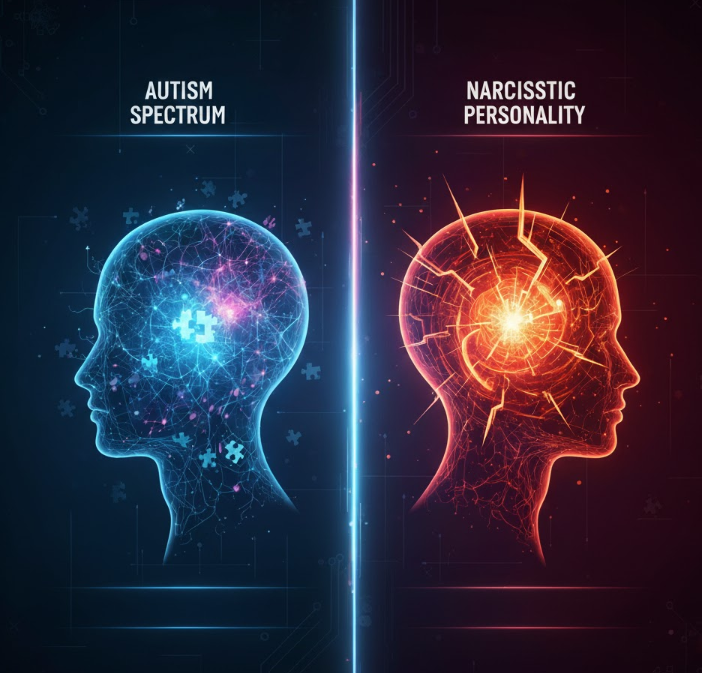
Autism and narcissism are two entirely different conditions that can sometimes appear similar on the surface, but they stem from fundamentally different neurological and psychological foundations. While both may involve challenges with social interaction and empathy, autism is a neurodevelopmental condition present from birth, whereas narcissistic personality disorder (NPD) is a mental health condition that typically develops through a combination of genetic and environmental factors.
Understanding the distinction between these two conditions matters deeply for families, educators, and healthcare providers. Misidentifying one for the other can lead to inappropriate interventions and missed opportunities for meaningful support. Let’s explore what sets them apart, where they might overlap, and why accurate understanding changes everything.
What Is Autism Spectrum Disorder?
Autism spectrum disorder (ASD) is a lifelong developmental condition affecting how individuals perceive the world, communicate, and interact socially. It exists on a spectrum because people experience varying levels of support needs and display different combinations of traits.
Common characteristics include differences in social communication, repetitive behaviors, sensory sensitivities, and intense focus on specific interests. Some individuals speak fluently while others may be nonverbal. Many possess exceptional abilities in pattern recognition, memory, or specialized fields.
Importantly, autism is not a personality disorder or a mental illness. It’s a neurodevelopmental difference that shapes how the brain processes information from infancy onward. People with autism often experience the world more intensely and may struggle to interpret social cues that seem automatic to neurotypical individuals.
At Dream Bigger ABA, we recognize that every person with autism has unique strengths and challenges. Early intervention through personalized ABA therapy helps children develop communication skills, manage sensory experiences, and build confidence in social situations.
What Is Narcissistic Personality Disorder?
Narcissistic personality disorder (NPD) is a mental health condition characterized by an inflated sense of self-importance, a deep need for excessive attention and admiration, and a lack of empathy for others. Unlike autism, NPD typically emerges during adolescence or early adulthood and reflects patterns of thinking and behavior rather than neurological differences.
People with NPD often display grandiosity, believe they are special or unique, and expect constant recognition even without achievements to warrant it. They may exploit others to achieve their goals, struggle with criticism, and have difficulty acknowledging the feelings and needs of those around them.
This disorder affects how someone relates to others and perceives themselves. While individuals with NPD may appear confident, they often harbor deep insecurity and vulnerability to criticism. Their behavior stems from psychological defense mechanisms rather than neurological processing differences.
The key distinction here is intentionality and emotional understanding. People with NPD typically understand social rules and emotional cues but may choose to disregard them when they conflict with personal desires.
Key Differences Between Autism and Narcissism
Though autism and narcissism can both involve social difficulties, the reasons behind these challenges differ drastically. Understanding these distinctions prevents harmful misdiagnosis and ensures appropriate support.
| Aspect | Autism Spectrum Disorder | Narcissistic Personality Disorder |
| Origin | Neurodevelopmental condition present from birth | Personality disorder that develops over time |
| Empathy | May struggle to express empathy but genuinely cares about others | Can understand emotions but lacks genuine concern for others’ feelings |
| Social Challenges | Difficulty reading social cues due to different processing | Understands social cues but may manipulate them for personal gain |
| Self-Perception | Often realistic or even negative self-image | Inflated self-importance and need for admiration |
| Intentionality | Social mistakes are unintentional | Behavior often involves deliberate manipulation |
| Response to Feedback | May struggle to understand criticism but willing to learn | Reacts defensively, denies faults, or blames others |
Why Autism and Narcissism Get Confused
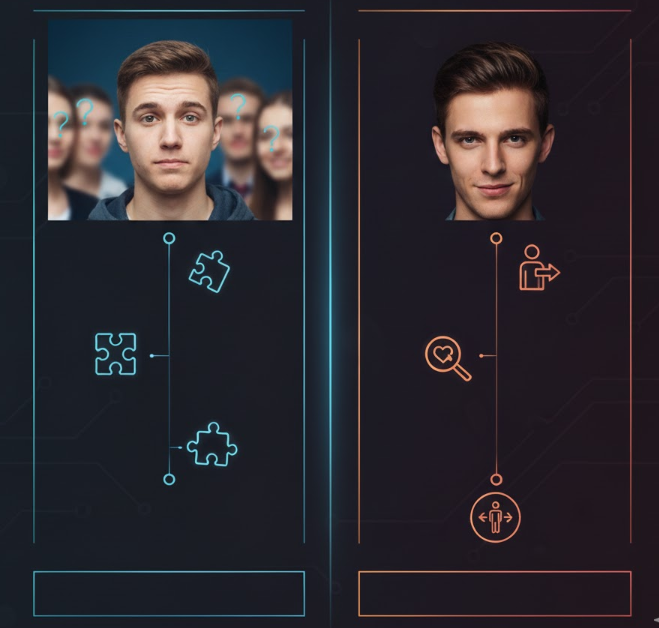
Several behavioral overlaps create confusion between autism and narcissism, particularly for those unfamiliar with the underlying mechanisms driving each condition.
Direct Communication Style: Both individuals with autism and those with NPD may come across as blunt or insensitive. However, someone with autism speaks directly because they process communication literally and may not recognize indirect social signals. In contrast, someone with NPD might be blunt because they prioritize their own perspective over others’ feelings.
Limited Empathy Expression: This is perhaps the most misunderstood similarity. People with autism often feel empathy deeply but struggle to express it in conventional ways or recognize when others need emotional support. Those with NPD understand emotional situations intellectually but lack the genuine emotional resonance that drives compassionate behavior.
Difficulty with Perspective-Taking: Individuals with autism may find it challenging to understand that others think differently than they do, a concept known as “theory of mind.” People with NPD can understand different perspectives but dismiss them when those perspectives don’t serve their interests.
Intense Focus: Autistic individuals often have passionate special interests they discuss extensively, which can be misinterpreted as self-centeredness. People with NPD genuinely center conversations on themselves out of perceived superiority.
These surface-level similarities mask fundamentally different internal experiences. One involves a neurological difference in processing social information, while the other reflects learned patterns of self-protective and self-aggrandizing behavior.
Empathy: The Critical Distinction
The empathy difference between autism and narcissism deserves deeper examination because it’s central to understanding both conditions.
Autism and Empathy: Research shows that people with autism experience what’s called “affective empathy”—they feel others’ emotions, sometimes overwhelmingly so. What they may struggle with is “cognitive empathy”—recognizing and interpreting social cues that indicate what someone else is feeling. This creates a gap between feeling and responding appropriately.
For example, an autistic person might not realize a friend is upset because they miss subtle facial expressions or tone changes. Once they understand their friend is hurting, however, they genuinely care and want to help. They may just need explicit communication rather than relying on unspoken social signals.
Narcissism and Empathy: Individuals with NPD typically possess cognitive empathy—they can read social situations and understand what others are feeling. What they lack is affective empathy—the emotional response that makes you care about another person’s pain. They might recognize someone is suffering but feel little motivation to alleviate that suffering unless it serves their purposes.
This fundamental difference means that therapy and support approaches must be entirely different. Teaching someone with autism how to recognize emotional cues can be highly effective. Addressing narcissistic patterns requires challenging deeply ingrained defense mechanisms and relationship patterns.
If you’re seeking support for a child with autism who struggles with social communication, Dream Bigger ABA provides evidence-based interventions that build both recognition and expression of empathy in developmentally appropriate ways.
Can Someone Have Both Autism and Narcissistic Traits?
While having both diagnosed conditions simultaneously is uncommon, it’s theoretically possible for someone on the autism spectrum to develop narcissistic traits or even NPD through environmental and psychological factors unrelated to their autism.
Understanding Comorbidity: Autism itself doesn’t cause narcissism, but the social challenges associated with autism can lead to protective behaviors that might appear narcissistic. For instance, someone who has been repeatedly misunderstood or rejected might develop defensive patterns, become overly focused on their own perspective, or struggle with relationships in ways that seem self-centered.
Trauma and Development: Individuals with autism who experience chronic invalidation, bullying, or lack of support might develop maladaptive coping strategies. These strategies could superficially resemble narcissistic traits—defensive behavior, difficulty acknowledging mistakes, or social withdrawal interpreted as superiority.
Differentiating True NPD: A qualified mental health professional can distinguish between autism-related social challenges with defensive overlays versus genuine narcissistic personality disorder. The key lies in examining the person’s internal experience, developmental history, capacity for genuine connection, and response to feedback when they feel safe.
It’s also worth noting that some behaviors in autism, such as talking extensively about special interests or needing routines respected, can be mislabeled as narcissistic self-centeredness by those who don’t understand neurodevelopmental differences.
Supporting Individuals with Autism vs. NPD
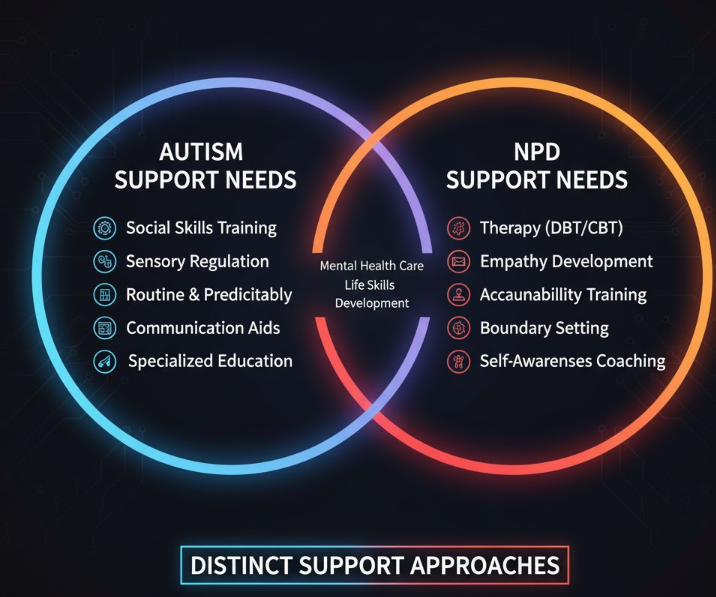
The support needs for autism and narcissism differ dramatically because the underlying conditions require different approaches.
Supporting Someone with Autism:
- Provide clear, direct communication without relying on hints or subtle cues
- Create predictable routines and environments that reduce sensory overwhelm
- Teach social skills explicitly rather than assuming intuitive understanding
- Validate their feelings and experiences without forcing neurotypical norms
- Use visual supports and concrete examples to explain abstract social concepts
- Celebrate their strengths and special interests as valuable contributions
Families working with children on the autism spectrum benefit greatly from structured interventions. Programs like those offered through Dream Bigger ABA help children develop practical communication strategies while honoring their neurological differences.
Supporting Someone with NPD:
- Establish and maintain firm boundaries about acceptable behavior
- Avoid feeding into grandiose narratives or excessive need for admiration
- Focus on accountability rather than excuses for harmful behavior
- Encourage professional therapy specifically designed for personality disorders
- Recognize that change requires the individual’s genuine motivation
- Protect your own emotional wellbeing when interacting with someone with NPD
The fundamental difference in approach reflects the conditions themselves: autism requires accommodation and skill-building around neurological differences, while NPD requires boundary-setting and psychological intervention around behavioral patterns.
Common Misconceptions About Autism and Narcissism
Several persistent myths create confusion and harm when left unchallenged.
Myth 1: People with Autism Lack Empathy Reality: People with autism feel empathy but may express it differently or struggle to recognize when empathy is needed. Their care for others is genuine and often profound.
Myth 2: All Narcissists Are Aware of Their Behavior Reality: Many people with NPD have limited insight into how their behavior affects others. The disorder itself creates blind spots around self-perception.
Myth 3: Autism Can Turn Into Narcissism Reality: These are fundamentally different conditions with different origins. Autism doesn’t evolve into personality disorders, though autistic individuals can develop mental health conditions separately.
Myth 4: Direct Communication Means Narcissism Reality: Blunt or honest communication is common in autism due to literal thinking and difficulty with social filters. Narcissistic communication involves intentional dismissal of others’ feelings.
Myth 5: People with NPD Can’t Change Reality: While challenging, individuals with NPD can make progress with appropriate therapy and genuine motivation, though outcomes vary significantly.

Understanding these distinctions helps create more compassionate and effective responses to both conditions. For families navigating autism diagnosis and support, accurate information prevents unnecessary stigma and guides appropriate intervention choices.
The Importance of Accurate Diagnosis
Misdiagnosis between autism and narcissism carries serious consequences. Treating autism as a personality disorder can lead to inappropriate therapies that pathologize natural neurodevelopmental differences and cause psychological harm.
Conversely, excusing genuinely manipulative or harmful behavior as “just autism” enables abuse and prevents someone with NPD from receiving appropriate mental health treatment.
Professional evaluation should include:
- Comprehensive developmental history from early childhood
- Assessment of social communication patterns across contexts
- Evaluation of sensory experiences and repetitive behaviors
- Examination of empathy expression versus empathy experience
- Analysis of intentionality and self-awareness in social situations
- Consideration of trauma history and environmental factors
Qualified professionals—including developmental pediatricians, clinical psychologists, and psychiatrists with expertise in both neurodevelopmental and personality disorders—can conduct thorough assessments that differentiate these conditions accurately.
For families wondering about autism evaluation, resources like how to get diagnosed with autism as an adult provide guidance on pursuing appropriate assessment pathways.
Moving Forward with Understanding
The relationship between autism and narcissism is one of distinction, not connection. While surface behaviors may occasionally appear similar to untrained observers, the internal experiences, origins, and appropriate interventions differ fundamentally.
For families raising children with autism, understanding these differences protects against stigma and ensures children receive neurodiversity-affirming support that builds on their strengths. For those dealing with narcissistic individuals, recognizing the distinction prevents excusing harmful behavior while maintaining compassion for genuine developmental differences.
Whether you’re seeking clarity about your own experiences, supporting a loved one, or working professionally with diverse populations, accurate knowledge about autism and narcissism creates better outcomes for everyone involved.
Frequently Asked Questions
What personality disorders are common with autism?
Autism itself is not a personality disorder. However, individuals with autism may sometimes be diagnosed with co-occurring mental health conditions, including anxiety disorders, depression, or obsessive-compulsive disorder. True personality disorders are less commonly diagnosed alongside autism, and when they are, careful evaluation is needed to distinguish autism traits from personality disorder symptoms.
Can a neurodivergent person be a narcissist?
Yes, neurodivergent individuals can develop narcissistic personality disorder, just as neurotypical people can. Neurodivergence (including autism, ADHD, dyslexia, etc.) refers to neurological differences in how the brain processes information, while narcissism is a personality disorder that develops through psychological and environmental factors. These are separate dimensions of human experience.
Is narcissism part of the spectrum?
No, narcissism is not part of the autism spectrum. The autism spectrum refers specifically to variations in neurodevelopmental traits related to social communication, sensory processing, and cognitive patterns. Narcissistic personality disorder is a distinct mental health condition classified separately as a personality disorder, not a neurodevelopmental condition.
At what age does narcissism peak?
Narcissistic traits typically peak during adolescence and early adulthood, roughly between ages 18-25, as part of normal identity development. For most people, these traits diminish with maturity. However, when these patterns persist and intensify into narcissistic personality disorder, they usually become evident by the mid-20s and can continue throughout life without appropriate intervention.
What are the 3 D’s of narcissism?
The 3 D’s of narcissism are Deny, Deflect, and Devalue. These represent common defense mechanisms: denying responsibility for problems, deflecting blame onto others, and devaluing people who threaten their self-image. These patterns help identify narcissistic behavior in relationships and distinguish it from communication challenges in autism.