Key Takeaways
- Whether a nurse practitioner can diagnose autism depends on state licensing laws, NP specialty, and clinical training — it is not a universal yes or no
- A Psychiatric Mental Health Nurse Practitioner (PMHNP) with specialized autism assessment training may be able to conduct a valid autism evaluation in full-practice-authority states — a primary care NP typically cannot
- What matters more than the credential title is whether the provider uses validated autism assessment tools (ADOS-2, ADI-R), takes a comprehensive developmental history, and produces a written diagnostic report aligned with DSM-5 criteria
- An autism diagnosis that is not accepted by schools, ABA providers, or insurance companies — regardless of who issued it — is not a functional diagnosis for service access purposes
- When wait times are long, a more strategic approach is pursuing multiple evaluation pathways simultaneously rather than defaulting to the fastest option without considering whether the outcome will be accepted
The Direct Answer: It Depends — and the Details Matter Enormously
The question “can a nurse practitioner diagnose autism” does not have a clean universal answer — and the families asking it deserve more than a simple yes or no, because the practical consequences of getting an inadequate evaluation are significant.
The answer is:
Legally — possibly. In the United States, 28 states and the District of Columbia grant nurse practitioners full practice authority — meaning NPs can diagnose, treat, and prescribe without physician oversight. In these states, nothing categorically prohibits an NP from diagnosing autism if they have appropriate training and use validated tools.
Practically — it depends on specialty and training. A Psychiatric Mental Health Nurse Practitioner (PMHNP) with specific training in developmental assessment and autism-specific instruments occupies a very different position from a family nurse practitioner (FNP) or pediatric nurse practitioner (PNP) who has not received autism assessment training. The credential tells you about licensure scope; it does not tell you about clinical competency for a specialized evaluation.
Functionally — the diagnosis must be accepted where it matters. A written autism diagnosis from any provider is only useful if schools, ABA therapy providers, and insurance companies accept it for services access. This is the most practically important consideration — and one that families pursuing the fastest path to diagnosis sometimes discover too late.
The Full Credential Landscape: Who Is Qualified to Diagnose Autism
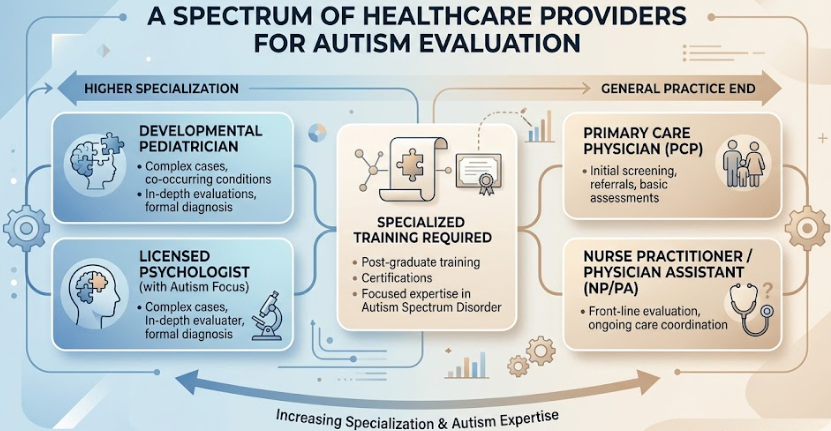
Understanding who typically conducts autism evaluations — and with what level of specialization — helps families identify the right provider for their situation.
Developmental pediatricians are physicians who have completed a fellowship in developmental-behavioral pediatrics after general pediatrics training. They are considered the gold standard for pediatric autism evaluation, with specific training in developmental disorders, validated assessment tools, and differential diagnosis. Wait times are typically long — often 6 to 18 months — precisely because demand significantly exceeds the supply of trained specialists.
Licensed psychologists (PhD or PsyD) with autism specialization represent the gold standard for comprehensive neuropsychological evaluation. They administer the full battery of assessment instruments — ADOS-2, ADI-R, cognitive testing, adaptive behavior assessment — and produce detailed reports that are universally accepted by schools and insurers. Child neuropsychologists offer this plus specialized cognitive profiling.
Child and adolescent psychiatrists — physicians with psychiatric fellowship training — can diagnose autism and are particularly appropriate for complex presentations with co-occurring mental health conditions. Their evaluations are typically accepted by all receiving institutions.
Pediatric neurologists evaluate autism when there are neurological concerns — seizure disorders, motor differences, or ambiguous presentations requiring neurological workup alongside autism evaluation.
Psychiatric Mental Health Nurse Practitioners (PMHNPs) are the NP subspecialty most likely to have relevant training for autism evaluation. PMHNPs complete graduate-level training in psychiatric assessment and diagnosis. In full-practice-authority states, a PMHNP with specific autism assessment training and use of validated tools can conduct an autism evaluation that may be accepted by various institutions — though acceptance is not guaranteed and should be confirmed before proceeding.
Primary care NPs (FNPs, PNPs, DNPs in general practice) are not typically trained in autism-specific assessment. They can identify developmental concerns, administer developmental screenings, make referrals, and play a critical role in identifying children who need evaluation — but conducting a comprehensive autism evaluation is generally outside the training and clinical scope of a primary care NP, regardless of state practice authority.
What Makes an Autism Evaluation Valid — Regardless of Who Conducts It
The single most important factor in whether an autism diagnosis is clinically valid and practically functional is not the letters after the provider’s name — it is the quality and comprehensiveness of the evaluation process. Regardless of credential type, a valid autism evaluation requires:
Validated assessment instruments. The gold-standard tools for autism diagnosis are the ADOS-2 (Autism Diagnostic Observation Schedule, Second Edition) — a structured direct observation assessment — and the ADI-R (Autism Diagnostic Interview-Revised) — a comprehensive structured parent interview covering developmental history. These tools require specific training for administration and coding. An evaluation that does not include validated instruments has a weaker diagnostic basis, regardless of who conducted it.
Comprehensive developmental history. A thorough account of the individual’s developmental timeline — language emergence, social development, play history, sensory responses, behavioral patterns — from birth through the present. This history is essential for applying DSM-5 criteria accurately, since autism must have features present from the early developmental period even if not identified until later.
Direct observation of the individual. Autism diagnosis requires observing the individual’s actual behavior, social communication, and interaction — not only parent report or questionnaire data.
Application of DSM-5 diagnostic criteria. The DSM-5 criteria for autism require documented evidence of persistent differences in social communication and interaction across contexts AND restricted, repetitive behaviors — with onset in the early developmental period and functional impact. The evaluation report must demonstrate how the findings meet these criteria.
A written diagnostic report. Documenting the evaluation process, instruments used, findings across assessment domains, diagnostic conclusion, and recommendations. This report is what schools, ABA providers, and insurance companies review when determining service eligibility.
An evaluation that is missing any of these components — regardless of the credential of the evaluating provider — produces a weaker diagnostic outcome that may not serve the family effectively.
The Practical Risk: An Unaccepted Diagnosis
The most concrete reason to think carefully about provider qualifications before pursuing evaluation is this: an autism diagnosis from a provider or process that the relevant institutions do not accept creates a situation where the family has spent time, money, and emotional energy on an evaluation — and then needs to do it again.
Insurance companies may require that autism diagnoses be made by specific provider types — typically physicians or licensed psychologists — before they will authorize ABA therapy coverage. A diagnosis from a provider outside their accepted list may result in a denied authorization, even if the clinical assessment was competent.
School systems receiving a diagnosis for the purpose of IEP eligibility evaluation will review the diagnostic report carefully. An evaluation conducted without validated instruments, missing developmental history, or not meeting their documentation requirements may not satisfy their eligibility determination process.
ABA therapy providers — including Dream Bigger ABA — require a documented autism diagnosis to begin services. The diagnosis must be from a qualified provider and must be documented in a written report. Confirming what documentation is required before beginning an evaluation prevents having to repeat the process.
Before pursuing an autism evaluation from any provider — including an NP — the most practical first step is to contact the specific schools, insurance plan, and ABA provider the family anticipates working with and ask directly: what credentials and documentation do you require for an autism diagnosis to be accepted?

How to Get an Autism Diagnosis: A Practical Roadmap
Given wait times that often extend 6 to 18 months for comprehensive evaluation, pursuing multiple pathways simultaneously is the most effective strategy for families.
Step 1: Start with the pediatrician or primary care provider Request a formal referral for autism evaluation from your child’s pediatrician. Ask specifically for a referral to a developmental pediatrician, child psychiatrist, or licensed psychologist with autism specialization. Establish the referral on record — this starts the documentation trail and may be required by insurance.
Step 2: Request a school-based evaluation simultaneously Under IDEA, parents can submit a written request to the school district for an educational evaluation at any time. The district has 60 days from parental written consent to complete the evaluation. A school evaluation is conducted for educational eligibility purposes, not clinical diagnosis — but it can unlock services and support while the clinical evaluation is pending. These two processes are independent and both should be pursued.
Step 3: Research evaluation options beyond the primary referral Developmental pediatrician waitlists are often the longest. Alternatives that may have shorter wait times — and which produce valid clinical diagnoses — include:
- Licensed psychologists in private practice with autism specialization
- University training clinic evaluations (often conducted by supervised doctoral students at lower cost)
- Hospital-based autism evaluation clinics
- Telehealth autism evaluation services (see below)
Step 4: If considering an NP for evaluation, verify the following first
- What is the NP’s specialty and specific autism assessment training?
- Do they administer the ADOS-2 and ADI-R, or equivalent validated instruments?
- Will the written report be accepted by your insurance plan for ABA therapy authorization?
- Will the report be accepted by your school district for educational evaluation purposes?
- In what state does this NP practice, and does that state grant full practice authority?
Getting concrete answers to these questions before scheduling — rather than after receiving a diagnosis — prevents the scenario of needing to repeat the evaluation.
Step 5: Prepare thoroughly for the evaluation Collect early developmental records — baby books, video of early development, daycare or preschool reports, prior evaluations. The developmental history portion of the evaluation is most accurate with specific, documented information. Many evaluators provide developmental history questionnaires in advance; completing these thoroughly and precisely significantly improves evaluation quality.
The Telehealth Autism Diagnosis Landscape
The post-COVID expansion of telehealth has produced a significant new category: telehealth-based autism evaluation services. These vary enormously in quality and should be approached with the same due diligence as any evaluation.
Some telehealth autism evaluation services employ licensed psychologists or developmental specialists who conduct full evaluations using validated instruments adapted for remote administration. These may produce valid, widely accepted diagnoses while dramatically shortening wait times compared to in-person specialist evaluation.
Others offer briefer evaluations, questionnaire-based approaches, or clinician reviews without direct observation — producing diagnoses of more limited validity.
As with NP-conducted evaluations, the key questions are the same: what instruments are used, what is the evaluating clinician’s training and credential, and will the resulting report be accepted by your insurance plan and school district?

Common Misconceptions About Autism Diagnosis and Provider Qualifications
“Any doctor can diagnose autism — it’s just a clinical judgment.” While autism is diagnosed through clinical judgment applied to behavioral observation, that judgment requires specific training in autism-specific assessment instruments and differential diagnosis. A general practitioner or primary care NP without this training is not equipped to conduct a comprehensive autism evaluation, even if they have the legal authority to issue diagnoses generally.
“The fastest diagnosis is the best strategy.” Speed matters — early diagnosis leads to earlier intervention — but a diagnosis that does not lead to service access has not accomplished the goal. A two-month evaluation from an NP that insurance rejects, followed by a 14-month wait for a specialist evaluation, is slower than pursuing the specialist evaluation from the start.
“A diagnosis is a diagnosis — they all open the same doors.” Different institutions have different requirements. An autism diagnosis from a PMHNP may be accepted by some ABA providers and some insurance plans and rejected by others. A diagnosis from a licensed psychologist using validated instruments is more universally accepted. Knowing your specific institutions’ requirements before evaluating prevents this problem.
“I can get an online quiz result and use that as a diagnosis.” Online autism questionnaires and screeners — including the AQ (Autism Spectrum Quotient) and RAADS-R — are useful for self-reflection and for identifying who should pursue formal evaluation. They do not produce diagnoses. No school, insurance company, or ABA provider will accept an online quiz result as an autism diagnosis.
“If a provider diagnosed autism, ABA therapy automatically starts.” ABA providers and insurance companies require a written diagnostic report from a qualified provider. The diagnosis itself initiates a process — insurance authorization, program development, provider matching — rather than immediately beginning services. Starting this process as early as possible, with a valid and documented diagnosis, reduces the total time to services.

Conclusion
Whether a nurse practitioner can diagnose autism is not a yes-or-no question with a clean universal answer — and families who treat it as one risk either dismissing a valid evaluation pathway or accepting an evaluation that will not serve their child’s actual needs. The credential matters; the specialty matters; the training matters; the tools used matter; and whether the resulting diagnosis will be accepted by the specific institutions in that family’s life matters most of all.
The pathway to a valid, functionally useful autism diagnosis is not necessarily the fastest pathway or the most geographically convenient one. It is the pathway that produces a comprehensive, well-documented evaluation using validated instruments by a provider with appropriate training — regardless of whether that provider holds an MD, PhD, PsyD, or PMHNP credential.
For families navigating this process in Northern Virginia, the evaluation step is the beginning — not the end — of the journey. What follows a valid diagnosis is access to early, evidence-based intervention that makes the concrete difference in communication, independence, and quality of life.
Dream Bigger ABA provides individualized ABA therapy for autistic children and their families across Northern Virginia — working with families from the point of diagnosis forward to build the skills and support that change trajectories. Connect with our team to explore services in Vienna, VA and Gainesville, VA.
Frequently Asked Questions
Can a nurse practitioner give an autism diagnosis?
It depends on several factors. In states with full practice authority, a Psychiatric Mental Health Nurse Practitioner (PMHNP) with specialized autism assessment training may conduct a valid autism evaluation. A primary care nurse practitioner without autism-specific training typically cannot — they can identify developmental concerns and make referrals, but a comprehensive autism evaluation requires specific clinical training beyond general NP preparation. What matters most is whether the NP uses validated autism assessment instruments (particularly the ADOS-2 and ADI-R), takes a comprehensive developmental history, conducts direct observation of the individual, applies DSM-5 criteria, and produces a written diagnostic report. Before pursuing evaluation from an NP, families should verify whether the resulting diagnosis will be accepted by their insurance plan for ABA therapy authorization and by their school district for educational eligibility purposes — these questions have more practical consequence than the credential question alone.
What are the characteristics of mild autism?
Mild autism — formally Level 1 ASD under the DSM-5, previously called Asperger’s syndrome — refers to autism that requires support but not substantial support. The characteristics include social communication differences without significant language delay: the person may speak fluently and intelligently but struggles with reciprocal conversation, reading social cues, understanding implicit social rules, and forming or sustaining peer relationships in developmentally expected ways. Restricted and repetitive behaviors are present but may be less externally visible than in other autism levels — often expressed as intensely focused interests, rigid routines, and insistence on sameness, rather than prominent motor stimming. Sensory sensitivities are frequently significant. Executive functioning challenges — in planning, flexibility, task initiation — often produce substantial daily difficulty. Anxiety is extremely common and frequently the most disabling feature of the profile. For a detailed exploration of the Level 1 presentation across childhood and adulthood, what is mild autism covers both the visible and invisible dimensions of this profile.
What is the 6-second rule for autism?
The 6-second rule is a communication accommodation guideline used by therapists, educators, and parents of autistic individuals. It means deliberately pausing for at least six full seconds after giving a direction, asking a question, or delivering any verbal prompt — before repeating, adding more language, or assuming the autistic person did not understand. Many autistic individuals require more processing time for spoken language than neurotypical communication conventions allow. The brain needs more time to fully receive, decode, and translate the verbal input into a planned response. When a speaker fills that processing window with a repeated instruction or additional language within two or three seconds, they interrupt processing that was underway — commonly producing apparent non-responsiveness or shutdown. Counting silently to six before speaking again is a simple, cost-free, and consistently effective accommodation that parents and teachers report meaningfully improves response rates across age groups and ability levels.
How do you get an autism diagnosis?
The most effective pathway to a valid autism diagnosis involves several parallel steps rather than a single sequential process. Start with a pediatrician referral for your child — or a primary care physician referral for adults — specifically requesting evaluation by a developmental pediatrician, child psychiatrist, or licensed psychologist with autism specialization. Simultaneously, submit a written request to the school district for an educational evaluation under IDEA — this process has its own timeline and unlocks educational services independently of the clinical diagnosis. Research multiple evaluation options: developmental pediatrician waitlists can run 12–18 months, but licensed psychologists in private practice, university training clinics, and reputable telehealth evaluation services may have shorter wait times while producing equally valid diagnoses. When preparing for the evaluation, gather early developmental history — videos, records, reports — and complete intake questionnaires thoroughly. Finally, confirm with your insurance plan and anticipated ABA provider what documentation they require from an autism diagnosis before scheduling, to ensure the evaluation you pursue will open the doors you need.
What are 5 signs of autism?
The five most clinically significant and consistently observed signs of autism are: (1) Limited or absent joint attention — reduced pointing to share interest, not following another person’s pointing gesture, and limited alternating of gaze between a person and an object to share an experience; (2) Social communication differences — difficulty with reciprocal conversation, challenges reading facial expressions and body language, limited use of gesture in communication, and difficulty forming developmentally appropriate relationships; (3) Repetitive motor movements and stimming — hand-flapping, rocking, finger-flicking, object spinning, or other self-stimulatory behaviors serving sensory regulatory functions; (4) Insistence on sameness and rigid routines — significant distress when expected routines change, specific rituals around daily activities, and inflexible thinking patterns; and (5) Sensory processing differences — hyper or hyposensitivity to sounds, textures, lights, tastes, or smells that meaningfully affects daily functioning across environments. These five features span the two core DSM-5 diagnostic domains and are present across the full autism spectrum — in some individuals very visibly, in others subtly beneath layers of compensatory masking.