
Key Takeaways
- 2e stands for twice-exceptional — a term describing individuals who are both intellectually gifted AND have a neurodevelopmental difference such as autism, ADHD, or dyslexia
- A 2e autistic child carries two exceptionalities simultaneously: extraordinary intellectual ability and the cognitive, sensory, and social differences of autism
- The two profiles actively mask each other — high intelligence hides autism symptoms, and autism-related challenges hide the gifted profile — making 2e children among the most frequently misidentified and underserved in educational settings
- There is no single IQ cutoff universally agreed upon for giftedness, but most 2e frameworks use an IQ of 130 or above — with important caveats about how standard IQ testing can underestimate autistic children’s true intellectual ability
- 2e autism and Level 2 autism are entirely different things — a common confusion this article directly addresses
What Is 2e Autism?
Twice-exceptional (2e) is an educational and clinical term used to describe individuals who meet two criteria simultaneously: they have intellectual giftedness — cognitive abilities significantly above the population average — and they have at least one learning disability, neurodevelopmental condition, or other exceptionality that creates significant challenges alongside those abilities.
When the exceptionality in question is autism, the individual is described as 2e autistic or having 2e autism. They are, at the same time, operating at an exceptionally high intellectual level in some domains and experiencing the genuine, often significant challenges of autism in others.
This is not a mild or edge-case phenomenon. Estimates suggest that gifted individuals are diagnosed with autism at higher rates than the general population, and that autistic individuals include a disproportionate number of people with exceptional intellectual abilities. The two exceptionalities co-occur with meaningful frequency — and yet the 2e profile is systematically identified late, misunderstood by schools, and poorly served by systems designed for one type of exceptionality at a time.
What Does 2e Autism Actually Look Like?
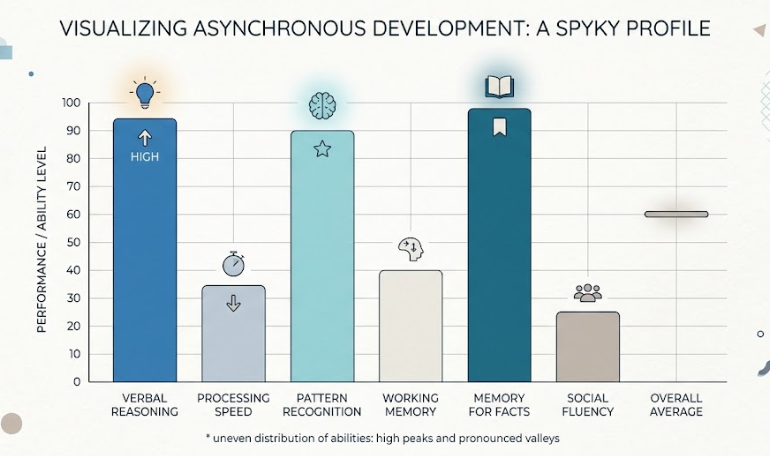
The hallmark of the 2e autistic profile is profound asynchronous development — a deeply uneven pattern of strengths and challenges that can be difficult to reconcile from the outside.
- A 2e autistic child might:
- Read chapter books fluently at age four but be unable to tolerate the texture of most foods or the noise level of a typical classroom
- Demonstrate encyclopedic knowledge of a narrow topic — paleontology, train systems, mathematics, astronomy — while struggling to follow three-step verbal instructions
- Score in the 99th percentile on a nonverbal reasoning test and simultaneously need significant support for emotional regulation and transitions
- Produce sophisticated, complex ideas in writing but have profound difficulty with handwriting mechanics or typing speed
- Navigate adult-level intellectual conversations but be unable to interpret facial expressions or manage the social dynamics of a peer group
This unevenness is diagnostically and educationally confusing. Teachers see a child who clearly understands difficult concepts and assume the behavioral or social difficulties must be willful, manipulative, or the result of laziness. Or they see the autism-related challenges and assume the child cannot handle advanced academic content. Both conclusions are wrong — and both lead to inadequate support.
The concept of hyperfixation — the intense, sustained focus on specific topics or systems — is particularly relevant here. For 2e autistic children, hyperfixation and autism describes a pattern that is simultaneously a cognitive strength (depth of knowledge, sustained attention, intrinsic motivation) and a feature that needs careful channeling in educational settings.
Why 2e Autism Gets Missed — and Why It Matters
The bidirectional masking of 2e is the central reason this profile goes unidentified for so long — often for years, sometimes for decades.
Intelligence masks autism: A child with a 150 IQ learns quickly to observe what neurotypical peers do socially and imitate it. They learn to suppress stimming in public, to make scripted small talk, to produce the appearance of social competency through pattern recognition and imitation rather than through natural social intuition. The autism is present — it takes enormous cognitive and emotional energy to maintain this masking — but it is not visible enough to trigger a referral. As explored in research on are people with autism smart, cognitive ability and autism are not mutually exclusive, but the combination creates identification challenges that the standard referral pipeline was not designed to catch.
Autism masks giftedness: An autistic child who has meltdowns, struggles with transitions, cannot tolerate the sensory environment of a standard classroom, and has significant executive functioning challenges does not look gifted to most educators. The giftedness is invisible behind the behavioral profile. These children are referred for behavioral intervention and emotional support — both of which they genuinely need — without anyone identifying that they are also operating at an exceptional intellectual level that demands appropriately challenging academic content.
The consequence: 2e autistic children frequently receive support for their challenges without enrichment for their abilities, or enrichment for their abilities without support for their challenges. Neither approach produces the outcomes this population is capable of achieving.
What Is the IQ of a 2e Child?
Most educational frameworks that use the twice-exceptional designation define giftedness as intellectual ability at or above the 98th percentile, which corresponds to an IQ score of approximately 130 or above on standardized assessments like the WISC-V (Wechsler Intelligence Scale for Children).
Some programs apply a broader gifted definition using the 90th or 95th percentile — corresponding to IQ scores of approximately 120–125. The threshold varies by school district, state guidelines, and program philosophy.
For autistic children specifically, standard IQ scoring carries an important caveat.
The most widely used IQ tests produce a Full Scale IQ (FSIQ) — a composite score that blends several cognitive domains including verbal comprehension, visual-spatial reasoning, fluid reasoning, working memory, and processing speed. Autistic individuals frequently show significant processing speed deficits and working memory challenges — not because their underlying intellectual capacity is limited, but because of motor coordination, anxiety, and executive functioning differences that slow performance on timed tasks.
When processing speed and working memory are disproportionately low compared to verbal and nonverbal reasoning, the FSIQ artificially suppresses the overall score and may produce a number that is not representative of the child’s actual intellectual potential.
Clinicians who assess autistic children are increasingly using the General Ability Index (GAI) — a composite of verbal comprehension and visual-spatial/fluid reasoning scores that excludes working memory and processing speed. A child with a FSIQ of 115 (not technically gifted) may have a GAI of 135 (clearly gifted), and the GAI is the more accurate indicator of intellectual potential for that child.
This is why 2e identification requires evaluators who understand both giftedness and autism — and why a standard school psychologist assessment, conducted under standard conditions, often fails to identify the gifted profile in an autistic child.
What Does 2e ADHD Mean?
2e ADHD follows the same definitional framework: a child or individual who is both intellectually gifted and has ADHD. It is the most common twice-exceptional combination — more common even than 2e autism — because ADHD affects executive functioning in ways that directly conflict with academic performance, making the combination of high ability and significant challenge particularly visible.
Many 2e autistic children also have co-occurring ADHD — making them triply exceptional in a sense, though that term is rarely used clinically. The combination of autism, ADHD, and giftedness produces a particularly complex profile:
- Gifted verbal abilities and sophisticated reasoning
- ADHD-driven difficulties with sustained attention, task initiation, and organization
- Autism-driven differences in social communication, sensory processing, and need for routine
- Executive dysfunction that cuts across both autism and ADHD, often more severe in combination than either alone
For families navigating a child with all three of these profiles simultaneously, the key clinical implication is that each exceptionality requires its own targeted support — and that generic approaches designed for neurotypical students, or even for autism-only or ADHD-only profiles, are unlikely to be sufficient.
How Do You Know If Your Child Is 2e?
There is no single test or checklist that produces a 2e identification. It is a clinical picture assembled from multiple data points, typically requiring a comprehensive neuropsychological evaluation. The following patterns, however, are reliable signals that a 2e evaluation is warranted:
Academic inconsistency that doesn’t make sense: A child who performs at an exceptionally high level in some subjects and significantly struggles in others — not due to interest or effort, but due to what appears to be genuine inability in the struggle areas — is showing the asynchronous profile that characterizes 2e.
Advanced language or reasoning alongside significant behavioral or emotional challenges: If a child is engaging in adult-level intellectual discussions at home but cannot manage a school day without significant distress, that gap warrants investigation.
Boredom-driven behavioral challenges: Some 2e autistic children are misidentified as having behavioral disorders because they become severely dysregulated in settings where they are academically under-challenged. The behavior is real; the cause is misidentified.
Autism diagnosis without acknowledgment of exceptional abilities: If your child has an autism diagnosis and teachers describe them as “bright” or “clearly smart” in certain areas, but the educational plan focuses exclusively on deficits, the gifted profile may not have been formally assessed.
Sensory, social, or behavioral challenges that don’t match intellectual profile: When a child’s emotional and behavioral maturity is significantly below their intellectual maturity — a pattern sometimes described as the 2e “uneven development” profile — this mismatch is a key indicator.
A formal neuropsychological evaluation with an evaluator experienced in both giftedness and autism is the definitive step. A standard school psychologist assessment is typically insufficient to identify the full 2e profile.
Famous People Who Are 2e
While retrospective diagnosis is always speculative — and many historical attributions are based on limited biographical evidence — several individuals are widely cited in discussions of twice-exceptional profiles:
Albert Einstein — struggled significantly in formal school settings, reportedly did not speak until age two or three, and showed several characteristics now associated with autism. His mathematical and theoretical reasoning abilities were extraordinary by any measure.
Alan Turing — the mathematician and computer science pioneer displayed many characteristics consistent with autism, including social difficulties, highly literal thinking, and intense focus on systematic problems. His intellectual contributions changed the course of history.
Temple Grandin — autistic and holds a PhD in animal science, is a successful author, public speaker, and inventor of livestock handling systems. One of the most prominent examples of an explicitly identified 2e autistic person in contemporary life.
Nikola Tesla — described social isolation, sensory sensitivities, and intensely focused intellectual preoccupations consistent with autism, alongside one of the most extraordinary engineering intellects of the 19th and 20th centuries.
Elon Musk — has publicly disclosed his Asperger’s diagnosis while building multiple companies valued in the hundreds of billions. Represents a contemporary, self-identified example of a 2e autistic adult profile.
It is worth emphasizing: the value of naming 2e individuals is not to romanticize autism or suggest that giftedness compensates for challenges. It is to illustrate that the autism-giftedness combination is real, historically significant, and worthy of the educational and clinical investment it requires.
Common Misconceptions About 2e Autism
“If they’re so smart, they don’t need extra support.” Intelligence does not negate the challenges of autism. A 2e autistic child with an IQ of 145 still experiences sensory overwhelm, social communication differences, executive dysfunction, and emotional regulation difficulties. The gifted profile changes the educational approach needed — it does not eliminate the support needs.
“If they need so much support, they can’t really be gifted.” The inverse error is equally common. Behavioral and functional challenges do not cap intellectual potential. Many 2e autistic children are placed in remedial or behavioral tracks because their challenges are more visible than their abilities, and their intellectual potential is never formally assessed or appropriately challenged.
“2e autism and Level 2 autism are the same thing.” They are completely different frameworks. 2e refers to twice-exceptional — a combination of giftedness and exceptionality. Level 2 autism is a DSM-5 severity designation indicating that an autistic individual requires substantial support in daily functioning. A 2e autistic child could be any DSM-5 level. A Level 2 autistic child is not necessarily 2e. This confusion is extremely common because of the overlapping terminology.
“2e children will figure it out on their own — their intelligence will compensate.” Intelligence is a resource, not a solution. Without explicit teaching of social skills, emotional regulation strategies, and executive functioning tools, 2e autistic children often hit significant walls in adolescence and adulthood when the complexity of social and academic demands outpaces the compensatory strategies their intelligence allowed them to develop informally. Early, targeted support produces far better outcomes than a wait-and-see approach.
Supporting a 2e Autistic Child: Where to Start
The core principle for supporting 2e autistic children is simultaneous enrichment and accommodation — not one or the other.
Enrichment means providing academic content at the child’s actual intellectual level, not their grade level or behavioral profile. Acceleration, subject-matter mentorship, project-based learning aligned with their intense interests, and access to intellectual peers are all part of this.
Accommodation means providing the sensory, social, executive functioning, and behavioral supports the child needs to access that enrichment without being constantly overwhelmed. Social skills training for autism, ABA-informed behavioral support, OT for sensory regulation, and explicit executive functioning instruction are all tools in this toolkit.
ABA therapy, specifically, is often underutilized for 2e autistic children because families and educators assume that high intelligence makes behavioral intervention unnecessary. In practice, ABA-informed support for 2e children focuses heavily on regulation, flexibility, social navigation, and managing the asynchronous development profile — areas where intellectual ability offers no automatic advantage.
Families in Northern Virginia exploring these services can connect with the team at Dream Bigger ABA in Vienna, VA and ABA therapy in Gainesville, VA to discuss how ABA support is tailored for complex profiles like 2e autism.

Conclusion
2e autism describes one of the most complex and most underserved profiles in both educational and clinical settings — children whose extraordinary intellectual abilities and genuine autism-related challenges exist simultaneously, each making the other harder to see and harder to address.
These children are not well served by approaches built entirely around their challenges, nor by approaches built entirely around their abilities. They need both — simultaneously, and from providers who understand how the two exceptionalities interact.
The practical path forward for families navigating a 2e autism profile is a comprehensive neuropsychological evaluation, an educational plan that addresses enrichment and accommodation in equal measure, and clinical support — including ABA therapy where indicated — that is calibrated to the full complexity of the child’s profile rather than a single dimension of it.
Dream Bigger ABA works with autistic children of all profiles and support levels across Northern Virginia, including those with complex dual-exceptionality presentations. Our individualized approach is designed to meet each child where they are — and build toward what they are capable of. Connect with our team to learn more about services in Vienna, VA and Gainesville, VA.
Frequently Asked Questions
How do you know if your kid is 2e?
The clearest signal is a significant, persistent mismatch between what a child clearly understands or can do intellectually and what their behavioral, emotional, or functional profile allows them to demonstrate or access. If your child reads years above grade level but cannot tolerate a standard classroom; produces extraordinarily sophisticated ideas but struggles to produce written work; demonstrates expertise in narrow domains while being unable to manage transitions or peer relationships — these patterns warrant a formal neuropsychological evaluation. The evaluation should be conducted by a clinician experienced with both giftedness and autism, and should include not just the FSIQ but domain-specific index scores like the GAI. School-based assessments alone are rarely sufficient to identify the full 2e profile.
What is the IQ of a 2e child?
Most twice-exceptional frameworks define giftedness as an IQ of 130 or above — the 98th percentile. Some programs use broader definitions beginning at IQ 120–125. For autistic children specifically, the Full Scale IQ can significantly underestimate true intellectual potential due to processing speed and working memory deficits that lower composite scores without reflecting actual reasoning ability. Clinicians experienced with autism are more likely to use the General Ability Index (GAI), which excludes those domains and better captures fluid and verbal reasoning ability. A child with a FSIQ of 118 and a GAI of 132 is functionally gifted in intellectual reasoning capacity — and deserves to be identified and supported as such.
What does 2e ADHD mean?
2e ADHD describes a child or individual who is both intellectually gifted and has attention-deficit/hyperactivity disorder. It is the most common twice-exceptional combination. The profile typically includes advanced intellectual ability in reasoning, vocabulary, or creative thinking alongside significant challenges in sustained attention, task initiation, impulsivity, and organization. Many 2e autistic children also have co-occurring ADHD — producing a complex triple profile where autism, ADHD, and giftedness all interact. Each condition in this combination requires its own targeted support strategy. ADHD interventions alone are insufficient for the autism component; autism interventions alone don’t fully address the ADHD component; and neither addresses the gifted profile, which requires enrichment and intellectual challenge rather than remediation.
What famous people are 2e?
Several historically and contemporarily prominent individuals are widely cited as likely or self-identified 2e, including those with autism or autism-spectrum traits alongside exceptional intellectual ability: Albert Einstein (learning differences and extraordinary theoretical reasoning), Alan Turing (social and sensory differences alongside landmark contributions to mathematics and computer science), Nikola Tesla (intense sensory sensitivities and focused intellectual preoccupations with extraordinary engineering ability), Temple Grandin (autistic, PhD, and internationally recognized expert in animal behavior and livestock systems), and Elon Musk (self-disclosed Asperger’s diagnosis alongside extraordinary entrepreneurial and engineering output). Retrospective attributions should be held loosely — but the pattern across history is clear: autism and exceptional intellectual ability co-occur with meaningful frequency.
How serious is Level 2 autism?It is important to clarify that Level 2 autism and 2e autism are completely different things — though they are frequently confused because of overlapping terminology. Level 2 is a DSM-5 severity designation — it means an autistic individual requires substantial support in both social communication and restricted/repetitive behaviors. This sits between Level 1 (requires support) and Level 3 (requires very substantial support). Level 2 autistic individuals often have functional language but use it in limited or unusual ways, struggle significantly with social interaction even when supported, and show inflexibility that substantially interferes with daily functioning. The level designation describes current support needs — not permanent capacity. Many Level 2 autistic individuals, with appropriate early intervention and consistent support, develop greater independence and functional ability over time. Level describes where a person is at a point in time, not where they can go with the right help. For more on how the diagnostic criteria map to real-world presentations, see the DSM-5 criteria for autism.