
TL;DR — Key Takeaways
- The vast majority of autistic people have no distinctive physical appearance — autism is a neurological condition, not one defined by visible physical features
- Some research has identified subtle facial differences at a population level in autistic groups, but these are statistically derived averages — not features visible in or identifiable in individual people
- What observers sometimes notice are differences in eye gaze, facial expression, posture, and movement — behavioral and motor characteristics, not structural physical ones
- “Autism ears” is not a medical term — it most commonly refers to auditory hypersensitivity, not any physical feature of the ear
- Many autistic people are told “you don’t look autistic” — a phrase that reflects a misunderstanding of what autism is, not an accurate observation about appearance
The Direct Answer: No — Not in Any Meaningful or Reliable Way
Autism does not have a face.
It does not produce a recognizable physical type. It does not cause distinctive facial features, body proportions, or physical characteristics that allow someone to be identified as autistic by looking at them. If you believe you can tell whether someone is autistic by looking at them, you cannot — and the confidence behind that belief is more likely to reflect stereotypes than perceptual accuracy.
This matters because “you don’t look autistic” has become one of the most commonly reported dismissive responses autistic people receive when they disclose their diagnosis. The implicit claim — that autism is visible, and that a person who does not fit the imagined visual profile cannot truly be autistic — has caused real harm. It has led to delayed diagnoses, denied accommodations, and autistic people being pressured to prove their own neurology to skeptics.
The question “do people with autism look different” deserves a thorough, honest answer — not because the answer is complicated, but because getting it right changes how we think about who autism affects and how we treat the people it affects.
What Autism Actually Looks Like — and What It Doesn’t
Autism is defined by two behavioral domains under the DSM-5: differences in social communication and interaction, and restricted, repetitive patterns of behavior and sensory processing. Neither of these domains is about physical appearance.
What observers sometimes interpret as “looking autistic” is not physical — it is behavioral and neurological:
- Eye contact patterns that differ from neurotypical expectations — less frequent, differently timed, or differently directed. This is a difference in social engagement, not facial structure. For a deeper look at how this works neurologically, autism eye gaze covers the research on where autistic individuals look and why.
- Facial expression timing and frequency — autistic individuals may express emotions with different latency, different intensity, or in ways that do not match what the listener expects. This is a difference in social communication output, not in the physical capacity for expression.
- Motor differences — differences in gait, posture, coordination, or fine motor movement are more common in autism than in the general population. These are real and sometimes visible — but they are motor, not physical structural differences.
- Stimming behaviors — self-stimulatory movements like hand-flapping, rocking, finger-flicking, or body rocking may be visible in some autistic individuals. These are regulatory behaviors, not physical features.
- Social positioning — reduced engagement in the typical social rituals of posture, gesture, and spatial orientation that neurotypical people unconsciously perform in conversation.
None of these constitute a distinctive physical appearance. They are behavioral patterns that vary enormously across the autism spectrum — many autistic people, particularly those who have learned to mask, display none of them visibly in everyday social interactions.
What the Research Actually Shows About Autism and Facial Features
There is a small body of research examining whether autistic individuals, as a group, have measurably different facial features from neurotypical controls. The findings are worth addressing directly — because they are real, but they are also systematically misunderstood.
Several studies using 3D facial scanning technology have found statistically significant differences in facial measurements between groups of autistic and neurotypical individuals — differences in the spacing between certain facial landmarks, the shape of the philtrum, or the proportion of certain facial regions.
What this does and does not mean:
What it means: At a population level, when hundreds of 3D scans are averaged and compared statistically, group differences emerge. This is scientifically interesting and may eventually contribute to understanding of how autism-associated genetic variants influence early facial development.
What it does not mean: These differences are not visible to the human eye. They are not distinctive features that would allow a person — or even a trained clinician — to look at an individual and correctly identify them as autistic. The effect sizes in these studies are small. The overlap between the autistic and neurotypical distributions is enormous. No clinician anywhere uses facial appearance as a diagnostic indicator for autism, because it has no diagnostic validity at the individual level.
The confusion arises when population-level statistical findings are translated into claims about individual identifiability. Those two things are not the same.
The Role of Co-Occurring Genetic Conditions
Where physical appearance differences DO exist in association with autism, they almost always come from co-occurring genetic conditions — not from autism itself.
Fragile X syndrome, which is associated with autism in approximately 1–3% of autistic individuals, does produce recognizable physical features: a long face, large ears, prominent jaw, and flexible joints, among others. Down syndrome, tuberous sclerosis, Angelman syndrome, and other genetic conditions that frequently co-occur with autism each have their own physical presentations.
When people believe they can “see” autism in a person’s face, they are often recognizing features of one of these co-occurring genetic conditions — not autism per se. Autism and the associated syndrome are distinct; the physical features belong to the syndrome, not to autism.
Most autistic people do not have any of these co-occurring genetic conditions. They have autism — a neurological difference with no externally visible physical marker.
What Are “Autism Ears”?
“Autism ears” is not a clinical or medical term. It circulates primarily in parent communities and online forums, and it is used to describe a few different phenomena — some meaningful, some not.
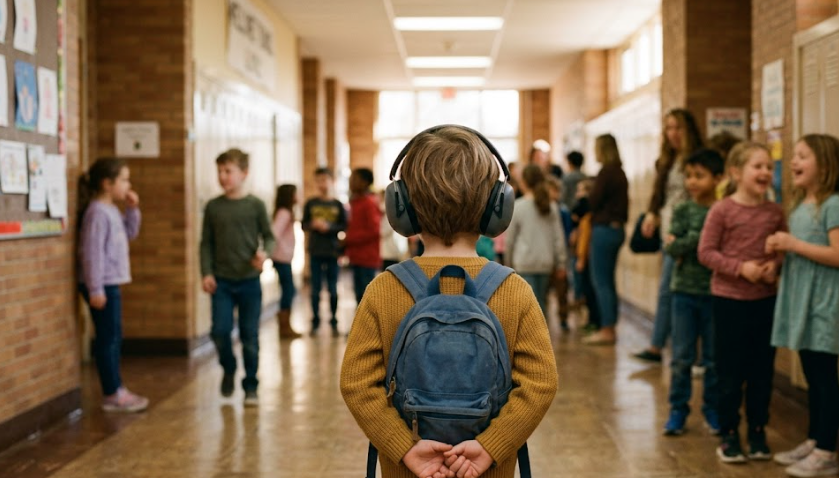
The most common use — auditory hypersensitivity: Many autistic individuals experience sounds as significantly louder, more intrusive, or more painful than neurotypical people do. A sound that registers as background noise to most people — a fluorescent light buzzing, a distant lawnmower, multiple conversations overlapping in a cafeteria — can be genuinely overwhelming to an autistic person with auditory hypersensitivity. This is a sensory processing difference, not a structural feature of the ear. The ears themselves are typically anatomically normal; the difference is in how the auditory cortex processes incoming sound, often with reduced habituation (the brain does not “tune out” sounds the way neurotypical brains do).
The less common use — ear-covering behavior: Some autistic individuals cover their ears in response to overwhelming auditory input. This visible behavior is sometimes colloquially called “autism ears” to describe the behavioral pattern. It is a coping response to sensory overload.
The rarest use — physical ear features: Some specific genetic syndromes associated with autism include ear anomalies — low-set ears or minor ear malformations — as physical features. These are features of the genetic syndrome, not of autism itself, and they affect a small minority of autistic individuals.
For most autistic people, “autism ears” means a nervous system that is highly sensitive to sound — not any visible difference in ear structure or appearance.
The Masking Factor: Why Autistic People “Don’t Look Autistic”
One of the central reasons autistic people are told “you don’t look autistic” — especially women, girls, and high-IQ individuals — is masking: the practice of consciously or unconsciously suppressing, camouflaging, or compensating for autistic differences in order to appear neurotypical in social settings.
Masking can include making deliberate eye contact even when it is uncomfortable, scripting conversations in advance, suppressing stimming behaviors in public, mirroring others’ facial expressions, and memorizing social scripts that allow an autistic person to navigate situations that would otherwise be deeply confusing.
Masking is not the absence of autism. It is autism plus an enormous cognitive and emotional load directed at appearing neurotypical. The autistic person who “doesn’t look autistic” is often exhausted in ways their observer cannot see. The autism stereotypes that shape what people expect autism to look like are built around the most visible, least-masked presentations — which is exactly why so many autistic people go undiagnosed for years or decades.
Masking is more common and more studied in autistic women and girls, which partially explains the significant diagnostic gap: autistic females are diagnosed later, at lower rates, and often with a longer history of mental health struggles attributable to the strain of sustained masking without support.
The phrase “you don’t look autistic” is not a compliment. It is a statement that the speaker’s internal picture of autism does not include this person — and that picture is almost certainly a stereotype.
How to Tell If You Might Be Autistic
If you are asking “how can I tell if I’m autistic,” you are in increasingly large company. Late diagnosis — in adolescence, adulthood, and even middle age — has become far more common as understanding of autism’s diverse presentations has grown.
Common experiences reported by adults who pursue and receive late autism diagnoses include:
- A persistent sense of being “different” from peers without being able to explain why
- Significant difficulty navigating social situations that seem effortless for others
- Exhaustion after social interactions that others describe as energizing
- A long history of intense, focused interests that are more consuming than typical hobbies
- Sensory sensitivities that have been present since childhood — to sounds, textures, lights, or smells
- Difficulty with transitions, unexpected changes, or open-ended situations
- A tendency toward very literal interpretation of language
- A history of depression, anxiety, or burnout that has been difficult to treat with standard approaches
- Being told, repeatedly throughout life, that you are “too sensitive,” “too intense,” “socially awkward,” or “hard to read”
These experiences are not a diagnosis — they are signals worth taking seriously. The formal diagnostic pathway involves a comprehensive clinical evaluation with a psychologist or psychiatrist experienced in autism assessment. For an overview of what the diagnostic criteria actually require, DSM-5 criteria for autism provides a clear starting point. Exploring what is mild autism can also help individuals understand how autism presents in adults who have spent years developing compensatory strategies.

Common Misconceptions About Autism and Appearance
“I can tell just by looking.” You cannot — and the research supports this directly. Neither trained clinicians nor untrained observers can identify autism from photographs or brief visual observation with any meaningful reliability. Studies that have tested this find performance close to chance.
“Autistic people always avoid eye contact.” Eye contact patterns in autism are variable and contextual. Some autistic people avoid it consistently; others make deliberate eye contact that they have learned is socially expected but find uncomfortable; others have no significant eye contact differences. Eye contact alone is not a diagnostic indicator and is not visible as a physical difference.
“If they can make eye contact, they’re not really autistic.” The capacity to make eye contact — even comfortable eye contact — does not preclude an autism diagnosis. The DSM-5 criteria describe differences in how eye contact functions socially and communicatively, not its categorical absence.
“Children with autism look different than adults with autism.” Autism has no physical developmental trajectory that changes appearance over time. Children do not “look autistic” and then stop looking autistic as adults. What changes with development is the behavioral profile — skills, strategies, and masking capacity — not any physical characteristic.
“Autism is obvious.” For a subset of autistic individuals — particularly those with Level 3 support needs, significant intellectual disability, or pronounced motor differences — autism-related behaviors may be highly visible. For the majority of autistic people, including those across all three support levels, the condition is not visible in the way many people assume.
Conclusion
People with autism do not look different — not in any meaningful, reliable, or diagnostically relevant way. Autism is a neurological profile, not a physical type. The features that sometimes make autistic people visible to observers are behavioral and motor — differences in eye gaze, facial expression timing, movement, and social patterning — not structural physical characteristics.
The belief that autism has a recognizable face has caused real harm: dismissed diagnoses, denied accommodations, and autistic people pressured to perform neurotypicality to be taken seriously. Understanding what autism actually is — and is not — visible in is foundational to treating autistic people with the accuracy and respect they deserve.
For families who have recently received an autism diagnosis — or adults who are wondering about their own neurology — the most important step is connecting with clinicians who understand autism across its full range of presentations, not just its most stereotyped ones.
Dream Bigger ABA works with autistic children and their families across Northern Virginia, delivering individualized ABA therapy that starts with who each child actually is — not a stereotype of what autism is supposed to look like. Connect with our team to learn about services in Vienna, VA and Gainesville, VA.
Frequently Asked Questions
Can you tell if someone looks autistic?
No — not reliably, and not in any scientifically defensible way. Autism is a neurological difference, not a physical one. There are no distinctive facial features, body proportions, or structural characteristics that identify someone as autistic on sight. Some research has found subtle, statistically measurable facial differences in autistic groups compared to neurotypical controls — but these are population-level averages, not individual identifiers. No clinician uses appearance to diagnose autism. People who believe they can tell “just by looking” are typically pattern-matching against stereotypes of autism, which are built around the most visible and least masked presentations — missing the majority of the autistic population entirely. Additionally, some genetic syndromes that co-occur with autism do have physical features; those features belong to the syndrome, not to autism itself.
What is the life expectancy of a person with high-functioning autism?
Research consistently finds that autistic individuals have shorter average life expectancy than the general population — and for those with high-functioning autism (Level 1 ASD, formerly Asperger’s syndrome, without co-occurring intellectual disability), the gap is smaller than for those with higher support needs but still present. Published estimates suggest individuals with Asperger’s-profile autism have a median age of death roughly 10–16 years earlier than the general population. Unlike the profound autism profile — where the primary drivers of reduced life expectancy are epilepsy and medical comorbidities — for high-functioning autistic adults, the primary contributors are elevated rates of depression, anxiety, eating disorders, and suicide risk. The life expectancy gap in this group is largely a mental health crisis, not a medical one. With appropriate mental health support, crisis intervention access, and strong social connection, the gap is likely reducible. These findings underscore why mental health support is not optional for autistic adults — it is clinically urgent.
How can I tell if I’m autistic?
If you are asking this question as an adult, the most reliable answer comes from a formal evaluation by a psychologist or psychiatrist with expertise in autism assessment — ideally one experienced with adults and with late diagnosis. Common experiences that prompt adults to seek evaluation include a lifelong sense of social difference that cannot be explained, significant sensory sensitivities, exhaustion after social interaction, intense and narrow interests, difficulty with open-ended or ambiguous situations, and a history of mental health challenges that have not responded well to standard treatment. Online screening tools — like the Autism Spectrum Quotient (AQ) or the Ritvo Autism Asperger Diagnostic Scale (RAADS-R) — can be useful starting points for self-reflection but are not diagnostic. A formal evaluation is the only pathway to an accurate diagnosis, which is worth pursuing because it opens access to appropriate support, accommodations, and self-understanding.
Can someone be autistic and look normal?
Yes — and this describes the majority of autistic people. Autism does not produce a distinctive physical appearance. Most autistic people, when observed casually, do not appear different from their neurotypical peers in any physically obvious way. What may be different — and what trained observers might notice in certain contexts — are behavioral patterns: eye contact differences, facial expression timing, movement characteristics, or social positioning. Many autistic people also mask extensively, consciously suppressing the behavioral differences that might otherwise be visible. The phrase “you don’t look autistic” — which many autistic people report hearing after disclosing their diagnosis — reflects a stereotype about what autism looks like, not an accurate assessment of the individual. Autism is a neurological difference. Neurology is not visible.
What are autism ears?
“Autism ears” is not an official medical or clinical term, but it is commonly used in two ways. Most frequently, it refers to auditory hypersensitivity — the experience of sound as disproportionately loud, intrusive, or painful due to differences in how the autistic brain processes sensory input. Many autistic individuals find sounds that most people filter out — fluorescent lighting hum, overlapping conversations, distant machinery — to be intensely distracting or genuinely distressing. This is a sensory processing difference, not a structural difference in the ear itself. Less commonly, “autism ears” is used to describe the ear-covering behavior seen in autistic individuals responding to auditory overwhelm. In a small subset of autistic individuals with co-occurring genetic syndromes, minor physical ear anomalies may be present — but these are features of the underlying syndrome, not of autism. For the vast majority of autistic people, the ears are anatomically typical; what differs is how the auditory cortex processes and responds to incoming sound.