Key Takeaways
- The United States currently reports among the highest autism rates globally — 1 in 31 children as of the most recent CDC surveillance data — but this reflects world-class diagnostic infrastructure as much as true biological prevalence
- Countries with the highest reported autism rates are almost always countries with the most developed screening programs, highest diagnostic awareness, and least stigma — not countries where autism is biologically more common
- The WHO estimates approximately 1 in 100 children worldwide have autism — a global average that masks enormous variation driven largely by access to diagnosis, not actual prevalence
- Qatar’s reported autism rates reflect its advanced healthcare investment and specific demographic factors — not a uniquely higher biological rate
- The most important global pattern: autism is everywhere, across every culture, ethnicity, and geography — and reported rates are rising almost exclusively in countries that are improving their capacity to find it
Which Country Has the Highest Reported Rate of Autism?
The short answer is the United States — but that answer requires significant context to be meaningful.
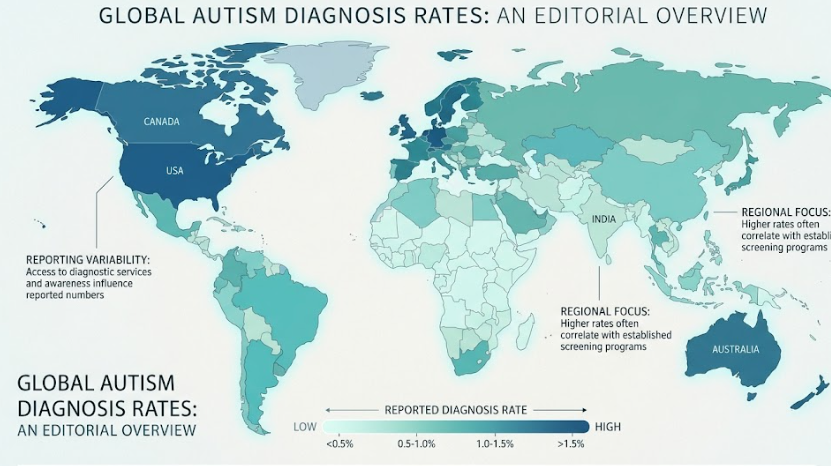
The CDC’s most recent surveillance data, published in 2024 and based on 2022 monitoring through its Autism and Developmental Disabilities Monitoring (ADDM) Network, found that 1 in 31 children aged 8 in the United States have autism spectrum disorder. That figure — approximately 3.2% of children — is among the highest formally documented autism prevalence rates anywhere in the world.
Other countries with high reported rates include:
- South Korea: A landmark 2011 study by researchers at Yonsei University used community screening — assessing the general school population rather than only clinically referred children — and found a prevalence of approximately 1 in 38 children (2.6%). This study was notable precisely because it captured autism in children who had never been clinically identified, dramatically raising estimates compared to studies relying only on clinic populations.
- United Kingdom: Estimated at approximately 1 in 57 (around 1.8%), based on a combination of clinical data and survey-based studies.
- Qatar: Reports rates in some studies approaching 1 in 66 or higher, driven by factors explored later in this article.
- Scandinavian countries (Denmark, Sweden, Norway): Consistently among the higher reporting countries in Europe, due partly to population registry data that captures more individuals than referral-based systems.
The WHO’s global estimate of 1 in 100 children worldwide having autism reflects the reality that most of the world lacks the screening infrastructure, diagnostic awareness, and clinical capacity to find autism at anything approaching the US rate — not that autism is biologically less common in those places.
Why Reported Rates Don’t Equal Actual Prevalence
The most important thing to understand about international autism data is the difference between reported prevalence and true prevalence.
Reported prevalence is how many people in a given population have been identified and diagnosed. True prevalence is how many actually have autism, regardless of whether anyone has identified it.
These two numbers diverge enormously across countries — and the gap is driven almost entirely by factors that have nothing to do with biology:
Diagnostic infrastructure: Autism can only be diagnosed when clinicians trained to recognize it are available and accessible. Countries with well-funded pediatric healthcare systems, trained developmental specialists, and systematic developmental screening produce far higher reported rates than countries without these resources.
Diagnostic criteria and awareness: The expansion of autism’s diagnostic criteria — particularly with the DSM-III in 1980, DSM-IV in 1994, and DSM-5 in 2013 — has been adopted and implemented at different rates in different countries. Countries using older or narrower diagnostic frameworks will report lower rates.
Stigma and help-seeking behavior: In many cultures, autism-related behaviors are attributed to spiritual causes, character flaws, poor parenting, or simply “the way this child is” — and families do not pursue or receive a medical diagnosis. This suppresses reported rates dramatically without reflecting lower true rates.
Language and framing: The concept of autism does not translate identically across all languages and cultural frameworks. Some countries have developed culturally adapted screening approaches; others apply direct translations of Western instruments that may not capture autism presentations accurately in different cultural contexts.
The practical implication: a country with a very low reported autism rate is far more likely to lack diagnostic capacity than to have less autism. As why autism rates are increasing explores in depth, rising rates globally track almost precisely with improved screening and awareness — not with any biological epidemic.
Why Is Autism More Common in America?
The United States reports higher autism rates than almost any other country — but the reasons are almost entirely structural, not biological.
The diagnostic criteria evolved here first and most aggressively. The DSM — the American diagnostic standard — underwent the most significant expansions of the autism definition in 1994 and 2013. American clinicians adopted these expanded criteria quickly and systematically, capturing far more individuals who would not have qualified under older, narrower definitions.
The CDC runs the world’s most rigorous autism surveillance system. The ADDM Network actively monitors autism prevalence across a representative sample of US states using multiple data sources — school records, medical records, and developmental evaluations. This surveillance methodology is uniquely comprehensive and consistently identifies autism that other countries’ passive reporting systems would miss.
Awareness is exceptionally high. Decades of public health campaigns, media coverage, advocacy, and educational programs have made American parents and pediatricians among the most autism-aware in the world. Developmental concerns are more likely to be recognized, more likely to be reported to a clinician, and more likely to result in evaluation.
Diagnostic substitution has occurred at scale. Children who a generation ago would have been labeled with intellectual disability, language disorder, or simply “difficult to teach” are now correctly identified as autistic. This substitution inflates autism rates while deflating rates of adjacent diagnoses.
There may be a modest true prevalence component. Factors like increasing average parental age, certain prenatal exposures, and changes in the neonatal survival rate for very preterm infants — who have elevated autism risk — may contribute a real biological component to increasing US rates. But this component is dwarfed by the diagnostic and surveillance factors above.
America does not necessarily have more autism than other countries. It has better infrastructure for finding it — and a longer history of looking.
Why Does Qatar Have High Autism Rates?
Qatar’s comparatively high autism prevalence reports — relative to other countries in the Middle East and Gulf region — have attracted research attention and are worth addressing directly. Several intersecting factors explain the pattern:
Qatar has invested substantially in healthcare infrastructure. The country’s National Autism Center, established in 2004, has driven significant improvements in diagnostic capacity, clinician training, and public awareness. Better screening finds more autism — this is the same pattern seen in every country that improves its diagnostic systems.
Qatar’s expatriate population is large and demographically distinctive. Approximately 85–90% of Qatar’s population consists of expatriates — predominantly from South Asia, Southeast Asia, the Philippines, and Western countries. This population skews toward educated, health-conscious individuals who are more likely to seek diagnosis and more likely to have access to healthcare systems where autism is recognized.
Consanguinity patterns in some communities. Among the native Qatari population, rates of consanguineous marriage (marriage between relatives, typically first or second cousins) have historically been higher than in many Western countries. Consanguinity increases the probability that both parents carry recessive genetic variants — and some autism-associated genetic variants may be expressed at higher rates in populations with elevated consanguinity. Research on autism prevalence in Gulf populations has examined this factor, though it is one contributor among many rather than a primary explanation.
Qatar’s affluence enables diagnosis access. The country’s wealth means that families have the financial resources to pursue specialist evaluations that are cost-prohibitive in many other countries.

What Do Global Autism Rates Actually Tell Us?
The cross-country autism data reveals something important that is often missed in the “which country has the most autism” framing: the pattern of who finds autism tells us more about diagnostic systems than about biology.
Countries at the top of autism prevalence tables — the US, South Korea, the UK, Scandinavian nations — share several characteristics: advanced healthcare systems, strong developmental screening programs, high public awareness, relatively low stigma around mental health diagnoses, and robust research infrastructure that actively looks for autism.
Countries with very low reported rates — across much of sub-Saharan Africa, South Asia, and parts of Latin America and Southeast Asia — share different characteristics: limited diagnostic infrastructure, low clinician training in autism recognition, significant stigma around developmental differences, and limited access to specialist evaluation even for families who seek it.
This pattern is consistent with a conclusion that research supports strongly: autism occurs across all human populations at broadly similar biological rates. The DSM-5 criteria for autism describe neurodevelopmental differences rooted in genetics — and human genetics does not vary dramatically enough between populations to explain a ten-fold difference in autism rates across countries. What varies dramatically is the capacity and willingness to find and name autism when it exists.
Common Misconceptions About Global Autism Rates
“Countries with lower autism rates must be doing something right.” Lower reported rates almost universally reflect lower diagnostic capacity, higher stigma, and less screening infrastructure — not better prevention, healthier lifestyles, or superior parenting. A child in a country with a 0.1% reported autism rate is not ten times less likely to be autistic than an American child. They are far less likely to be identified and supported.
“The US rate is high because of something uniquely American.” The US rate is high because American surveillance is uniquely rigorous. The most meaningful contributor to the US’s position near the top of global autism rates is the CDC ADDM Network’s methodology — not diet, lifestyle, vaccination practices, or any other environmental factor unique to American life.
“Autism is a Western concept that doesn’t apply in other cultures.” Autism’s core features — differences in social communication, restricted and repetitive behaviors, sensory processing differences — have been documented in every culture and country where systematic research has been conducted. The concept is not Western. The diagnostic terminology and assessment infrastructure originated in Western medicine, which has influenced how and where autism is named — but the underlying condition is universal.
“High autism rates mean a country has an autism crisis.” High reported rates primarily reflect good identification systems. The crisis is not in the rates — it is in the gap between identified need and available support in every country, including those with high reported rates. Finding autism is the first step toward supporting autistic people; it is not, itself, the problem.

What Does God Say About Autism?
This question appears in enough parent searches that it deserves a genuine, respectful answer — not dismissal.
Parents who search this question are often in one of the most emotionally raw periods of their lives — recently navigating a diagnosis, struggling to make sense of their child’s experience, and reaching toward the framework that has always given their life meaning. That impulse is entirely human and deserves a thoughtful response.
The Bible, the Quran, the Torah, and other foundational religious texts do not mention autism by name — autism was not clinically recognized or named until the 20th century. But every major religious tradition speaks to questions that autism raises: the value of each human life, the meaning of difference, the nature of suffering, and the obligations of community toward its most vulnerable members.
Across Christianity, Islam, Judaism, Hinduism, Buddhism, and many indigenous traditions, the consistent thread is the inherent dignity and sacred worth of every human being — without exception, without condition, without prerequisite of neurological conformity. The premise that a child’s value is diminished by how their brain is wired is not found in the theological mainstream of any major tradition.
Many religious communities — including Catholic, Protestant, Jewish, and Muslim communities — have developed specific ministries, theological frameworks, and practical resources for autistic individuals and their families. Disability theology — a growing field of religious scholarship — has produced serious work on how faith communities can honor, include, and support people with neurodevelopmental differences. Many families find their faith not in tension with an autism diagnosis but as a foundation for navigating it.
What religious parents frequently arrive at, across traditions, is something like this: their child — exactly as they are, neurologically, behaviorally, and relationally — is loved completely and known fully by God. That framing does not minimize the real challenges of autism. It refuses to define a person by those challenges.

Conclusion
No country has “more autism” in any biologically meaningful sense. What countries have, in different measures, is different capacity and willingness to find it. The global pattern of autism prevalence is almost perfectly predicted by a country’s investment in diagnostic infrastructure, the breadth of its diagnostic criteria, and the degree to which stigma suppresses help-seeking behavior.
The United States sits near the top of global autism rates not because American children are uniquely vulnerable — but because American surveillance is uniquely comprehensive. Every country that improves its screening capacity sees its autism rates rise toward the rates already seen in the most diagnostically advanced nations. That pattern is one of the clearest signals that autism is universal, that it is distributed across all human populations, and that the variation we observe across countries is a variation in detection rather than in reality.
For families anywhere navigating an autism diagnosis — whatever brought them to search this question — the most important takeaway is this: your child’s neurology is not unique to your country, your culture, or your circumstances. Autism is a human phenomenon. And the support that makes the most meaningful difference — early, evidence-based, individualized intervention — is available.
Dream Bigger ABA provides individualized ABA therapy for autistic children and their families across Northern Virginia — regardless of background, country of origin, or how the diagnosis was received. Connect with our team to explore services in Vienna, VA and Gainesville, VA.
Frequently Asked Questions
What countries have the highest autism rates?
The countries with the highest reported autism rates include the United States (approximately 1 in 31 children, per 2024 CDC data), South Korea (1 in 38 in a landmark 2011 population-wide study), Hong Kong, Australia, and several Scandinavian countries including Denmark and Sweden. These countries share a common characteristic: strong diagnostic infrastructure, high awareness, and relatively low stigma — not a uniquely higher biological autism rate. The WHO estimates global autism prevalence at approximately 1 in 100 children, reflecting how profoundly underidentified autism remains in most of the world. Countries with very low reported rates — in parts of Africa, South Asia, and Southeast Asia — are almost certainly not reflecting true lower prevalence but rather inadequate screening, stigma, and limited access to specialist diagnosis.
Why does Qatar have high autism?
Qatar’s comparatively high reported autism rates — particularly relative to neighboring countries in the Gulf region — reflect several intersecting factors. Qatar has invested substantially in healthcare infrastructure, including a National Autism Center that has significantly expanded diagnostic capacity and clinician training since 2004. Its large expatriate population — educated, health-conscious, and accustomed to healthcare systems where autism is recognized — is more likely to seek and receive diagnosis. Additionally, some research has examined the role of consanguinity (marriage between relatives) in Gulf populations, which can increase the expression of recessive genetic variants including some associated with autism risk. These factors combine to produce higher ascertainment — more autism found — rather than necessarily reflecting a higher biological rate than other countries with equivalent infrastructure.
Why is autism more common in America?
The United States reports among the highest autism rates globally primarily because of three factors unrelated to biology: the world’s most rigorous autism surveillance infrastructure (the CDC’s ADDM Network, which actively monitors prevalence rather than passively counting diagnoses); the early and comprehensive adoption of expanded diagnostic criteria that brought far more individuals into the autism category; and decades of public awareness efforts that make American parents and pediatricians among the most likely globally to recognize and pursue evaluation for autism-related differences. A genuine but smaller contribution may come from demographic factors like increasing average parental age. America does not necessarily have more autism than other countries — it has better infrastructure for identifying it, and a longer history of looking systematically.
What billionaire has autism?
Elon Musk is the most publicly known billionaire to have disclosed an autism diagnosis — specifically Asperger’s syndrome, which he announced on Saturday Night Live in May 2021. Asperger’s syndrome was previously used as a diagnostic label for autistic individuals without significant language or intellectual delays; it was unified under the broader autism spectrum disorder (ASD) diagnosis in the DSM-5 in 2013. Musk’s disclosure was significant partly because of its casualness — he mentioned it matter-of-factly as part of who he is, rather than as a confession or explanation. Other highly accomplished individuals who have publicly identified as autistic include Temple Grandin (professor, author, livestock industry innovator), who is among the most recognized autistic public figures globally. The pattern of autistic individuals among the highly accomplished reflects something research supports: the same neurological differences that create autism-related challenges can also produce extraordinary depth of focus, systematic thinking, and pattern recognition.
What does God say about autism?
Religious texts do not address autism directly — the condition was not clinically recognized or named until the 20th century. But every major religious tradition speaks to the questions autism raises for families: the value of every human life, the meaning of difference and difficulty, and the obligations of communities toward people who need support. Across Christianity, Islam, Judaism, Hinduism, Buddhism, and most indigenous spiritual traditions, the consistent theological theme is the inherent and unconditional worth of every human being — a worth that does not depend on neurological conformity or communicative ability. Most mainstream religious scholarship and pastoral care firmly rejects the idea that autism is a divine punishment, a spiritual failing, or a diminishment of a person’s worth before God. Many families across religious traditions find that their faith does not conflict with an autism diagnosis — it provides the foundation from which to navigate it, advocate for their child, and find meaning in the experience. Disability theology is a growing field of serious religious scholarship addressing precisely these questions for families who want to explore their faith tradition’s resources on neurodevelopmental difference.