
Key Takeaways
- Early walking is not a recognized early sign or red flag for autism — it does not appear in the autism diagnostic criteria or in clinical screening guidelines
- Motor development in autism is variable and complex — some autistic children walk early, many walk on time, and some walk later than average; timing of walking onset alone is not diagnostically meaningful
- The motor behavior most reliably associated with autism is toe-walking (persistent walking on the balls of the feet), not early onset of independent walking
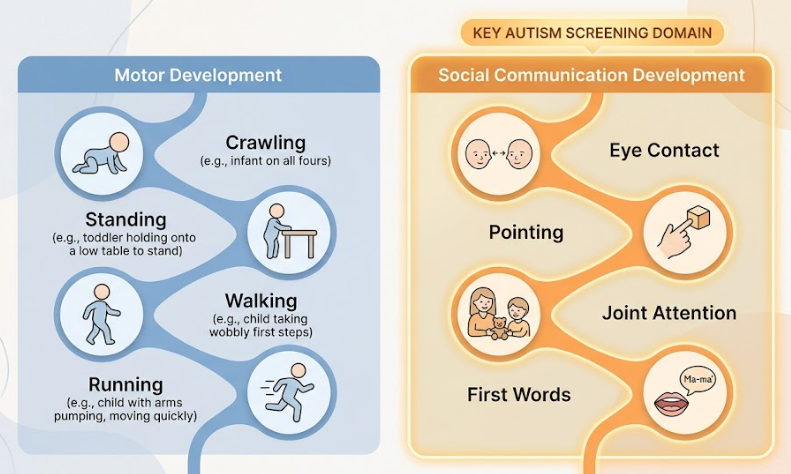
- What actually matters for early autism detection is social communication development: joint attention, response to name, social smiling, and language emergence — not motor milestones
- An uneven developmental profile — where a child is advanced in one domain and delayed in another — is more relevant to autism evaluation than any single advanced milestone in isolation
The Direct Answer: Early Walking Is Not a Recognized Sign of Autism
If your baby walked at 9 or 10 months and you are wondering whether this is connected to autism — the answer is no. Early independent walking does not appear on any autism screening tool, in any diagnostic criteria, or in any clinical guideline as a warning sign for autism spectrum disorder.
This is not because motor development is irrelevant to autism. It is because the motor features associated with autism are primarily about quality and pattern of movement — not whether a child took their first independent steps at 10 months versus 13 months.
The question parents are really asking when they search this — often prompted by a passing comment, a parenting forum thread, or a vague memory of reading something about autism and development — is whether their advanced baby might be showing a hidden sign of autism. The reassuring answer is that early walking is not that sign.
Understanding what autism’s relationship with motor development actually looks like — and what the early signs that do matter actually are — gives parents genuinely useful information for their child’s developmental monitoring.
Motor Development in Autism: A Complex and Variable Picture
The autism research literature on motor development is more nuanced than popular understanding suggests. Motor differences in autism are real and well-documented — but they are not about walking early.
Typical motor development timeline: Independent walking typically emerges between 9 and 18 months, with the average around 12 months. Walking before 9 months is unusual; walking after 18 months without explanation warrants evaluation. Early walking — before 10 months — is uncommon in any population, autistic or neurotypical.
What the research actually finds about walking in autism: Studies examining the motor development of autistic children find a heterogeneous picture. Some autistic children do reach walking milestones within the typical range or even early. Others walk later than average. No consistent directional pattern of early-versus-late walking distinguishes autistic from neurotypical children as a group.
What is more consistently documented is this: the quality of motor development in autism often differs from neurotypical patterns, even when the timing is within the normal range. This includes:
- Differences in gait mechanics — how the child walks, not when
- Higher rates of motor coordination difficulties and co-occurring Developmental Coordination Disorder (DCD)
- More frequent hypotonia (low muscle tone) affecting posture, stamina, and fine motor development
- Different patterns of motor learning and imitation of motor sequences
For an exploration of how joint hypermobility — often associated with low muscle tone — intersects with autism, hypermobility and autism covers the connective tissue and motor development connection that researchers have begun to examine more carefully.
The Motor Feature That IS Associated With Autism: Toe-Walking
If parents are looking for a motor behavior that has genuine research support as being more common in autism, toe-walking — walking persistently on the balls of the feet rather than heel-to-toe — is it.
Toe-walking is observed in a significant proportion of autistic children. Studies estimate that persistent toe-walking occurs in approximately 20–30% of autistic children, compared to approximately 5% in the general pediatric population. This elevated rate makes toe-walking clinically meaningful as a potential indicator warranting further evaluation — though toe-walking also occurs in many children without autism and has multiple non-autism causes.
Why do some autistic children toe-walk?
The mechanisms are not fully established but include:
- Sensory processing differences — for children with tactile hypersensitivity, the sensation of the full heel contacting the ground may be uncomfortable or overwhelming. Walking on the balls of the feet reduces the sensory surface area in contact with the floor.
- Proprioceptive seeking — toe-walking provides intense proprioceptive input through the calf muscles and Achilles tendon. For children seeking proprioceptive feedback, toe-walking may serve a self-regulatory function.
- Motor pattern preference — some autistic children develop toe-walking as a habitual motor pattern without a clear sensory driver.
- Muscle tone differences — hypotonia affecting the ankle and lower leg can influence the natural mechanics of walking.
Important context: Idiopathic toe-walking — toe-walking without a clear cause — is common in toddlers generally and typically resolves by age 3. Toe-walking that persists beyond age 3, or that is accompanied by other developmental concerns, warrants evaluation by a pediatrician and possibly a physical therapist and developmental specialist.
Toe-walking is also associated with Achilles tendon tightness in some children, cerebral palsy, and other conditions — making it a non-specific finding that requires clinical contextualization rather than an automatic autism indicator.
What the Earliest Signs of Autism Actually Are
If early walking is not a relevant early sign of autism, what should parents actually watch for? The earliest reliable indicators of autism are social-communicative in nature — not motor.
By 2–3 months: Research using prospective sibling studies — following babies born to autistic individuals who are at elevated genetic risk — has found that autistic infants can show subtle differences in social responsiveness even in the first months of life. Reduced frequency of social smiling specifically in response to another person’s face (as opposed to non-social visual stimuli) has been observed. This is extremely subtle and not detectable through routine observation by most parents or clinicians.
By 6–9 months:
- Reduced frequency of looking at faces and following faces with gaze
- Limited social babbling directed at caregivers
- Reduced response to their own name being called
- Limited reaching toward caregivers to be picked up
- Reduced sharing of emotional expressions reciprocally
The autism eye gaze research documents how differences in where autistic individuals look — and what draws their visual attention — can be measurable even in the first year of life, reflecting different social processing priorities in the developing autistic brain.
By 12–15 months:
- Absence of declarative pointing — pointing to show things of interest (not just to request), which is the most reliable early behavioral marker
- Not following a caregiver’s pointing gesture — when a parent points at something across the room, a neurotypical 12-month-old looks at what they are pointing toward; reduced or absent following of pointing is a key red flag
- Limited joint attention — not coordinating attention between a person and an object to share an experience
- Inconsistent or limited response to name
- No babbling with communicative intent
By 18–24 months:
- No single words by 16 months
- No two-word spontaneous phrases by 24 months
- Any loss of previously acquired language or social skills at any age
Walking — early, late, or on time — does not appear on this list. The developmental monitoring that matters for early autism identification is focused on the social communication system, not the motor system.
The Uneven Development Profile: Why Some Autistic Children Seem Advanced in Some Areas
One piece of context that may explain why some parents connect early walking to autism is the well-documented pattern of asynchronous development in autism — where a child is strikingly advanced in one developmental domain while simultaneously delayed or different in another.
An autistic child who walks at 9 months, develops a sophisticated understanding of how machines work at 18 months, and memorizes the entire alphabet by age 2 — while simultaneously showing limited pointing, reduced response to their name, and minimal social babbling — is showing a classic uneven profile. The motor precocity and the specific cognitive precocity are real. They are not what drives autism evaluation.
What drives evaluation is the social communication picture — the limited pointing, the reduced name response, the absent declarative gaze sharing. Those features, evaluated against the DSM-5 criteria for autism, are what produce a diagnosis. The early walking is a data point about one developmental domain; it does not interpret the rest of the profile.
This is why no single milestone — early or late — is diagnostically meaningful in isolation. Autism evaluation requires looking at the full developmental picture, weighted toward the social communication domains that autism specifically affects.
Common Misconceptions About Early Walking and Autism
“I read that autistic babies walk early because they’re precocious.” Motor precocity is not a defining feature of autism in the research literature. While some autistic children may walk early, this is not a typical finding and is not part of any clinical screening or diagnostic framework. The overlap between some autistic individuals’ narrow-domain advanced abilities and motor timing is not well-established.
“My child walked at 9 months — I should have them screened for autism.” Early walking alone is not an indication for autism screening. The standard autism screening recommendation is for all children at 18 and 24 months regardless of motor development, and for children of any age when parents or clinicians have specific social communication concerns. A 9-month-old walking is showing robust motor development — not an autism flag.
“If my child walked early but has other delays, does that mean autism?” An uneven developmental profile — where one domain is advanced and another is delayed — is clinically relevant and worth discussing with a developmental pediatrician. But the conversation is driven by the domain that concerns you (language delay, social communication differences, sensory behaviors) — not by the early walking itself.
“Toe-walking and early walking are the same kind of red flag.” They are not. Early walking (timing of milestone) is not associated with autism. Toe-walking (persistent pattern of walking on the balls of the feet after age 3) is associated with autism at elevated rates. These are different observations requiring different clinical interpretation.
“Motor development doesn’t tell us anything about autism.” This overcorrects. Motor development in autism is genuinely interesting and clinically relevant — particularly gait differences, hypotonia, coordination challenges, and toe-walking. What it does not tell us about is timing of walking onset. The how of motor development in autism matters more than the when.

What to Watch for Instead: A Practical Early Monitoring Framework
For parents with a young child — particularly those with autism in the family — here is a practical developmental monitoring framework focused on what actually matters for early autism identification.
Month 2–3: Watch for: social smiling in response to your smile (not just random smiling). A baby who does not smile back when you smile warmly at them by 2–3 months is showing something worth tracking.
Month 4–6: Watch for: consistent eye contact during feeding and play, interest in faces over objects, reciprocal cooing and babbling with turn-taking quality.
Month 9–10: Watch for: following your pointing gesture when you point across the room, beginning to point themselves (index finger extending toward things of interest), imitating simple sounds and gestures.
Month 12: Watch for: response to their name at least 50% of the time in quiet conditions, use of gestures including waving and reaching, showing you things they find interesting.
Month 15–18: Watch for: consistent declarative pointing (pointing to share, not just to request), at least a few clear words used communicatively, reciprocal back-and-forth interaction including social games.
At any age: Watch for: loss of previously acquired language, social behaviors, or play skills. Any regression — losing words, losing the habit of making eye contact, losing social responsiveness — warrants immediate evaluation rather than waiting to see if it resolves. Skill regression in autism explains why regression is always taken seriously rather than attributed to a developmental phase.

Conclusion
Early walking is not a sign of autism. It is a motor milestone whose timing, within the typical 9–18 month range and even somewhat before it, tells clinicians very little about the social-communicative developmental picture that autism actually affects.
The features that matter for early autism identification — joint attention, declarative pointing, response to name, reciprocal social smiling, language emergence, and the absence of developmental regression — are all in the social communication domain, not the motor domain. The motor feature most associated with autism is not early walking onset but persistent toe-walking, alongside gait differences and coordination challenges that reflect how autistic individuals move through the world rather than when they first began to do so.
Parents who notice early motor development in their child can set aside the autism concern that may have brought them to this article. The monitoring that matters is social and communicative — and building that developmental picture, from the earliest months forward, is where the clinical attention belongs.
Dream Bigger ABA supports autistic children and their families across Northern Virginia with individualized, evidence-based ABA therapy — delivered from a foundation of accurate understanding of autism’s actual early signs, clinical features, and developmental trajectory. Connect with our team to explore services in Vienna, VA and Burke, VA.
Frequently Asked Questions
What is the biggest red flag for autism?
The most clinically predictive single early red flag for autism is the consistent absence of declarative joint attention by 12–14 months — specifically, a child who does not point with an extended index finger to share interest in something (not just to request it), does not follow when a caregiver points across the room, and does not alternate their gaze between a person and an object to check for shared attention. Joint attention is the neurological foundation of social communication and language development. Its consistent absence in the first 12–18 months is the most reliable early behavioral marker of autism identified in prospective developmental research. Other major red flags include no babbling with communicative intent by 12 months, no single words by 16 months, no spontaneous two-word phrases by 24 months, inconsistent or absent response to their own name despite normal hearing, and any loss of previously acquired language or social skills at any age. Early walking is not on this list.
Do autistic kids start walking early?
Some autistic children do walk early — before 10–11 months — but this is not the typical or characteristic pattern, and it is not a reliable indicator of autism in either direction. Motor development timing in autism is heterogeneous: some autistic children walk early, the majority walk within the typical 9–18 month range, and some walk later than average. No consistent directional finding distinguishes autistic children as a group from neurotypical children on timing of walking onset. What is more consistently documented in autism is that the quality and pattern of motor movement may differ — including a higher rate of persistent toe-walking, gait differences detected in biomechanical analysis, more frequent co-occurring motor coordination challenges, and hypotonia affecting posture and stamina. If early walking is accompanied by social communication concerns — limited pointing, reduced response to name, limited social smiling — those concerns warrant developmental evaluation regardless of the motor timeline.
What is one of the earliest signs of autism?
One of the earliest observable signs of autism — detectable in the first year of life in prospective high-risk studies — is reduced social smiling in response to another person’s smile. While all babies smile, autistic infants may smile less frequently and less consistently in direct response to a caregiver’s social overture, even in the first 2–3 months of life. This is subtle enough that most parents and clinicians will not identify it in routine observation. More reliably detectable at 6–9 months is reduced interest in faces and reduced visual attention to eyes during social interaction, alongside limited social babbling directed at caregivers. By 9–12 months, reduced or absent response to name, limited pointing, and limited joint attention emerge as the most clinically actionable early signs. These are all social-communicative features — not motor features. Early walking is not among the earliest signs of autism.
What is the 6-second rule in autism?
The 6-second rule is a practical communication accommodation used by teachers, therapists, and parents of autistic individuals. It means deliberately waiting at least six full seconds after giving a direction, asking a question, or making a communicative prompt — before repeating, adding language, or assuming the autistic person did not hear or understand. Many autistic individuals process incoming spoken language more slowly than neurotypical expectation — not because of inattention or non-compliance, but because auditory processing differences mean the brain requires more time to fully receive, decode, and translate speech into a planned response. When an adult speaks and then immediately repeats or layers on additional instruction within two or three seconds, they interrupt language that is still being actively processed, commonly producing confusion, shutdown, or apparent non-responsiveness. Implementing consistent six-second wait time — counting silently rather than filling the pause — is one of the most simple, no-cost, and reliably effective communication accommodations reported by families and educators across age groups and ability levels.
What billionaire has autism?
Elon Musk is the most widely known billionaire to have publicly disclosed an autism-related diagnosis, announcing on Saturday Night Live in May 2021 that he has Asperger’s syndrome — the former diagnostic label for autistic individuals without language or intellectual delays, unified under the broader autism spectrum disorder diagnosis in the DSM-5 in 2013. His disclosure was notable for its casual, matter-of-fact presentation — he mentioned it as part of who he is rather than as a limitation requiring explanation or apology. Among other accomplished individuals who have publicly identified as autistic, Temple Grandin — professor, author, and livestock industry innovator — remains one of the most recognized autistic public figures globally, having built an extraordinary career in a specialized domain that drew directly on characteristic autistic cognitive strengths. The breadth of professions and achievement levels represented among publicly identified autistic individuals reflects something the research consistently supports: autism does not set a ceiling on accomplishment. What changes outcomes is access to appropriate support and environments suited to individual neurological strengths.