Floortime therapy for autism is a relationship-based, child-led intervention that uses play as the primary vehicle for building the emotional connection, communication, and social-cognitive development that form the foundation of everything else an autistic child learns. It is grounded in the understanding that genuine developmental progress in autism begins not with behavioral compliance but with authentic relational engagement, and that the path to that engagement runs directly through the child’s own interests, sensory preferences, and natural play tendencies.
The principles behind floortime therapy for autism were developed by child psychiatrist Dr. Stanley Greenspan and his colleague Serena Wieder, who observed that the most meaningful developmental progress in autistic children happened not through structured drills but through warm, responsive, emotionally attuned interaction that met the child exactly where they were and built from there. Decades later, the approach remains one of the most discussed and most family-friendly options in the autism intervention landscape.
What Floortime Actually Is

Floortime, formally known as the DIR/Floortime model where DIR stands for Developmental, Individual Difference, and Relationship-based, is both a theoretical framework for understanding child development and a practical set of techniques for building that development through relationship-centered play interaction.
The developmental component of DIR recognizes that healthy social and emotional development progresses through a specific sequence of functional emotional developmental capacities, from the earliest shared attention and engagement through increasingly complex capacities for two-way communication, shared problem-solving, symbolic thinking, and logical emotional understanding. The framework uses these developmental capacities as the map for assessing where an autistic child currently is developmentally and what the next appropriate challenge level looks like, rather than using chronological age as the primary reference.
The individual difference component recognizes that every autistic child has a unique sensory and motor processing profile that shapes how they experience and respond to the world, and that effective intervention must be tailored to that specific profile rather than applied generically. A child who is sensory-seeking and highly active requires a very different floortime interaction style than a child who is sensory-avoidant and easily overwhelmed, even though both children may be at a similar developmental level on the emotional milestones that floortime targets.
The relationship component is the heart of the model. Floortime is built on the premise that the quality of the emotional connection between the child and the adults in their life is not a pleasant bonus to developmental intervention but its primary engine. Without the safety, warmth, and genuine mutual engagement of a real relationship, the developmental capacities floortime aims to build cannot be effectively established.
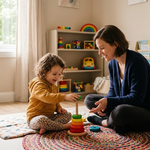
In practical terms, floortime involves an adult getting down to the child’s physical level, literally on the floor, entering the child’s activity and interest rather than redirecting them to the adult’s agenda, and using warm, animated, emotionally attuned interaction to build the circles of communication that Greenspan identified as the core unit of social-emotional development. A circle of communication is a complete back-and-forth exchange, an opening from the child and a response from the adult that the child then responds to in turn, and building more of these circles in longer and longer chains is the measurable moment-to-moment work of floortime.
At ABA therapy in Centreville, VA, relationship-based principles inform the overall approach to working with autistic children, because the research on what drives genuine developmental progress in autism consistently points to the quality of relational engagement as a foundational variable that no skill-based intervention can be fully effective without.
The Six Developmental Milestones Floortime Targets
The DIR framework identifies six core functional emotional developmental capacities that floortime intervention works to build in sequence, each representing a genuine developmental achievement that supports everything that comes after it.
Self-regulation and shared attention, the first milestone, is the foundation of all subsequent development. It involves the child’s ability to regulate their sensory and emotional state well enough to be present and attentive in interaction with another person. A child who cannot achieve shared attention because they are overwhelmed by sensory input or emotionally dysregulated cannot learn from social interaction, which is why floortime begins here rather than with more complex social goals.
Engagement and relating, the second milestone, involves the child developing genuine emotional investment in the adults around them, showing pleasure in social interaction, seeking out connection, and demonstrating that relationships with specific people are meaningful and motivating. This is the emotional attachment foundation that all social and communicative development builds upon.
Two-way intentional communication, the third milestone, involves the child engaging in purposeful back-and-forth exchanges with another person, using gestures, vocalizations, facial expressions, or actions to open and close communication circles. This milestone is pre-verbal and pre-symbolic but represents a profound developmental achievement in intentional communication.
Complex communication and shared problem-solving, the fourth milestone, involves the child stringing multiple communication circles together in purposeful sequences to achieve shared goals, negotiate, and solve problems in interaction with another person.
Symbolic and creative thinking, the fifth milestone, involves the emergence of the symbolic capacity that underlies pretend play, language, and all higher-order cognitive development, as the child begins to use one thing to represent another.
Logical and abstract thinking, the sixth milestone, involves the child developing the capacity to connect ideas logically, understand causal relationships, and engage in the kind of abstract reasoning that supports academic learning and complex social understanding.
For families wanting to understand how these developmental capacities connect to the specific communication patterns they observe in their autistic child, reading about autism echolalia and autism scripting provides important context for how language development in autism connects to these broader developmental milestones.
Things to Know About Floortime Therapy for Autism
Before comparing floortime to other approaches and exploring what it looks like across different ages and presentations, these foundational points build a more accurate picture of what floortime actually is and what it realistically offers:
- Floortime is not unstructured free play. The adult’s role involves active, intentional therapeutic work that requires training and skill to execute well, even though it looks like play from the outside.
- Following the child’s lead in floortime does not mean passively watching whatever the child does. It means entering the child’s world, building on their interest, and using that shared engagement as the context for developmental challenge.
- Floortime can be used alongside other interventions including ABA therapy and speech therapy rather than as an alternative that excludes other approaches.
- The intensity of formal floortime sessions is typically supplemented by parents implementing floortime principles throughout daily caregiving routines, which is where much of its developmental impact accumulates.
- Progress in floortime is measured in developmental milestones and the quality of relational engagement rather than in discrete skill counts, which produces a different kind of evidence for progress than some other approaches.
- Floortime is applicable across the autism spectrum, including with minimally verbal children and children with significant sensory and motor differences, because it begins from wherever the child currently is developmentally rather than requiring prerequisite skills.
How Floortime Differs from Directive Approaches

The most meaningful distinction between floortime and more directive therapeutic approaches in autism lies in who sets the agenda for the interaction and what the primary target of intervention is considered to be.
In directive approaches, the adult identifies specific skills to be built and creates structured learning opportunities designed to teach those skills through repeated practice with clear prompting and reinforcement systems. The adult leads, the child responds, and the measure of progress is the child’s performance on the targeted skills within and across sessions.
In floortime, the child’s own interests, activities, and emotional engagement are the starting point, and the adult’s role is to enter that world and use the emotional connection created through genuine shared interest as the engine for developmental challenge. The adult follows before they lead, and the measure of progress is the quality and complexity of the developmental capacities being built through the relational interaction.
These are not simply different techniques for achieving the same goals. They reflect genuinely different theoretical understandings of what drives developmental progress in autism. Directive approaches prioritize skill acquisition through structured learning. Floortime prioritizes the development of the foundational social-emotional capacities that, in the DIR framework, are understood as the prerequisites for all other learning rather than as targets to be built in parallel with other skills.
In practice, many clinicians and families find that the most effective approach combines elements of both frameworks, using floortime principles to build the relational engagement and emotional connection that makes structured learning possible, while using structured approaches to build specific skills that genuine daily functioning requires. The tension between these approaches in the autism intervention field is real but is often better understood as a question of sequence and emphasis than of mutual exclusion.
Understanding how ABA and floortime relate to each other specifically is addressed in the FAQ section below, but the broader context of how different autism interventions compare and complement each other is worth exploring through the overview of speech therapy for autism and occupational therapy for autism as the most commonly combined intervention partners for both approaches.
Floortime in Practice Across Age Groups
The principles of floortime remain consistent across the lifespan, but how they are applied in practice changes significantly as the child develops and as the specific developmental challenges of different life stages come into focus.
With toddlers and young children, floortime focuses primarily on the earliest developmental capacities, building shared attention, emotional engagement, and the first intentional back-and-forth communication circles. Sessions often look like an animated adult enthusiastically joining whatever the child is doing, commenting on it, adding to it, and using playful obstruction and challenge to create the need for the child to communicate more intentionally. A child who is spinning a toy being gently engaged by an adult who starts spinning their own toy and looks at the child with an expression of shared delight is being offered an invitation to connection that builds the emotional engagement milestone from within the child’s own chosen activity.
With preschool and school-age children, floortime shifts toward building the higher developmental milestones, complex communication, shared problem-solving, and symbolic play. Sessions at this stage often involve elaborate pretend play scenarios that the child authors and the adult supports and extends, using the narrative of the play to build perspective-taking, emotional understanding, and logical thinking within a context the child finds genuinely engaging.
With older children and adolescents, floortime principles translate into interest-based conversation and activity rather than floor-based play, but the core elements remain: entering the person’s world with genuine curiosity, building on their interests, and using the emotional connection of shared engagement as the context for developmental challenge at the edge of their current capacities.
Floortime and Parent Involvement
One of the most distinctive and practically significant features of floortime as an intervention model is the central role it assigns to parents and caregivers rather than limiting intervention to formal therapy sessions with a clinician.
Because floortime’s primary mechanism is the quality of relational interaction rather than a specific clinician technique, parents who learn to apply floortime principles throughout their daily interactions with their child become powerful therapeutic agents in their own right. The cumulative hours of warm, responsive, developmentally attuned interaction that a parent implementing floortime principles can provide across a day far exceed anything a weekly or even daily therapy session can deliver, and this is precisely where much of the developmental impact of the model accumulates.
Parent coaching in floortime typically covers how to read the child’s current regulatory state and adjust the interaction accordingly, how to follow the child’s lead while still offering developmental challenge, how to use playful obstruction and gentle challenge to create communication opportunities within the child’s own activities, and how to build the emotional warmth and animation that make interactions genuinely engaging rather than technically correct but emotionally flat.
The parent coaching dimension also means that floortime intervention has a meaningful impact on the parent-child relationship itself, not just on the child’s developmental profile. Parents who learn to enter their child’s world with genuine curiosity and enjoyment often report significant shifts in their own experience of interacting with their autistic child, moving from anxiety about their child’s development to genuine pleasure in the relationship that both supports the child’s development and improves family quality of life.
At ABA therapy in Reston, VA, family coaching and parent involvement are built into the support framework for every autistic child, because the research consistently shows that the family’s capacity to implement developmentally supportive interaction across daily life is one of the strongest predictors of long-term outcomes.
Comparing Floortime to Other Autism Interventions
| Approach | Primary Focus | Who Leads | Best For |
| Floortime (DIR) | Emotional development and relational engagement | Child-led with adult following | Building foundational social-emotional capacities |
| ABA therapy | Skill acquisition and behavioral development | Adult-directed with structured reinforcement | Building specific functional skills and reducing barriers |
| Speech therapy | Communication and language development | Collaborative, adapted to child’s level | All communication goals across the spectrum |
| Occupational therapy | Sensory processing and daily living skills | Collaborative, child preferences respected | Sensory regulation, motor skills, daily independence |
| PEERS social skills | Pragmatic and social communication | Group-based structured instruction | Adolescent and adult social navigation |
| RDI | Relational development through guided participation | Adult guides, child responds | Building dynamic intelligence and relational flexibility |
What Progress in Floortime Looks Like
Progress in floortime therapy for autism is often less immediately visible than skill-based progress because it is happening at the level of developmental capacities and relational quality rather than discrete, countable behaviors. Families who know what to look for, however, find that floortime progress is both real and deeply meaningful.
Early progress signs include the child making more eye contact during shared play activities they genuinely enjoy, seeking out the adult to share an experience rather than playing in parallel, showing more emotional expressiveness in interaction, and tolerating the adult’s entry into their play without distress or withdrawal.
More established progress looks like the child initiating more back-and-forth exchanges, extending the length of communication circles before the interaction breaks down, showing genuine pleasure in relational interaction rather than just tolerating it, and beginning to use the adult as a partner in play and problem-solving rather than as an obstacle or a background presence.
The developmental milestones framework gives families and clinicians a map for understanding where progress is occurring and what the next developmental challenge level looks like, making it possible to track genuine developmental movement even when the outward changes are subtle in the early stages of intervention.
At ABA therapy in Annandale, VA, progress monitoring includes the quality of relational engagement and emotional developmental milestones alongside skill-based measures, because a comprehensive picture of an autistic child’s development requires both dimensions rather than just the behavioral metrics that are easiest to count.
For families managing the sensory dimensions of their child’s engagement capacity alongside floortime work, reading about autism sensory issues provides the essential context for understanding how sensory processing differences affect the first and most foundational floortime milestone, self-regulation and shared attention, and why sensory support and relational intervention need to work together.
Floortime Progress Across the Developmental Milestones
| Milestone | Early Signs of Progress | Established Progress |
| Self-regulation and shared attention | Tolerating adult presence during preferred activity | Sustaining calm, focused engagement in shared interaction |
| Engagement and relating | Brief moments of eye contact and shared delight | Actively seeking out specific adults for shared experience |
| Two-way intentional communication | Responding to adult’s communicative bids consistently | Initiating back-and-forth exchanges spontaneously |
| Complex communication and shared problem-solving | Stringing two to three communication circles together | Extended problem-solving exchanges with adult as partner |
| Symbolic and creative thinking | First pretend play acts, using objects symbolically | Elaborate pretend narratives with emotional themes |
| Logical and abstract thinking | Connecting ideas with simple causal language | Understanding others’ perspectives and motivations in play |
Frequently Asked Questions
Floortime therapy for autism generates important and specific questions for families choosing between approaches and wanting to understand what the evidence and clinical experience actually support. These answers address the most commonly asked ones directly.
Is floortime good for autism?
Yes, floortime is a well-established and evidence-supported approach for autism that is particularly effective for building the relational engagement, emotional connection, and early social-communicative foundations that underpin all further development.
The evidence base for floortime has grown substantially since Greenspan first described the DIR model, with studies documenting improvements in functional emotional developmental capacities, social communication, and parent-child interaction quality in autistic children receiving DIR/Floortime intervention. A landmark study by Greenspan and Wieder following 200 autistic children through DIR/Floortime intervention found that a significant proportion showed what they described as optimal outcomes, with meaningful improvements in social engagement, communication, and daily functioning. More recent randomized controlled studies have added to the evidence base, though the overall body of evidence is less extensive than for ABA therapy simply because floortime has been studied less systematically rather than because it is less effective. For autistic children whose primary developmental needs are in the relational and emotional domains, floortime is not just good but may be the most directly targeted approach available.
How do you help a 4 year old with autism?
Supporting a 4 year old with autism most effectively combines responsive, child-led play interaction at home with early intervention services including ABA therapy, speech therapy, and occupational therapy, all delivered in naturalistic contexts that match how young children learn best.
At four years old, the most important supports address the developmental domains where autistic children of this age most commonly need help: social-emotional engagement, communication development, sensory processing, and the daily living skills that support preschool participation. Floortime principles are particularly well-matched to this age because four-year-old children learn primarily through play and relationship, and the child-led naturalistic approach of floortime fits the developmental context of early childhood better than highly structured directive approaches. Alongside formal intervention, parents applying floortime principles throughout daily routines, following their child’s lead in play, responding to every communication attempt warmly and contingently, and building the shared attention and emotional engagement that are the foundations of later development, often produce more cumulative developmental impact than any formal therapy program alone. For a broader developmental framework for this age, reading about autism in infants and the autism milestone checklist provides helpful context for understanding where a four-year-old autistic child is developmentally and what the next milestones to support look like.
Which therapy is best for autism?
The best therapy for autism is an individualized combination that addresses the specific profile of the autistic individual, typically including ABA therapy for skill building, speech therapy for communication, and occupational therapy for sensory and daily living needs, with floortime principles woven through the relational dimension of all of them.
No single therapy is universally best for autism because the spectrum is too broad and individual profiles too varied for any one approach to address every autistic person’s needs optimally. The research most consistently supports early, intensive, naturalistic intervention that combines behavioral, communicative, and sensory-motor components as the most effective overall approach, particularly in early childhood. Within that framework, the specific balance between approaches should be determined by a comprehensive assessment of each child’s developmental profile and the goals that will make the most meaningful difference to their daily life and wellbeing. The quality of the therapeutic relationship, the extent to which each intervention is adapted to the individual’s sensory and communication profile, and the degree to which skills are generalized across real daily environments matter more than the specific theoretical allegiance of the program.
What is the difference between ABA and floortime?
ABA therapy uses structured learning principles with adult-directed teaching to build specific functional skills, while floortime is child-led and uses emotionally attuned play interaction to build foundational social-emotional and relational developmental capacities.
The distinction goes deeper than technique. ABA and floortime reflect genuinely different frameworks for understanding what drives development in autism. ABA is built on the science of learning and behavior, using antecedents, behaviors, and consequences to systematically build functional skills and reduce barriers to participation. Floortime is built on a developmental and relational framework, using the emotional connection of genuine play interaction to build the social-emotional foundations that DIR theory views as the prerequisites for all other learning. In practice, the best modern ABA therapy incorporates naturalistic and relationship-based elements that overlap significantly with floortime principles, and floortime programs often incorporate structured practice for specific skill goals. The dichotomy between them is less absolute in skilled clinical practice than in theoretical debate, and families do not need to choose between them as if selecting opposing philosophies when a thoughtful integration may serve their child better than either alone.
What are 5 interventions for autism?
The five most evidence-supported interventions for autism are ABA therapy, speech and language therapy, occupational therapy, social skills therapy, and floortime or other relationship-based developmental approaches, each targeting different but interconnected aspects of autistic development.
ABA therapy addresses skill acquisition, behavioral development, and functional independence through structured, data-driven learning approaches that have the most extensive evidence base of any autism intervention. Speech and language therapy builds communication across the full range from first intentional communication through complex social language, using approaches tailored to each individual’s communication profile and level. Occupational therapy addresses sensory processing differences, fine and gross motor development, and the daily living skills needed for independence across home, school, and community. Social skills therapy builds the pragmatic and social-communicative skills that affect peer relationships, school participation, and eventually workplace functioning through approaches including PEERS, social stories, video modeling, and naturalistic peer practice. Floortime and other relationship-based developmental approaches build the foundational social-emotional capacities that support all other development through warm, responsive, child-led interaction that prioritizes genuine relational engagement over skill compliance. When these five approaches are coordinated around a shared understanding of an individual child’s profile and goals, they address the full range of autism-related developmental needs more comprehensively than any single intervention can achieve alone.