Autism echolalia is the repetition of words, phrases, or sentences that an autistic person has heard from someone else, either immediately after hearing them or long after the original moment has passed. It is one of the most frequently observed communication patterns in autism and also one of the most commonly misunderstood by the adults responding to it.
Echolalia is not random noise or meaningless repetition. For most autistic individuals, it is a genuine and functional communication strategy rooted in how their brain processes, stores, and produces language. Understanding autism echolalia from that perspective changes everything about how it should be approached at home, in school, and in therapy.
What Is Autism Echolalia?

The word echolalia comes from the Greek word for echo, and that captures the basic mechanism accurately. An autistic person hears language, retains it, and reproduces it either in the moment or at a later time. What that simple description misses is the enormous range of purposes that reproduction can serve.
Echolalia exists on a spectrum of its own within autism. At one end sits immediate echolalia, where a person repeats what was just said to them, often within seconds. At the other end sits delayed echolalia, where language heard days, weeks, or even years ago resurfaces in a new context. Both forms carry meaning, though that meaning is not always obvious to people who are not familiar with the specific individual.
A child who responds to the question “do you want juice?” by repeating “do you want juice?” is not being obstinate or failing to understand. They may be using the echo as a processing tool while their language system works on producing a response. They may also be using repetition as an affirmative, having learned that repeating something functions as a yes in their communication history. Context and relationship knowledge are everything when it comes to reading echolalia accurately.
At ABA therapy in Centreville, VA, therapists assess the communicative function behind each child’s echolalic patterns before building any language support plan, because the right response depends entirely on what the behavior is actually doing for that child.
Immediate vs Delayed Echolalia
Understanding the two main forms of echolalia helps caregivers respond in ways that actually match what the autistic person needs in a given moment.
Immediate echolalia happens right after hearing language and serves several functions. It can be a processing strategy, buying time while the brain formulates a response. It can be an affirmative response, particularly in children who have not yet developed yes and no reliably. It can also reflect difficulty inhibiting the repetition of heard language, a neurological pattern rather than a communicative choice.
Delayed echolalia involves language that has been stored and is retrieved later. A child who repeats a phrase from a film when they are anxious is drawing on stored language that carries the emotional tone they need in that moment. A teenager who uses a line from a previous conversation with a trusted adult when navigating a new stressful situation is applying a language template that worked before to a situation that feels similar.
The connection between delayed echolalia and scripting is very close, and the two terms are sometimes used interchangeably. The core distinction is that delayed echolalia describes the mechanism, repeating past language, while scripting describes the deliberate use of that capacity as a communication and regulation tool. Reading more about autism scripting builds a fuller picture of how these two patterns connect and reinforce each other across the lifespan.
What Echolalia Is Actually Communicating

One of the most important shifts in how clinicians and families understand echolalia has been the recognition that there is almost always communicative intent behind it, even when that intent is not immediately legible. The phrase “gestalt language processing” describes the way many autistic individuals acquire and use language in whole chunks rather than building it word by word from individual units, and echolalia is a direct expression of that processing style.
When a child hears language in an emotionally significant moment, that whole phrase gets stored together with the emotion, the situation, and the meaning of that original context. Later, when a similar emotion or situation arises, the stored phrase comes back because the brain has tagged it as relevant. The child who repeats a line about adventure when they are excited, or a line about sadness when they are upset, is doing something linguistically sophisticated even if it does not look that way from the outside.
This matters practically because it means the most effective response to echolalia is engagement with the meaning rather than correction of the form. A caregiver who hears a script and responds to what it seems to be communicating, rather than prompting the child to say it differently, is treating the child as a communicator and building the kind of reciprocal exchange that supports language growth over time.
For families navigating early language development, exploring autism in infants provides useful context about how communication differences begin emerging in the earliest months and how early support shapes the trajectory significantly.
Things to Know About Autism Echolalia
Before looking at how echolalia develops and what helps, these foundational points shift how the behavior tends to be understood and responded to:
- Echolalia is a sign that the brain is processing and storing language, which is a strength to build on rather than a deficit to correct.
- Suppressing echolalia without offering alternative communication tools tends to increase anxiety and reduce overall communication.
- Many autistic people continue to use echolalia throughout their lives as one tool among many, and that is a completely functional outcome.
- The specific phrases a person echoes often reveal what media, relationships, and experiences matter most to them, which is valuable information for building connection.
- Echolalia frequency tends to increase under stress, fatigue, or sensory overload, making it a useful indicator of a child’s internal state.
- Responding to echolalia as if it communicates something real, because it usually does, is one of the most effective things a caregiver can do to support language development.
How Echolalia Develops Over Time
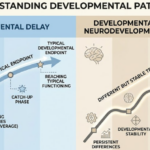
Echolalia typically follows a recognizable developmental pathway when it is supported thoughtfully rather than suppressed. Understanding that pathway helps families know what to look for and what to celebrate along the way.
In the earliest stages, echolalia is often direct and unmodified. A child repeats whole phrases exactly as they were heard, with the same intonation and rhythm as the original. This stage reflects the brain building a library of usable language chunks.
As language development progresses, modified echolalia begins to appear. The child starts adjusting stored phrases slightly to fit new situations, swapping out a word here or there, or combining elements from different scripts. This is a significant milestone that indicates movement toward generative language use.
Later still, many autistic individuals develop what speech pathologists call mitigated echolalia, where stored language is used as a flexible template rather than a fixed phrase. The echo becomes a scaffold for new language rather than a reproduction of old language, and at that point it begins to blend seamlessly into spontaneous speech.
This developmental arc is one reason why the goal of language support in autism should be expansion rather than elimination. The child who echoes today is building the language system that supports spontaneous communication tomorrow, provided the environment responds to them as a communicator throughout.
At ABA therapy in Reston, VA, therapists use naturalistic developmental approaches that work with a child’s current communication profile to support this progression in ways that respect how the autistic brain learns language most effectively.
Echolalia and Emotional Regulation
A dimension of echolalia that often goes undiscussed is its function as an emotional regulation tool. Repeating familiar language, particularly language connected to calm or positive emotional memories, activates a sense of predictability and comfort that serves the nervous system in moments of stress or overwhelm.
A child who repeats a comforting phrase from a beloved book during a difficult transition is doing something very similar to what another child might do by hugging a favorite toy or humming a familiar tune. The repetition of known, trusted language is grounding. It reconnects the person to a familiar emotional state when the current environment is generating too much uncertainty or demand to manage comfortably.
This regulatory function is also why echolalia tends to increase when demands increase. A child who echoes more at the end of a school day, during an unexpected change, or in a new social environment is not regressing. They are drawing more heavily on their most reliable regulation tool because the circumstances require it.
Understanding how echolalia connects to the broader picture of sensory and emotional regulation is easier when you also explore autism shutdown, which describes what happens when the regulation strategies available to an autistic person, including echolalia, are no longer sufficient to manage the load being placed on the nervous system.
Echolalia Across Different Contexts
| Context | How Echolalia Appears | Likely Function |
| Responding to questions | Repeating the question back instead of answering | Processing time, affirmative response, or language retrieval difficulty |
| During transitions | Repeating a familiar calming phrase | Emotional regulation, managing unpredictability |
| In play | Using media dialogue as play narration | Language for play, connection through shared scripts |
| Under sensory overload | Increased scripted phrase repetition | Self-regulation, nervous system grounding |
| In new social settings | Rehearsed greeting phrases or conversational lines | Social navigation, reducing cognitive demand of unscripted interaction |
| After stressful events | Repeating phrases from the stressful situation | Processing, making meaning, emotional integration |
How to Respond to Echolalia Effectively
The most consistent guidance from both research and the autistic community on responding to echolalia is to treat it as meaningful communication and engage with its intent. This does not mean ignoring language development goals. It means pursuing those goals from a position of genuine communicative respect.
Practically, this looks like responding to the meaning of the echo rather than its form. If a child uses a film line that in context seems to mean they are hungry, respond to the hunger rather than prompting them to say it differently. If a child echoes a question back at you, try answering as if they said yes and see whether that interpretation holds. Over time, this kind of engaged response teaches the child that their communication attempts land and produce results, which is the foundation of all language motivation.
Offering expansions rather than corrections is another powerful strategy. When a child produces an echoed phrase, adding a little language around it models more flexible expression without rejecting what they offered. The message is always that what they communicated mattered, and here is one more way it could also be said.
Families looking to understand how communication differences connect to sensory experience can find it useful to explore autism eye contact alongside echolalia, since both reflect how the autistic brain manages the simultaneous demands of sensory processing and language production during social interaction.
Echolalia and Its Connection to Other Autism Traits
| Related Trait | How It Connects to Echolalia | What It Tells Us |
| Scripting | Delayed echolalia is the mechanism that makes scripting possible | Both reflect gestalt language processing |
| Special interests | Echoed phrases are often drawn from special interest media | Interest depth shapes the language library |
| Sensory sensitivity | Echolalia increases under sensory overload | It is a regulation tool as much as a language tool |
| Masking | Some autistic people suppress visible echolalia in public | Suppression carries a real cognitive and emotional cost |
| Anxiety | Higher anxiety reliably increases echolalia frequency | Frequency is a useful real-time anxiety signal |
| Language development | Echolalia is a developmental stage, not a developmental ceiling | With support it progresses toward flexible speech |
Frequently Asked Questions
Autism echolalia generates specific and practical questions from families, educators, and anyone trying to understand autistic communication more fully. Here are direct answers to the most commonly asked ones.
What is an example of echolalia in autism?
A child who responds to “do you want to go outside?” by repeating “do you want to go outside?” rather than saying yes or no is showing a clear example of immediate echolalia.
Other examples include a child who repeats a line from a cartoon every time they feel excited, an autistic adult who uses a phrase their parent said during a comforting moment as a self-soothing tool during stressful situations, or a child who narrates play using dialogue pulled directly from a favorite film. In each case, the repeated language carries meaning connected to the emotion or situation of either the original context or the current one, and often both at the same time.
Do kids with autism outgrow echolalia?
Many autistic children move through echolalia toward more flexible language over time, though some continue to use it throughout their lives as one functional communication tool among many.
The trajectory depends significantly on the level of language support the child receives, how well their communication attempts are responded to, and individual neurological factors. Echolalia that is supported and engaged with tends to evolve toward modified and then generative language much more reliably than echolalia that is suppressed or corrected. Some autistic adults continue to use echolalic patterns, particularly under stress or in demanding social situations, and that continued use does not represent a failure of development. It represents a functional communication strategy that has remained useful.
Is echolalia ADHD or autism?
Echolalia is most strongly associated with autism, though some repetitive speech patterns can appear in ADHD and other conditions, so it is not diagnostic on its own.
Echolalia as a consistent, functional communication pattern is primarily documented in autism research and clinical practice. ADHD can involve impulsive speech and interrupting, but the specific pattern of repeating heard language as a communication and regulation strategy is more characteristic of autistic language processing than of ADHD. That said, autism and ADHD frequently co-occur, and a child with both conditions may show overlapping speech patterns. A comprehensive evaluation by a speech-language pathologist or developmental specialist is the most reliable way to understand what is driving a specific child’s communication patterns.
How do you stop echolalia in autism?
The goal should not be stopping echolalia but expanding the communication toolkit so the autistic person has more options available alongside it.
Trying to eliminate echolalia without providing alternative communication strategies tends to increase anxiety and reduce overall communicative engagement rather than producing the language improvement that was hoped for. The most effective approach is to work with a speech-language pathologist or ABA therapist who understands gestalt language processing and can build on existing echolalic patterns toward more flexible language. Responding to echoes as meaningful communication, offering expansions, and building vocabulary through interest-based activities are all more productive than suppression strategies.
What triggers echolalia?
Echolalia is commonly triggered by stress, sensory overload, social demands, emotional intensity, transitions, and situations where generating original language feels difficult or inaccessible.
Any circumstance that increases the cognitive or emotional demand placed on the nervous system tends to increase echolalia frequency, because the brain turns to its most reliable language tools when resources are stretched. Specific triggers vary between individuals but commonly include noisy or unpredictable environments, unfamiliar social situations, unexpected changes in routine, the end of a long demanding day, and moments of strong emotion whether positive or negative. Tracking when echolalia increases in a specific child reveals a great deal about what that child finds most challenging and where they need the most support.