
Key Takeaways
- The claim originated from academic researchers who published a 2021 consensus statement in Nature Reviews Endocrinology, signed by 91 scientists calling for caution around prenatal acetaminophen use
- On September 22, 2025, President Trump and HHS Secretary Robert F. Kennedy Jr. publicly stated the FDA would warn against Tylenol use during pregnancy — but the FDA’s own accompanying letter stopped short of establishing a causal link
- The science shows associations between prenatal acetaminophen exposure and neurodevelopmental outcomes — not proven causation
- A major federal lawsuit (MDL) was dismissed in December 2023; an appeal is currently active in the Second Circuit Court of Appeals
- No settlements or average payouts have been established — any website claiming otherwise is misleading families
Who Actually Said Tylenol Causes Autism?
No single scientist coined the phrase “Tylenol causes autism.” The theory developed over more than a decade of epidemiological research and entered mainstream public awareness through two major events separated by four years.
The first was academic: In 2021, Ann Bauer, PhD, an epidemiologist at the University of Massachusetts Lowell, led an international group that published a consensus statement in Nature Reviews Endocrinology. A total of 91 scientists, clinicians, and public health professionals signed it. Their message was not that acetaminophen causes autism — it was that the accumulated evidence warranted “precautionary action” and more focused research. That distinction matters enormously, and it consistently gets lost in headlines.
The second was political: On September 22, 2025, President Donald Trump and HHS Secretary Robert F. Kennedy Jr. held a White House press conference explicitly linking prenatal Tylenol use to autism. Trump told pregnant people directly: “Don’t take Tylenol.” Kennedy announced the FDA would issue a warning to physicians and begin the process of updating safety labeling for acetaminophen products.
What the FDA’s own “Dear Doctor” letter actually said that same evening was more measured: “While an association between acetaminophen and autism has been described in many studies, a causal relationship has not been established and there are contrary studies in the scientific literature.”
So the short answer to “who said Tylenol causes autism?” is: researchers raised the concern carefully; politicians stated it as fact. The scientific reality falls somewhere more complicated.
What Is Acetaminophen, and Why Is Its Role in Autism Being Studied?
Acetaminophen — sold under the brand name Tylenol and found in hundreds of over-the-counter combination products — has been used during pregnancy for decades as the go-to option for pain and fever relief. For most of that time, it was considered the safest choice compared to NSAIDs like ibuprofen, which carry known risks during pregnancy.
The hypothesis linking it to autism draws on its properties as a potential endocrine disruptor in animal models, meaning it may interfere with hormonal signaling involved in fetal brain development. Researchers theorized that disruptions in testosterone, prostaglandin, and oxidative stress pathways during critical developmental windows could alter brain formation in ways that increase risk for autism spectrum disorder (ASD) or ADHD.
The Research Behind the Theory: What the Studies Actually Show
The body of evidence here is real — but it is also genuinely contested. Here is a fair accounting of where the science stands.
Studies suggesting an association:
- A 2021 study by Alemany et al., using data from 74,000 mother-child pairs, found a 19% higher presence of ASD diagnoses in children with prenatal acetaminophen exposure — an association, not a proven cause
- A 2020 ECHO (Environmental influences on Child Health Outcomes) Consortium study, funded by the NIH and pooling data from six birth cohorts, found children with the highest prenatal acetaminophen exposure had approximately 20% higher ADHD risk and 30% higher ASD risk compared to unexposed children
- An August 2025 meta-analysis from researchers at Mt. Sinai, cited by the Trump administration at their September press conference, was the most recent study to suggest an association
Studies casting doubt on the theory:
- Multiple high-quality studies using sibling controls — which help account for shared genetics and environment — show the association weakens significantly or disappears when family-level confounders are controlled
- A large Mendelian randomization study, which uses genetic data to reduce confounding, found no meaningful causal relationship between acetaminophen and autism
- Researchers who study autism causation note that observational epidemiology cannot separate the effect of the drug from the effects of whatever pain or illness the pregnant person was treating in the first place
Understanding why autism rates are increasing requires grappling with the fact that many environmental factors show statistical associations with ASD — and most of those associations reflect complex, multi-directional relationships rather than clean cause-and-effect.
The Critical Problem: Confounding by Indication
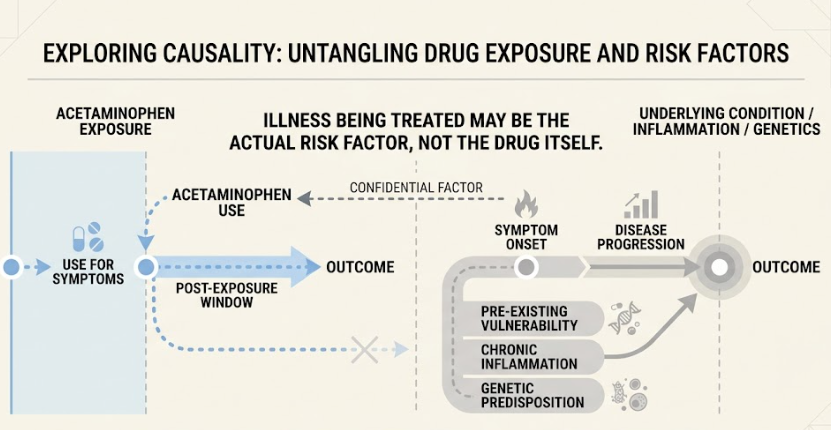
The biggest methodological challenge across all of these studies is called confounding by indication — the idea that the reason someone takes a medication may itself carry the risk, independent of the drug.
Women who take acetaminophen during pregnancy often do so because they have:
- Fever from infections — untreated fever independently affects fetal neurodevelopment
- Chronic inflammatory conditions — which have known genetic overlap with ASD
- Chronic pain conditions — some of which run in families that also have higher rates of autism and ADHD
- Genetic risk factors for ADHD or ASD — researchers have found that pregnant people with these genetic profiles are both more likely to use acetaminophen and more likely to have a child with ASD
This does not mean acetaminophen is harmless. It means many studies cannot cleanly isolate the drug as the causal variable. When researchers attempt to control for these factors, observed associations consistently shrink. Knowing the DSM-5 criteria for autism makes clear that ASD is a heterogeneous, multi-factorial condition — not one that a single prenatal exposure is likely to explain on its own.
What Happened in the Courtroom: The Tylenol Autism Lawsuits
Starting in 2021 and accelerating through 2022, plaintiff law firms began filing mass tort lawsuits against retailers (CVS, Walgreens, Walmart, Costco) and manufacturers (Kenvue, formerly the consumer health division of Johnson & Johnson). The claims: these companies knew or should have known about neurodevelopmental risks and failed to warn consumers.
In October 2022, cases were consolidated into a Multi-District Litigation (MDL No. 3043) in the Southern District of New York before Judge Denise Cote.
Here is what happened next:
In December 2023, Judge Cote issued a pivotal ruling, barring all of the plaintiffs’ expert witnesses under Daubert standards — the legal framework governing whether scientific testimony is reliable enough to be admissible in federal court. The court found that the experts’ methodology did not meet the required threshold. A summary judgment in favor of defendants followed in 2024, effectively ending the federal litigation.
This ruling does not mean the science is definitively wrong. It means the evidence did not meet the legal standard needed to hold companies liable. That distinction is important for families trying to understand both the research and the litigation separately.
Plaintiffs filed an appeal with the Second U.S. Circuit Court of Appeals. The September 2025 Trump administration announcement added significant fuel — plaintiffs argued that if federal health agencies now accept the relevant expert’s work as credible science, courts should not have excluded it. Oral arguments were heard in November 2025, and as of mid-2026, a ruling has not yet been issued.

What Health Organizations Actually Say
Despite the September 2025 White House announcement, no major independent health organization has issued a blanket prohibition on acetaminophen during pregnancy.
- FDA (September 2025): Issued a “Dear Doctor” letter advising physicians that acetaminophen should be used during pregnancy primarily for cases of high fever when the fever itself poses fetal risk — while simultaneously stating that a causal relationship has not been established
- ACOG (American College of Obstetricians and Gynecologists): Its 2021 statement held that evidence does not prove a direct relationship from judicious acetaminophen use during pregnancy; as of this writing, that remains their position
- Society for Maternal-Fetal Medicine: Found evidence on a causal link between acetaminophen and neurodevelopmental disorders to be “inconclusive”
- Autism Science Foundation: Stated in September 2025 that associating prenatal Tylenol with autism is “premature” and risks “misleading families who deserve clear, factual information”
The consistent clinical guidance across all of these bodies: use the lowest effective dose for the shortest duration necessary. Consult your OB or midwife. Do not simply tolerate high fever or significant pain out of fear — both carry independent, documented fetal risks.
Common Misconceptions About the Tylenol-Autism Theory
“The science is settled — Tylenol causes autism.” It is not settled. Dozens of studies have found associations; other well-designed studies — particularly those controlling for genetics and family environment — find little to no meaningful causal effect. The research community is actively debating this, and the FDA itself said causation has not been established.
“If a federal judge dismissed the lawsuits, the science must be fake.” Legal evidentiary standards and scientific merit operate under entirely different frameworks. Studies can raise important questions without the expert testimony derived from them meeting a Daubert threshold. The MDL dismissal was a procedural and evidentiary ruling — not a verdict on the underlying epidemiology.
“I took Tylenol during pregnancy, so my child’s autism was caused by it.” Individual causation cannot be inferred from population-level associations, even real ones. Autism is influenced by hundreds of genetic variants and multiple environmental factors. For families seeking clarity on genetic contributions, genetic testing for autism may offer meaningful information about heritability in your specific family.
“There’s going to be a big class action settlement soon.” No settlements have been issued. No average payout exists. The federal appeal is still pending. State court cases face significant hurdles. Websites advertising guaranteed payout amounts are not providing accurate information.
“The biggest cause of autism is environmental exposures like Tylenol.” Genetics is the most consistently established driver of autism risk, with heritability estimated between 64% and 91% in twin studies. Environmental factors — including prenatal exposures — are studied as potential modifiers, not primary causes.
What to Do If You Took Tylenol During Pregnancy: A Practical Framework

Step 1: Understand the difference between risk and certainty Even if future research confirms a population-level association between prenatal acetaminophen and ASD, the vast majority of children with significant prenatal exposure do not develop autism. Population statistics describe groups — not what happened in your specific pregnancy.
Step 2: Don’t replace your OB’s guidance with news headlines The Trump administration’s announcement generated enormous media coverage. Your OB or midwife should be your primary source of clinical guidance about your specific pregnancy history, health conditions, and risk profile.
Step 3: Focus on what is actionable today A diagnosis — or the possibility of one — points toward evaluation and early support, not retrospective blame. Early intervention consistently produces better long-term outcomes. Behavioral support through social skills training for autism and structured ABA therapy can make a measurable difference in communication, independence, and daily functioning.
Step 4: Pursue evaluation if you have developmental concerns If your child is showing signs of developmental differences, a formal evaluation is the most productive next step. The earlier a child receives evidence-based support, the better the outcomes. Families in Northern Virginia can access ABA therapy services through Dream Bigger ABA in Vienna, VA and ABA therapy in Gainesville, VA.
Step 5: Consult an attorney only with realistic expectations If you believe you have a legal claim, consult a qualified plaintiff attorney who can give you a current, honest assessment of where the litigation stands. Do not rely on websites promising large payouts or guaranteed settlements.
Conclusion
The question “who said Tylenol causes autism?” does not have a single answer. Academic researchers raised the concern cautiously over more than a decade, crystallizing it in a 2021 consensus statement calling for more research and precautionary guidance. The Trump administration amplified that concern into a sweeping public warning in September 2025 — well ahead of where the science stands — while the FDA’s own accompanying statement maintained that causation has not been proven. And a federal court found in December 2023 that the expert testimony supporting these claims did not meet legal standards for reliability.
The science is real enough to keep studying. The legal claims face significant hurdles. And the evidence still does not support the conclusion that prenatal Tylenol is who said Tylenol causes autism in any individual child’s case.
If your child has been diagnosed with ASD — regardless of what you’ve been told about its cause — the most productive path forward is early, consistent, evidence-based support. Research consistently shows that outcomes improve with earlier intervention.
At Dream Bigger ABA, we work with families across Northern Virginia to deliver individualized ABA therapy built on compassion, clinical rigor, and genuine partnership with parents. If you’re ready to take the next step for your child, explore our services in Vienna, Gainesville, and across the region — or contact our team to learn how we can help.
Frequently Asked Questions
What is the average payout for the Tylenol autism lawsuit?
A: No average payout has been established because no settlements have been reached. The federal MDL was dismissed in December 2023 after Judge Cote excluded plaintiffs’ expert witnesses under Daubert standards, and a summary judgment in favor of defendants followed in 2024. An appeal is currently pending in the Second Circuit Court of Appeals, with oral arguments heard in November 2025 and a ruling not yet issued. Some state court cases continue independently. Any source advertising a specific payout figure is not providing accurate information.
What is the biggest contributor to autism?
A: Based on the current scientific consensus, genetics is the most consistently supported driver of autism risk. Twin and family studies show heritability estimates ranging from 64% to 91%. Hundreds of genetic variants — most individually rare but cumulatively significant — have been identified in association with ASD. Environmental factors, including advanced parental age, prenatal infections, certain chemical exposures, and potentially some medications, are studied as possible modifying influences. No single environmental exposure has been identified as the dominant cause of autism.
When did the Tylenol lawsuit start for autism?
A: Plaintiff lawsuits began accumulating in 2021 and 2022, largely catalyzed by the 2021 consensus statement in Nature Reviews Endocrinology and subsequent media coverage. The federal Multi-District Litigation (MDL No. 3043) was officially established in October 2022 in the Southern District of New York. The MDL was dismissed in December 2023 following a Daubert ruling, with summary judgment entered in 2024. An appeal is currently active in the Second Circuit Court of Appeals.
Is it bad to have Tylenol while pregnant?
A: The FDA, ACOG, and Society for Maternal-Fetal Medicine have not issued blanket prohibitions against acetaminophen during pregnancy. The standard clinical guidance is to use the lowest effective dose for the shortest duration necessary and to consult your healthcare provider before taking it regularly or for extended periods. Untreated high fever during pregnancy also carries documented fetal risks — which is why clinicians have not moved to categorical avoidance. The September 2025 administration announcement added urgency to the public conversation, but the FDA’s own accompanying letter did not establish that the drug causes autism. Discuss your specific situation with your OB or midwife.
Does Tylenol affect fetal development?
A: In animal studies, acetaminophen functions as an endocrine disruptor, meaning it can interfere with hormonal pathways involved in fetal brain development. In human observational studies, higher prenatal acetaminophen exposure — particularly for extended durations of four weeks or longer — has been associated with modestly elevated risks of ASD and ADHD diagnoses. However, these studies cannot conclusively rule out confounding factors such as the underlying illness being treated, maternal genetics, and family-level risk factors. No regulatory body has concluded that therapeutic doses of acetaminophen definitively cause developmental harm. The research is ongoing and actively evolving.