If you’re wondering what is nonverbal autism, here’s the short answer: it refers to autistic individuals who have very limited or no spoken words. It does not mean a lack of understanding, intelligence, or emotion. Many communicate effectively through other methods like gestures, sign language, picture exchange (PECS), or speech-generating devices and apps.
Some are “minimally verbal” or fluctuate between speaking and not speaking depending on stress, environment, or sensory load. The core idea is access—when a person has reliable tools to express needs and ideas, their abilities become clear even if speech isn’t their primary mode.
Quick Definition, In Context ✅
Nonverbal autism describes autistic people who do not rely on speech for daily communication. Some may use a few approximations or single words on occasion, but they primarily communicate through gestures, signs, AAC apps, PECS, or typed text. Nonverbal status can be lifelong for some, temporary for others, and it exists on a continuum with minimally verbal and preverbal profiles.
Key idea: Communication is far broader than speech. When we support communication first, speech often grows as a byproduct.
How It Looks Day To Day
You might notice a child guiding your hand to an object, bringing pictures to request snacks, or tapping a speech-generating app to say “all done.” They may hum, script, or use echolalia. Behavior can become a communication attempt when access to reliable expressive tools is missing. That’s why the first intervention focus is building a functional communication system the child can use anywhere.
Examples you’ll see in real life:
- Pointing to a picture of a swing to ask for playground time
- Handing a cup to signal “more juice”
- Tapping a button on an AAC device that says “break please” during homework
Why It Happens: What We Know And What We Don’t
There isn’t one single cause. Genetics, brain connectivity differences, and co-occurring conditions like apraxia of speech or oral-motor planning challenges may influence speech development. Early environments that support communication access, visual learning, and motor planning can change trajectories meaningfully. Importantly, the absence of speech is not evidence of low comprehension. Many nonverbal autistic individuals understand more than they can express.
Nonverbal, Minimally Verbal, Preverbal: What’s The Difference?
The terms are descriptive, not diagnostic labels, and they help teams match supports to needs.
Communication Profiles At A Glance
| Profile | Typical Speech Use | Primary Communication Modes | What To Prioritize First |
| Nonverbal | Few to no consistent spoken words | AAC apps, PECS, signs, gestures, typed text | Robust AAC, modeling, partner training |
| Minimally verbal | Up to a few dozen words, inconsistent | Mix of spoken words and AAC | Expand core vocabulary, choice-making |
| Preverbal | Emerging or situational speech | Gestures, vocalizations, early AAC | Frequent opportunities to request/comment |
📝 Things to know: Development is not linear. Children can move between profiles with the right supports. Celebrate any reliable communication, spoken or not.
How To Support Communication First
The best outcomes happen when you combine robust AAC, functional communication training, and caregiver coaching, delivered consistently across home, school, and community settings. Below is a practical playbook you can use immediately.
Step 1: Choose A Reliable Communication System
- Robust AAC app on tablet with core words and quick phrases
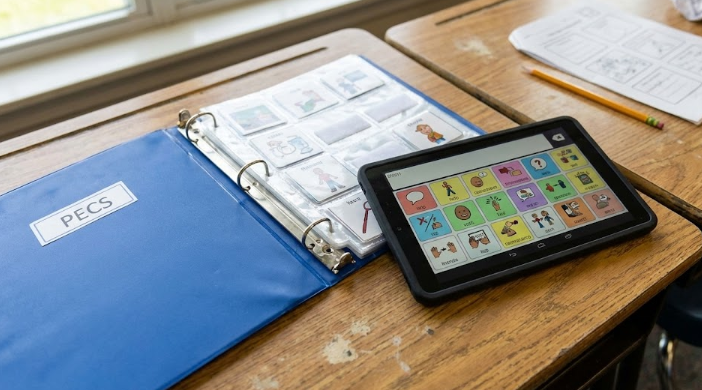
- PECS for visual, low-tech requesting and commenting
- Sign language for families comfortable modeling signs daily
- Single-message buttons for fast “help,” “break,” or “more”
Which option is best? The best system is the one your child can use across places, people, and activities with the least effort. If durability and portability matter most at the playground, laminated PECS might win. If your child loves screens and navigation, a robust AAC app often scales best over time.
Step 2: Teach Requests Before Anything Else
Start with high-value requests like favorite snacks or activities. Every correct communication gets the real thing immediately. This builds the “communication works” mindset.
Step 3: Model, Model, Model
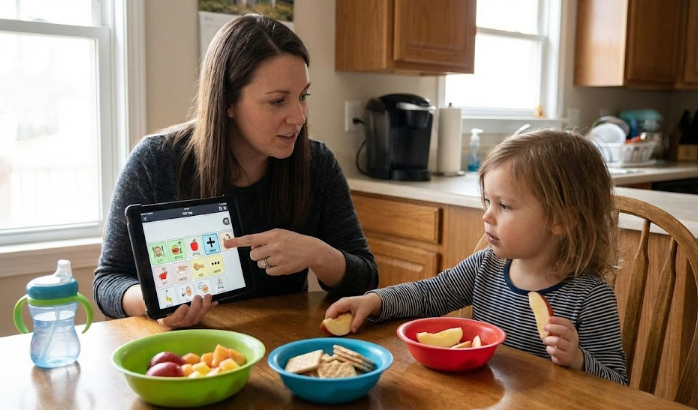
Adults should speak and tap the AAC at the same time during natural moments. Modeling shows where words live and how to use them. Keep sentences short, repeat often, and honor any attempt.
Step 4: Generalize Across People And Places
Practice at breakfast, in the car, at the store, and on the playground. The more places the system works, the faster it becomes the child’s default.
Evidence-Based Therapy Options, Explained Simply
ABA With A Communication-First Lens
Applied Behavior Analysis can be powerful when the goals are functional and child-centered. A strong ABA plan prioritizes Functiona l Communication Training (FCT), choice-making, toleration skills, and daily living routines. If you are near Northern Virginia, explore local options such as ABA therapy in Alexandria,ABA therapy in Fairfax, and ABA therapy in Manassas for community-based, family-inclusive programs.
Speech-Language Therapy
SLPs assess oral-motor planning, expressive and receptive language, and AAC fit. Therapy targets initiation, vocabulary, and pragmatic functions like protesting, requesting, and commenting.
Occupational Therapy
OTs address sensory regulation, postural control, and fine-motor access to AAC. Better regulation often unlocks better learning.
Why this mix works: ABA builds habits and reinforcement for using a system, SLPs tune the language and layout, and OTs make access easier. Together they create a 360-degree support plan.
How To Choose The Right AAC Or Program
Use these filters to avoid common pitfalls:
- Can my child ask for what they love within 2 taps or one exchange?
- Will this system work in the car, outside, and at school?
- Do all adults know how to model and respond?
- Does the team collect simple data that actually informs tomorrow’s session?
Decision Helper: Matching Needs To Options
| Primary Need | Best-Fit Option | Why It’s Likely Best | What To Watch Out For |
| Fast access to a few essentials | Single-message buttons + PECS | Quick, durable, no charging | Limited vocabulary if not expanded |
| Growth to sentences and core words | Robust AAC app | Scales to phrases, literacy links | Needs training, protected time |
| Motor planning challenges | Keyguard + larger icons | Reduces mis-hits | Overly large icons can slow search |
| Limited budget | Paper-based core boards | Free, printable, portable | Requires lamination and upkeep |
Behavior Is Communication: Reducing Frustration Safely
Challenging behavior often declines when kids get a reliable communication tool. Pair that with:
- Visual schedules for predictability
- First–then cards to ease transitions
- Choice boards for autonomy
- Calm routines for sensory regulation
If you want to understand how autistic traits intersect with identity and symbols used by the community, you may find autism symbols and their meanings helpful. For overlaps with other conditions, see BPD vs autism and insights on social connection in autism and empathy.
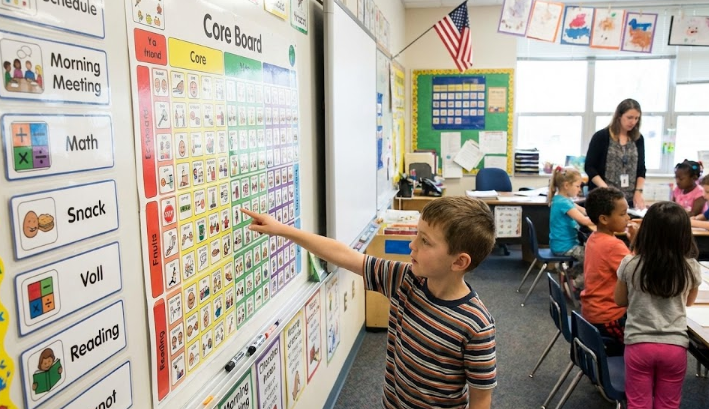
School Collaboration That Actually Works
- Request an AAC evaluation through the IEP.
- Ask for goals that generalize across classes and recess.
- Train paraprofessionals to model and respond, not just prompt.
- Share a small home-to-school log that celebrates communication attempts.
How Families Can Help At Home
- Keep AAC visible and charged.
- Offer two good choices all day long.
- Narrate your day with short phrases while pointing to icons.
- Celebrate attempts. A sincere “Yes, you asked for swing!” plus the swing is powerful reinforcement.
Practical micro-routines:
- Breakfast requests: milk, cereal, fruit, help
- Door routine: open, wait, go, stop
- Play: more, different, turn, help, my turn, all done
When Speech Emerges
Some children begin using single words or approximations after months of reliable AAC. Others remain primarily AAC users yet still improve social communication. There is no one right outcome. The right outcome is a child who can tell you what they need, think, and feel, any time, any place.
Things To Know Before You Start 🧠
- AAC does not stop speech. It often supports it.
- Consistency beats intensity. Small daily reps across routines beat long clinics without carryover.
- Adjust access. If tapping is hard, add a keyguard or bigger icons. If paper is torn, laminate and ring-bind.
- Honor autonomy. Build comments, protests, and jokes, not just requests.
Local Care, Real Families
Families in Northern Virginia often blend in-home ABA, center-based sessions, and school supports. If you’re comparing options, schedule a visit, ask to observe, and request a sample daily data sheet. Community-rooted teams often provide better generalization.
Common Misconceptions, Debunked
- “Nonverbal means incapable.” False. Many understand complex language.
- “They’re not interested in social connection.” Many are, but they need accessible ways to join.
- “AAC is a last resort.” It’s a first-line support for functional communication.
For a deeper look at identity topics and neurodivergent experiences that sometimes get conflated, you might value BPD vs autism and autism and empathy. For symbolic representation in the community, explore autism symbols.
How This Article Helps You Decide
You now have a stepwise path: choose an accessible system, teach strong requests, model everywhere, blend therapies, and track what works. Use the decision tables above to quickly match options to needs, and lean on local teams for coaching and carryover.
Conclusion: what is nonverbal autism
Nonverbal autism describes people who do not rely on spoken words but can and do communicate through AAC, visuals, signs, and behavior. Start with communication access, pair it with supportive therapies, and measure progress by independence and joy, not by decibel count. If you’re near NOVA, explore programs like ABA therapy in Alexandria,ABA therapy in Fairfax, and ABA therapy in Manassas to build a consistent plan across home and community.
Frequently Asked Questions
How to talk to a nonverbal autistic child?
The most helpful approach is to use their communication system while you speak. Model short phrases on their AAC or PECS, keep language concrete, and pair words with actions. Offer two real choices often, wait patiently after you model, and honor any attempt. Add visual supports like first–then cards and core boards around the home so communication is available everywhere, not just during “therapy time.”
Do non-verbal autistics ever speak?
Yes. Some develop spoken words later, especially after consistent AAC use reduces pressure and frustration. Others remain primarily AAC users yet expand their expressive language meaningfully. The key is providing reliable communication first, so the child can participate now. When the brain is not busy with frustration, learning accelerates, and speech has more room to grow if it is going to develop.
Why do autistic people go nonverbal sometimes?
Many autistic people experience situational shutdowns or speech block during high stress, sensory overload, or fatigue. In those moments, spoken language can drop even if the person usually talks. Keeping AAC, text, or writing options available reduces pressure and lets them communicate without speech. Preventive strategies like predictable routines, breaks, noise control, and clear choices reduce the frequency of speech loss.
What is nonverbal autism behavior?
It is more accurate to call it communication without speech. You may see pointing, guiding an adult’s hand, handing pictures, or tapping icons, as well as vocalizations, echolalia, or scripting. Challenging behaviors can surface when a person cannot access a reliable way to say “help,” “stop,” or “I need a break.” Building and honoring a functional communication system is the most direct way to reduce frustration-driven behaviors.
How serious is non-verbal autism?
“Serious” depends on functional impact, not the presence or absence of speech. The most important factor is access to effective communication and supportive environments. With robust AAC, trained partners, and consistent routines across home and school, many nonverbal autistic individuals thrive, learn academics, build friendships, and express preferences. Measure progress by autonomy, engagement, and quality of life rather than by speech alone.