RBT Janks is a structured prompting and error-correction strategy used by Registered Behavior Technicians within Applied Behavior Analysis (ABA) therapy to reduce prompt dependency and build independent responding in learners with autism. It combines a specific sequence of prompt fading, reinforcement, and transfer trials to help clients move from reliance on cues to genuine skill mastery.
Key Takeaways
- RBT Janks is a prompt-fading protocol rooted in ABA principles, designed to systematically reduce a learner’s dependency on prompts over time.
- The technique is most effective when paired with consistent data collection and regular program reviews by a supervising Board Certified Behavior Analyst (BCBA).
- Prompt hierarchy, timing, and reinforcement schedules are the three variables that make or break the Janks approach in clinical practice.
- RBTs who master this technique report higher rates of skill generalization across settings and communication partners.
- The strategy is applicable across a wide range of skill domains, from communication and daily living skills to academic readiness tasks.
- Understanding a learner’s individual profile, including diagnostic details and any history of skill regression in autism, is essential before implementing this technique.
What RBT Janks Actually Is and Where It Comes From
The term “Janks” in ABA circles refers to a specific procedural approach that structures how a Registered Behavior Technician delivers, fades, and transfers prompts during discrete trial training (DTT) and naturalistic teaching sessions. The name is associated with practitioners who formalized the error-correction sequences now used widely in clinic and home-based ABA programs across the United States.
At its core, the technique is built around the premise that prompting without a deliberate fading plan creates learned helplessness. When a child consistently receives a full physical or verbal prompt to complete a task, they stop attempting to initiate the behavior independently. RBT Janks addresses this by layering transfer trials, which are brief, low-demand repetitions of the target behavior following a prompted trial, so the learner has repeated opportunities to respond without assistance.
The procedure typically follows this sequence:
- Error or no-response detected: The RBT identifies that the learner did not respond correctly or at all within the defined latency window.
- Prompt delivery: A controlling prompt (the level of prompt guaranteed to produce the correct response) is immediately delivered.
- Reinforcement: The correct prompted response is reinforced, usually with a brief or moderate reinforcer to maintain motivation without overshadowing the upcoming transfer.
- Transfer trial: A second presentation of the same instruction is given within seconds, this time with no prompt or a reduced prompt level.
- Reinforcement of independent response: If the learner responds correctly without the prompt, a higher-value reinforcer is delivered to increase the probability of future independent responding.
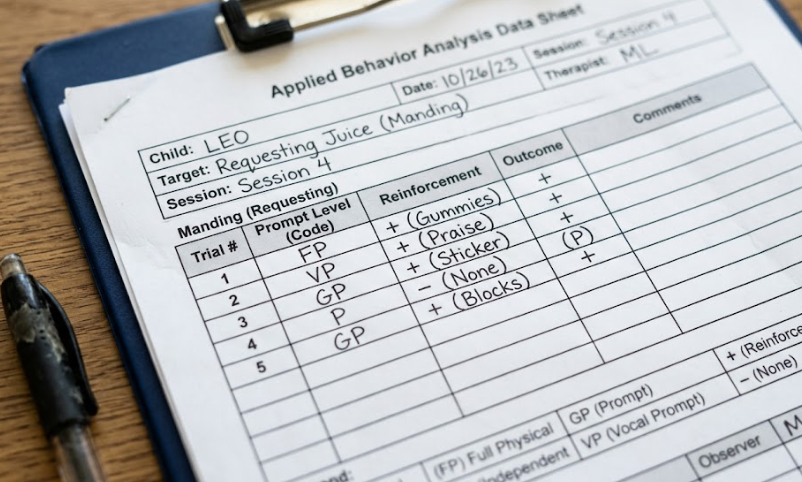
This cycle is documented in real time so the supervising BCBA can review prompt levels, latency data, and reinforcement effectiveness on an ongoing basis.
Why Prompt Dependency Is a Real Clinical Problem
Prompt dependency is one of the most discussed challenges in ABA therapy, and it is the primary problem that RBT Janks is designed to solve. When a learner only performs a behavior in response to an external cue, the behavior has not truly been acquired. It has been borrowed from the environment.
This matters enormously in practical terms. A child who can label objects only when a therapist points to them first will struggle in a classroom, at home, or on a playground where no one is following the same prompt protocol. Skill generalization, the ability to use a behavior across people, settings, and materials, is the actual goal of ABA therapy. Without systematic prompt fading, generalization is severely limited.
Research published in peer-reviewed behavior analysis journals consistently shows that transfer trials embedded into error-correction sequences significantly accelerate the pace at which learners achieve independent criterion on new skills. The Janks approach formalizes this finding into a teachable, replicable procedure that RBTs can implement with fidelity.
It is also worth understanding the broader diagnostic context in which this work happens. Clinicians who understand the dsm 5 criteria for autism recognize that deficits in social communication and restricted, repetitive behaviors are the defining features of autism spectrum disorder. These core characteristics often make prompt fading more complex, because learners may have strong preferences for predictability and sameness, which can inadvertently reinforce prompt dependency if not proactively managed.

How to Implement the Janks Protocol Correctly
Getting RBT Janks right requires attention to three overlapping variables: your prompt hierarchy, your timing, and your reinforcement schedule. Errors in any one of these can undermine the entire procedure.
Setting Up Your Prompt Hierarchy
Before you run a single trial, you need to know which prompt level functions as your controlling prompt for this specific learner on this specific skill. What works for a verbal imitation target may be completely different from what works for a matching task. Common prompt levels used in the Janks framework include:
- Full physical prompt (hand-over-hand guidance)
- Partial physical prompt (light touch or gestural guidance)
- Model prompt (therapist demonstrates the response)
- Gestural prompt (pointing, nodding, or directing attention)
- Positional prompt (placement of the correct item closer to the learner)
- Vocal or verbal prompt
The controlling prompt is the lowest level that reliably produces a correct response. Using a more intrusive prompt than necessary slows fading. Using one that is insufficient wastes a trial and can increase frustration.
Timing the Transfer Trial
Timing is everything. The transfer trial must follow the prompted trial within a short interval, typically two to five seconds, to maintain the behavioral momentum created by the reinforced prompt. If you wait too long, the learner’s response chain is disrupted and the transfer loses its effectiveness. Most experienced RBTs develop a rhythm where the transfer trial feels like a natural continuation of the interaction rather than a separate event.
Reinforcement Differentiation
Reinforcement differentiation, where the transfer trial response earns a more valuable reinforcer than the prompted response, is what shapes the learner toward independence. Without this gradient, the learner has no behavioral reason to respond without the prompt. You can vary reinforcement through:
- Duration of access to a preferred item
- Quality or type of preferred item
- Quantity of a consumable reinforcer
- Social reinforcement intensity (big celebration vs. quiet acknowledgment)
Monitoring Generalization
As you collect data across sessions, you and your BCBA should track not just whether the learner is responding correctly, but whether correct responding is occurring at the lower prompt levels over time. Progress stalls are often a signal that the prompt hierarchy needs adjustment or that a different reinforcer should be assessed.
RBT Janks in the Context of a Growing Field
The demand for qualified RBTs in the United States has grown substantially over the past decade. According to the Behavior Analyst Certification Board (BACB), the number of active RBTs in the U.S. has climbed into the hundreds of thousands, driven in large part by increased autism diagnoses and expanded insurance coverage for ABA therapy under state mandates. Researchers and clinicians continue to examine why are autism rates increasing, and the answers point to improved diagnostic awareness, broader diagnostic criteria, and greater access to screening, which all translate into more families seeking ABA services.
For RBTs entering the field, mastering structured techniques like Janks is not optional. Supervisors and BCBAs expect new technicians to implement evidence-based procedures with fidelity from the start. A technician who runs trials without a clear error-correction plan wastes instructional time and risks setting back a learner’s program.
There is also a growing recognition that biological and genetic factors shape how individual learners respond to ABA programming. Families who pursue genetic testing for autism sometimes receive information that directly informs the clinical team’s approach, including which reinforcers are likely to be effective and which sensory factors may interfere with learning.
Things to Know
- RBT Janks is a prompting protocol, not a curriculum. It tells you how to teach, not what to teach. The target skills are determined by the BCBA and the individualized treatment plan.
- Not every learner needs the same controlling prompt. Running a prompt assessment before starting a new skill target saves significant time and reduces unnecessary errors.
- Transfer trials must be reinforced even when the correct response follows the prompted trial by only a short interval. Some RBTs mistakenly skip reinforcement on the transfer because it feels “too easy.” This is a fidelity error.
- Learners with a documented history of skill regression require especially careful monitoring. Regression can reset a learner’s progress on targets that were previously mastered, meaning the error-correction sequence may need to restart.
- In many states, RBTs are required to operate under a specific supervision ratio defined by the BACB. Make sure your implementation of any technique, including Janks, is reviewed regularly by your supervising BCBA.
- Documentation of prompt levels, reinforcement schedules, and response data is legally and clinically important. In the event of a program audit or insurance review, your data is your evidence of service quality.

Comparing Prompt Fading Strategies in ABA
| Strategy | How It Works | Best For | Key Risk |
| RBT Janks (Transfer Trial) | Prompted trial followed immediately by unprompted trial | Learners with moderate prompt dependency | Rushing transfer timing |
| Most-to-Least Prompting | Start with full prompt, systematically reduce level | Early learners, new complex skills | Slow fading leads to dependency |
| Least-to-Most Prompting | Start with no prompt, add only if no response | Learners with some existing repertoire | Repeated errors before prompt |
| Time Delay (Progressive) | Introduce increasing pause before delivering prompt | Strong imitation or echoic learners | Frustration during delay period |
| Graduated Guidance | Physical prompt faded spatially during the response | Motor skills, self-care routines | Requires close physical contact |
Each strategy has a role in a comprehensive ABA program. RBT Janks is particularly valued because it keeps error rates low while systematically building independence, a balance that is difficult to achieve with less structured approaches.
The Bottom Line on RBT Janks
RBT Janks is not a shortcut or a trendy add-on to ABA therapy. It is a disciplined, learner-centered approach to error correction that, when implemented with fidelity, meaningfully reduces prompt dependency and accelerates skill generalization. The technique respects the learner’s potential for independence and builds toward it in a structured, data-driven way.
If you are an RBT looking to sharpen your clinical skills, start by reviewing your current error-correction sequences with your BCBA and asking whether transfer trials are being embedded consistently across all skill programs. If you are a parent or caregiver, ask your child’s therapy team how they handle prompted responses and what their plan is for systematically fading support over time. That conversation will tell you a great deal about the quality of the program your child is receiving.
Frequently Asked Questions
Is RBT Janks a formally published ABA procedure or a field-developed practice?
The Janks approach is primarily a field-developed prompting and error-correction sequence that has been refined through clinical practice rather than a single published academic paper. It draws directly from established ABA principles around transfer trials and prompt fading that are well-documented in the behavior analysis literature. Many ABA agencies have formalized it into their training materials and competency assessments for new technicians.
How many transfer trials should you run after a prompted response?
The standard practice is one to three transfer trials following a prompted response, depending on the learner’s history and the skill being targeted. Running too many transfer trials in a row can reduce motivation and disrupt the natural flow of the session. Your supervising BCBA should specify the exact number in the written program.
Can RBT Janks be used during naturalistic teaching, or only in DTT?
The protocol adapts well to naturalistic teaching environments, though the timing and delivery look different outside a structured table-top setting. In naturalistic contexts, the transfer trial is embedded into the ongoing activity, such as during play or mealtime, rather than structured as a formal discrete trial. The core logic of prompt, reinforce, transfer remains the same.
What should an RBT do if a learner consistently fails the transfer trial?
Consistent failure on transfer trials usually signals that the controlling prompt level needs to be reassessed or that the reinforcement differential is not strong enough. The RBT should document the pattern and bring it to the BCBA’s attention at the next supervision meeting. Continuing to run failing trials without adjusting the program does not help the learner and may increase frustration.
How long does it typically take for a learner to achieve independent responding using this approach?
Time to independence varies widely based on the skill complexity, the learner’s current repertoire, and how consistently the protocol is implemented across all sessions. Some learners achieve independence on simple targets within a few sessions. More complex social or academic skills may require weeks or months. Consistent, daily implementation with accurate data collection produces the fastest results.