Finding the right support for a child with autism can feel overwhelming, especially when you are navigating a new diagnosis and unfamiliar terminology. A board certified behavior analyst in Broken Arrow is a licensed, credentialed professional who designs and oversees Applied Behavior Analysis (ABA) therapy, one of the most research-backed interventions available for children on the autism spectrum.
Key Takeaways
- BCBAs hold national credentials issued by the Behavior Analyst Certification Board (BACB) and must meet strict education, supervision, and exam requirements before practicing.
- ABA therapy in Broken Arrow is typically covered by Oklahoma insurance plans under state autism mandate laws, but prior authorization is almost always required.
- The assessment process comes before treatment, and a quality BCBA will spend significant time observing your child before writing a single goal.
- Early intervention produces the strongest outcomes, but ABA therapy is effective across a wide age range, not just for toddlers.
- Red flags to watch for include high caseloads, little parent training, and programs that use punishment-based tactics as a primary tool.
- Asking specific questions about supervision ratios, data collection methods, and caregiver involvement separates quality providers from average ones.
What a BCBA Actually Does (and Why the Credential Matters)
Not everyone who delivers ABA therapy holds a BCBA credential. In fact, most of the direct therapy is carried out by Registered Behavior Technicians (RBTs), who work under BCBA supervision. Understanding this distinction is essential before you start making phone calls to providers in the Broken Arrow area.
A BCBA is responsible for:
- Conducting functional behavior assessments (FBAs) to identify why challenging behaviors occur
- Writing individualized treatment plans based on your child’s specific strengths and deficits
- Supervising RBTs and ensuring the therapy is delivered correctly
- Analyzing data collected during sessions to make real-time adjustments
- Training caregivers so skills generalize from the clinic to home
The Behavior Analyst Certification Board (BACB) issues the BCBA credential at the national level. To earn it, a candidate must hold at least a master’s degree in behavior analysis or a related field, complete 2,000 hours of supervised fieldwork, and pass a rigorous written examination. Oklahoma also requires BCBAs to hold a state license issued through the Oklahoma State Board of Behavioral Health. This two-layer credentialing system gives families an added layer of protection when searching for a qualified provider.
If someone presents themselves as a behavior specialist or ABA therapist without either credential, ask direct questions. In Oklahoma, practicing as a behavior analyst without proper licensure is not legal for those billing insurance or working in clinical settings.
How ABA Therapy Works in a Broken Arrow Clinical Setting
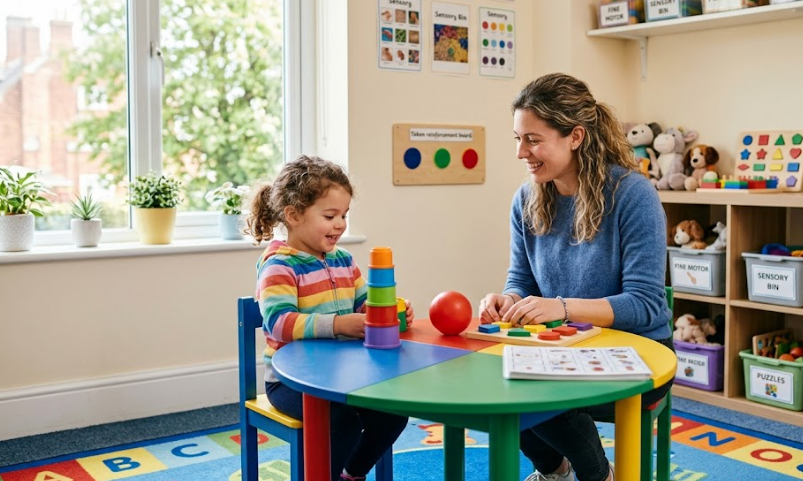
ABA therapy is not a single technique. It is a science-based framework that uses principles of learning and motivation to teach skills, reduce harmful behaviors, and increase independence. In a Broken Arrow clinic, your child’s program will typically follow a structured process from assessment through discharge.
The Assessment Phase
Before therapy begins, your assigned BCBA will conduct an initial intake and a comprehensive skills assessment. Common tools include the VB-MAPP (Verbal Behavior Milestones Assessment and Placement Program) and the ABLLS-R (Assessment of Basic Language and Learning Skills). These tools map out exactly where your child currently performs across dozens of skill domains, including communication, social skills, self-care, and academic readiness.
This phase often takes two to three weeks and should include direct observation of your child, caregiver interviews, and possibly school record review. Be cautious of any provider that rushes this process. A thorough baseline assessment is what separates a truly individualized program from a cookie-cutter approach.
Goal-Setting and Treatment Planning
Once the assessment is complete, your BCBA will write a treatment plan with specific, measurable goals. A good treatment plan targets skills that matter in your child’s daily life, not just skills that are easy to measure. For example, a goal around functional communication is far more meaningful than a goal around memorizing colors in isolation.
Parents should be invited to participate in the goal-setting conversation. Your input about what matters most at home, at school, and in the community is not optional, it is critical to good clinical practice.
Ongoing Data Collection and Progress Monitoring
Every ABA session should generate data. RBTs record each trial or observation point, and your BCBA reviews this data regularly, typically weekly or biweekly, to determine whether the current teaching strategies are working. If a child is not making progress, the BCBA should adjust the program proactively, not wait for a quarterly review to notice a problem.

Understanding Autism Diagnosis in Relation to ABA Eligibility
ABA therapy is most commonly prescribed for children diagnosed with Autism Spectrum Disorder (ASD). In Oklahoma, insurance coverage for ABA is tied to a formal ASD diagnosis, which must be documented by a licensed psychologist, developmental pediatrician, or psychiatrist. Understanding the dsm 5 criteria for autism is useful for families who are still in the diagnostic process, as these criteria directly determine whether your child qualifies for insurance-funded ABA services.
It is also worth understanding that autism presentations vary widely. Researchers and clinicians have spent years examining why are autism rates increasing, and while part of the trend reflects better diagnostic awareness and expanded criteria, it also means more families in Broken Arrow are seeking qualified BCBA services than ever before.
One thing many families notice after starting school or transitioning between programs is a sudden loss of previously mastered skills. This phenomenon, known as skill regression in autism, is something a skilled BCBA should address directly in the treatment plan, using structured maintenance protocols and regular probing to catch regressions early.
Additionally, some families first suspect autism because of sensory-related behaviors they observe at home. If you have wondered whether something like is chewing clothes a sign of autism, the answer is nuanced. Sensory seeking behaviors like this can be associated with autism but are not diagnostic on their own, and a BCBA can help families address sensory behaviors through evidence-based strategies regardless of where they originate.
What to Look for When Choosing a Provider in Broken Arrow
Broken Arrow is part of the greater Tulsa metro area, which means families have access to a reasonable number of ABA providers. However, not all clinics operate at the same standard of care. Here is a breakdown of what separates quality providers from those that fall short.
| Factor | What to Look For | Red Flags |
| BCBA Caseload | 8-12 active clients per BCBA | 20+ clients with limited contact |
| Supervision Hours | BCBA observes directly weekly | Supervision is only paperwork review |
| Parent Training | Structured caregiver training built into the program | Parent involvement is optional or minimal |
| Data Review | Weekly or biweekly program adjustments | Quarterly reviews only |
| Staff Turnover | Low RBT turnover, consistent staffing | Rotating technicians with no continuity |
| Insurance Transparency | Upfront breakdown of costs and authorizations | Vague billing practices |
Questions Worth Asking During Your Intake Call
- How many clients does each BCBA supervise at your clinic?
- How often will the BCBA observe my child directly during sessions?
- What does parent training look like, and how many hours per month are included?
- How do you handle insurance authorizations and re-authorizations?
- What is your approach to naturalistic teaching versus discrete trial training?

Insurance Coverage for ABA Therapy in Oklahoma
Oklahoma law requires most private insurance plans to cover ABA therapy for individuals with an autism diagnosis. This mandate applies to employer-sponsored plans regulated under state law, but it does not automatically cover all plans. Self-funded employer plans, for example, are regulated under federal ERISA law and are not required to follow Oklahoma’s mandate.
Here is a practical step-by-step process for navigating insurance before your child starts therapy:
- Call the member services number on your insurance card and ask specifically whether your plan covers ABA therapy for autism.
- Confirm whether the plan is fully insured (covered by Oklahoma mandate) or self-funded (may not be).
- Ask about prior authorization requirements and what documentation the plan needs from the diagnosing provider and the BCBA.
- Request the list of in-network ABA providers in the Broken Arrow area.
- Ask about your deductible, out-of-pocket maximum, and any session limits.
- Get everything confirmed in writing before your child’s first session.
For families who qualify, Oklahoma Medicaid (SoonerCare) covers ABA therapy as well, and prior authorization is required there too. The BCBA’s clinic typically handles the authorization process, but staying informed as a parent protects you from unexpected billing surprises.
Things to Know
- Oklahoma requires BCBAs to hold both the BACB national credential and a state behavioral health license. Verify both before starting services.
- ABA therapy hours vary widely based on your child’s needs. Some children receive 10 hours per week, others receive 35 or more. More hours are not automatically better; the right intensity is based on your child’s assessment, not a standard package.
- Generalization is a core goal of ABA. Skills taught in the clinic should transfer to your home, your child’s school, and the community. If generalization is not being addressed, ask your BCBA why.
- Insurance re-authorizations typically happen every six months. Missing a deadline can create a gap in services, so track these dates carefully.
- BCBAs are ethically required by the BACB’s Professional and Ethical Compliance Code to use the least restrictive intervention strategies first. Punishment-based techniques should be rare and heavily justified.
- Telehealth BCBA supervision is available in some cases, particularly for parent training sessions. Ask your provider whether hybrid service delivery is an option.
The Bottom Line on Board Certified Behavior Analyst Broken Arrow
Choosing a board certified behavior analyst in Broken Arrow is one of the most important decisions you will make for your child’s development. The credential matters, the supervision structure matters, and the quality of the therapeutic relationship matters just as much. Families who ask detailed questions upfront, stay engaged throughout the process, and advocate for regular data reviews consistently report better outcomes than those who take a hands-off approach.
Your next step is straightforward: verify the BCBA’s credentials through the BACB’s public certificate verification system at bacb.com, confirm Oklahoma state licensure, and schedule an intake call with at least two providers before committing. The right fit exists in this market, and you have every right to take the time needed to find it.
Frequently Asked Questions
How long does ABA therapy typically last for a child in Broken Arrow?
Duration varies widely based on your child’s needs, goals, and rate of progress.
Some children complete an intensive ABA program within 12 to 18 months and transition to a less intensive maintenance model. Others may continue for several years. Your BCBA should set clear benchmarks and have honest conversations about expected timelines rather than keeping your child enrolled indefinitely without measurable progress.
Can my child receive ABA therapy and attend school at the same time?
Yes, and in most cases, coordination between the ABA team and the school is strongly recommended.
Many Broken Arrow families schedule clinic-based ABA therapy before or after school hours. Your BCBA can also collaborate with your child’s IEP team to align goals across both settings, which improves skill generalization significantly.
What is the difference between a BCBA and a BCaBA?
A BCaBA (Board Certified Assistant Behavior Analyst) holds a bachelor’s-level credential and must always practice under BCBA supervision.
BCaBAs cannot independently design or oversee treatment programs. They work as an intermediate level between RBTs and BCBAs. If a clinic lists a BCaBA as your child’s primary behavior analyst, ask who the supervising BCBA is and how often they are directly involved.
Does ABA therapy work for older children or teenagers?
ABA therapy is effective across the lifespan, not just for young children.
While early intervention produces the strongest outcomes, older children and teens benefit from ABA targeting social skills, vocational readiness, independent living, and emotional regulation. The strategies look different from early childhood programs, but the science behind them is the same.
How do I know if my child’s ABA program is actually working?
Progress should be visible in your child’s data trends and in real-life skill use at home, school, and in the community.
Ask your BCBA to walk you through the data graphs at each review. If your child is not meeting targets after a reasonable trial period, the program should be adjusted, not just repeated. Lack of progress is information, and a quality BCBA treats it that way.