Key Takeaways
- Yes — one twin absolutely can have autism while the other does not, including in identical (monozygotic) twins who share 100% of their DNA
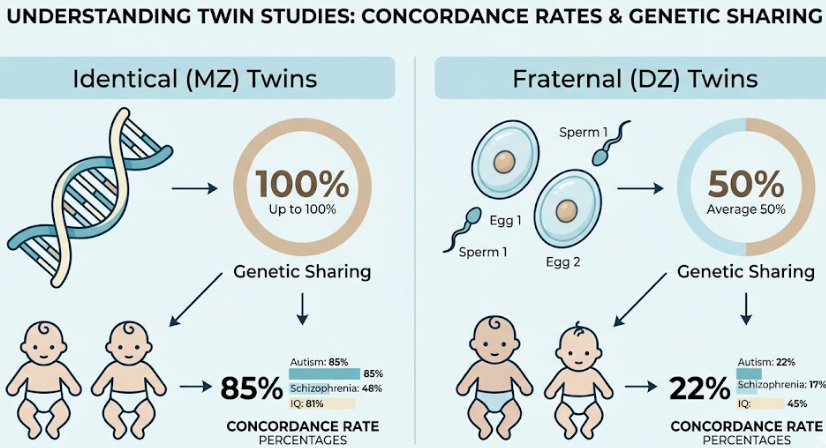
- Identical twins show autism concordance rates of approximately 60–90% — meaning even with identical genetics, one in ten to four in ten identical twin pairs will be discordant for autism
- Fraternal (dizygotic) twins show concordance of approximately 5–30% — similar to recurrence risk for non-twin siblings
- The less-than-100% concordance in identical twins is scientific proof that autism cannot be explained by genetics alone — prenatal environment, epigenetics, and developmental timing all play a role
- Studying discordant identical twin pairs — one autistic, one not — is one of the most powerful research tools available for identifying the non-genetic contributors to autism
The Direct Answer: Yes — and It Is More Common Than Most People Expect
One twin can absolutely have autism while the other does not. This occurs in fraternal twin pairs regularly — fraternal twins share only about 50% of their DNA, the same as any two siblings — and it also occurs in identical twin pairs, even though identical twins share essentially all of their genetic material.
The scientific term for this pattern is discordance: when twins differ in a trait or diagnosis, they are discordant for that condition. When both twins share it, they are concordant.
The rates at which identical twins are concordant for autism — both autistic — tell us a great deal about how much of autism is genetically driven. The rates at which they are discordant — one autistic, one not — tell us something equally important: that genes alone do not fully explain autism.
For families of twins navigating a diagnosis in one child but not the other, these rates are both reassuring and sobering: your situation is scientifically expected, well-documented, and at the center of some of the most important autism research being conducted today.
Identical vs. Fraternal Twins: The Concordance Rates
Before interpreting twin data, the distinction between twin types matters enormously.
Monozygotic (identical) twins develop from a single fertilized egg that splits into two embryos. They share essentially 100% of their nuclear DNA. They are always the same biological sex.
Dizygotic (fraternal) twins develop from two separate eggs fertilized by two separate sperm simultaneously. They share approximately 50% of their DNA — the same genetic relationship as any two full siblings. They can be the same or different sexes.
The concordance rates for autism across twin types, drawn from the published research:
Identical (monozygotic) twins: Concordance estimates range from approximately 60% to 90% across major twin studies. The variation in estimates reflects differences in diagnostic criteria (narrow vs. broad autism definitions), sample sizes, ascertainment methods, and whether the studies are population-based or clinic-referred.
Fraternal (dizygotic) twins: Concordance estimates range from approximately 5% to 30% — substantially lower than identical twins but still higher than the general population rate, reflecting the shared genetic and prenatal environment that fraternal twins experience.
What these numbers mean practically:
- If you have identical twins and one is autistic, the probability the other also is autistic is somewhere between 60% and 90% — not 100%, and not a coin flip
- If you have fraternal twins and one is autistic, the probability the other is also autistic is roughly 5–30% — meaningfully elevated compared to the general population, but majority of fraternal co-twins of autistic children do not themselves have autism
- The gap between identical and fraternal concordance rates demonstrates that genetics plays a substantial role — but the fact that identical concordance is not 100% demonstrates that genetics is not the whole story
Why Identical Twins Can Be Discordant for Autism
This is the most scientifically compelling aspect of autism twin research — and one of the most important findings for understanding what autism is.
If autism were entirely determined by genetics, and if identical twins share 100% of their DNA, then concordance in identical twins should approach 100%. It does not. This gap — the 10% to 40% of identical twin pairs where one is autistic and the other is not — tells researchers where to look for the non-genetic contributors to autism.
Several mechanisms explain discordance in identical twins:
Epigenetic differences. While identical twins share the same DNA sequence, they do not necessarily express that DNA identically. Epigenetic marks — chemical modifications to DNA and the proteins it wraps around, which regulate which genes are turned on or off — can differ between twins. These differences arise from random developmental processes and from different microenvironments experienced in the womb. Research has found systematic epigenetic differences between autistic and non-autistic identical co-twins that are not present in concordant pairs.
De novo mutations arising after twinning. After the fertilized egg splits into two embryos, each twin’s cells continue dividing independently. Copying errors during those cell divisions can produce new genetic mutations that are unique to one twin. Some autism-associated variants arise precisely this way — de novo mutations in the autistic twin that are absent in the non-autistic co-twin despite starting with identical DNA.
Differential prenatal environments. Identical twins are in the same uterus but are not necessarily in identical environments within it. Differences in placental blood flow, nutrient delivery, positioning, and oxygen supply between twins can affect neurodevelopment. Twin-to-twin transfusion syndrome — where blood flow is unevenly distributed between identical twins — is an extreme example, but subtler differences in prenatal resource distribution may affect the neurodevelopmental trajectory of one twin differently from the other.
Stochastic developmental variation. Some neurodevelopmental differences arise from random variation in the timing and precision of biological processes during embryonic development — not from genetic or environmental factors specifically, but from the inherent randomness of complex biological systems.
The practical implication of all these mechanisms: even in families where autism’s genetic risk is high enough to affect one identical twin, the developmental outcome for the co-twin is not predetermined. This is precisely why studying discordant identical twin pairs is so valuable — each pair represents a natural experiment with genetics held constant, allowing researchers to examine what non-genetic factors tipped the developmental outcome in one direction for one twin and another direction for the other.
What Discordant Twin Research Teaches Us
Families with one autistic twin and one non-autistic twin sometimes wonder whether they should be concerned about the non-autistic twin’s development, whether the non-autistic twin carries genetic risk they should understand, or what explains the difference between their children. Twin research addresses all of these questions.
The non-autistic co-twin often shows subclinical autism-related traits. Research consistently finds that the non-autistic identical co-twins of autistic individuals — people who did not develop autism despite sharing their twin’s genetic profile — show elevated rates of social communication differences, restricted interests, sensory sensitivities, and language quirks that fall below the diagnostic threshold but are above population averages. This pattern, called the broad autism phenotype, confirms the genetic contribution to autism: the genetic risk is present in both twins, but something in the developmental process crossed the diagnostic threshold for one and not the other.
Cognitive strengths are often shared. In discordant identical twin pairs, both twins frequently show similar cognitive strengths — particularly in pattern recognition, systematic thinking, and specific domain expertise — even when only one carries the autism diagnosis. This suggests that some of the cognitive features associated with autism are expressions of the same underlying genetic profile, regardless of whether the full diagnostic picture emerges.
Family recurrence risk is real but not deterministic. For families who have one autistic child and are expecting a twin pregnancy — or who have discordant twins and are considering future children — genetic testing for autism provides the clearest available information about what specific genetic variants are present and what they imply for other family members. Recurrence risk counseling with a genetic counselor translates these findings into practical guidance.
What Is Asperger’s Syndrome?
Asperger’s syndrome is a diagnostic label that was used for approximately two decades — from its inclusion in the DSM-IV in 1994 until its removal from the DSM-5 in 2013 — to describe individuals who met the core criteria for autism but did not have significant language delays in early childhood and did not have intellectual disability.
The condition was first described by Austrian pediatrician Hans Asperger in 1944, one year after Leo Kanner’s landmark autism paper, though his work was not widely known in the English-speaking world until Lorna Wing translated and expanded on it in the 1980s.
Under the DSM-IV, the defining features of Asperger’s syndrome were:
- Significant differences in social interaction and social communication
- Restricted, repetitive patterns of behavior and interests
- No clinically significant language delay (single words by age 2, phrases by age 3)
- No significant cognitive delay
- Not better accounted for by another diagnosis
In 2013, the DSM-5 eliminated Asperger’s as a separate diagnosis and unified it with all autism presentations under the single umbrella of autism spectrum disorder (ASD). Individuals formerly diagnosed with Asperger’s are now diagnosed with Level 1 ASD — autism that requires support but not substantial or very substantial support. For a detailed look at what this presentation involves in daily life, what is mild autism covers the Level 1 profile across childhood and adulthood.
Many people who received an Asperger’s diagnosis before 2013 continue to use the term for personal identification, community connection, and self-understanding — and that use is clinically and socially valid. The elimination of the label from the DSM was a classification decision, not a statement that the people who identified with it were somehow mistaken about their neurology.
It is worth noting that historical research has documented Hans Asperger’s participation in the Nazi regime’s child euthanasia programs during World War II — a history that has prompted ongoing conversation within the autistic community about the name of the diagnosis. This does not change the clinical validity of the presentation it describes; it does affect how some autistic individuals relate to the label personally.
How Is Autism Diagnosed?
Autism is a clinical diagnosis — not a genetic test result, a blood draw, or a brain scan. It is established through a comprehensive behavioral and developmental evaluation conducted by trained clinicians.
The core process includes:
Parent interview (developmental history): A structured interview — most commonly the ADI-R (Autism Diagnostic Interview-Revised) — in which the evaluator gathers detailed information from parents about the child’s developmental history from infancy: language milestones, social development, play patterns, repetitive behaviors, and sensory responses.
Direct observation and assessment of the individual: The ADOS-2 (Autism Diagnostic Observation Schedule, Second Edition) is the gold-standard direct assessment — a structured series of activities designed to elicit social communication behavior. A trained clinician observes and codes the individual’s responses in real time across multiple domains.
Cognitive and adaptive behavior assessment: Standardized measures of intellectual functioning and daily living skills establish the full developmental profile and inform the DSM-5 support level designation.
Integration against DSM-5 criteria: The evaluator integrates all findings against the DSM-5 criteria for autism — specifically the two required domains of social communication differences and restricted/repetitive behaviors — to determine whether a diagnosis is warranted.
There is no single test that confirms or rules out autism. The diagnosis is a clinical judgment based on observed behavior, reported developmental history, and the professional expertise of the evaluating clinician.
Common Misconceptions About Autism in Twins
“If one identical twin has autism, the other definitely will too.” This is false. Identical twin concordance is approximately 60–90% — meaning 10–40% of identical co-twins of autistic individuals do not have autism themselves. The genetic risk is shared; the outcome is not predetermined.
“If one fraternal twin has autism and the other doesn’t, autism must not be genetic.” The fraternal concordance rate (5–30%) is actually strong evidence for genetic contribution — it is substantially higher than the general population rate of approximately 3%, showing that shared genetic factors elevate risk in fraternal twins despite their not sharing identical DNA.
“The non-autistic twin must have protected the other somehow.” Twin concordance and discordance are products of neurobiological processes, not sibling dynamics. The non-autistic twin did not “escape” autism through any action or characteristic — they experienced a different developmental outcome due to epigenetic, prenatal, or stochastic factors that research is working to understand.
“Asperger’s is a mild form of autism.” Asperger’s — now classified as Level 1 ASD — is not mild in the sense of being minimally affecting. It is a form of autism without language or intellectual delay, but it carries significant challenges in social navigation, sensory processing, anxiety, and executive functioning. The word “mild” describes what is visible to outside observers, not the daily functional experience of the individual.
“If the non-autistic twin shows some autism traits, they must have autism too.” The broad autism phenotype — subclinical autism-related traits in relatives of autistic individuals — is common and does not constitute an autism diagnosis. Having traits without meeting the full diagnostic criteria for significant impairment or reaching a clinical threshold is different from having autism. Many genetic relatives of autistic individuals carry this phenotype.

Conclusion
One twin can absolutely have autism while the other does not — even in identical twin pairs sharing essentially all of their DNA. This is not a paradox; it is one of the most scientifically meaningful observations in autism research. The fact that identical twin concordance falls between 60% and 90% rather than 100% tells us that autism is substantially genetic but not entirely so — that epigenetic differences, prenatal environment, and developmental variation all contribute to whether the genetic risk translates into a diagnosis.
For families with a discordant twin pair, this science offers both validation and perspective. The autism in one child is not more or less “real” for having a non-autistic twin. The non-autistic twin did not escape through any fortunate accident of character. Two children who began as genetic duplicates took different developmental paths — and both deserve to be understood on their own terms.
What remains constant across twin concordance, Asperger’s discussions, diagnostic processes, and all the other angles families approach autism from: the most important thing is connecting autistic children with early, evidence-based support that is calibrated to who they actually are.
Dream Bigger ABA provides individualized ABA therapy for autistic children and their families across Northern Virginia — tailored to each child’s specific profile, not a generalized template. Connect with our team to explore services in Vienna, VA and Gainesville, VA.
Frequently Asked Questions
Can just one twin have autism?
Yes — and this is well-documented in both identical and fraternal twin pairs. In identical (monozygotic) twins, who share essentially all of their DNA, autism concordance is approximately 60–90%. This means roughly 10–40% of identical twin pairs are discordant — one twin is autistic and the other is not. In fraternal (dizygotic) twins, who share approximately 50% of their DNA like any two siblings, concordance is approximately 5–30%. Discordant identical twin pairs represent some of the most scientifically valuable cases in autism research, because they allow researchers to study what non-genetic factors — epigenetic differences, differential prenatal environments, de novo mutations arising after twinning — contribute to autism when genetics are essentially controlled. For parents with a discordant twin pair, the non-autistic co-twin often shows subclinical autism-related traits (the broad autism phenotype) even without meeting the full diagnostic criteria.
What is Asperger’s syndrome?
Asperger’s syndrome was a DSM diagnostic category used from 1994 to 2013 for individuals who showed the core features of autism — differences in social communication and restricted, repetitive behaviors — without significant language delays in early childhood and without intellectual disability. It was named after Austrian pediatrician Hans Asperger, who described the presentation in 1944. In 2013, the DSM-5 unified Asperger’s syndrome and all other autism presentations under the single diagnosis of autism spectrum disorder (ASD). Individuals formerly diagnosed with Asperger’s are now diagnosed with Level 1 ASD — autism that requires support but not substantial or very substantial support. Many people continue to use “Asperger’s” informally for personal identification, and this self-identification remains valid. The core presentation — autistic social and behavioral differences without language or intellectual delay — is most often encountered today as what is mild autism or Level 1 ASD in clinical settings.
What are the three main symptoms of autism in adults?
In adults, the three core autism symptom domains — which persist across the lifespan from their origins in early development — present distinctively shaped by years of experience and compensation. (1) Social communication differences manifest in adults as difficulty navigating the implicit rules of workplace culture, exhausting sustained social performance (masking), challenges with the rhythm and reciprocity of adult relationships, and difficulty reading the emotional subtext of conversation. (2) Restricted and repetitive behaviors appear in adults as intensely focused professional or personal interests, rigid daily routines with significant distress when disrupted, and executive functioning challenges — planning, flexibility, task initiation — that affect work and independent living. (3) Sensory processing differences shape adult life through difficulty in sensory-demanding environments — open-plan offices, crowded social venues, public transit — that are rarely accommodated. Most autistic adults also carry elevated rates of anxiety and depression as secondary features that compound functioning across all three domains.
How is autism diagnosed?
Autism is diagnosed through a comprehensive clinical evaluation — not through any blood test, genetic test, or brain imaging. The evaluation process includes a structured developmental history interview with parents or caregivers (using instruments like the ADI-R), direct observation and assessment of the individual using standardized tools (the ADOS-2 is the gold standard), cognitive and adaptive behavior testing, and integration of all findings against the DSM-5 diagnostic criteria. The DSM-5 requires persistent differences in social communication and interaction across contexts, plus restricted and repetitive behaviors, with onset in the early developmental period and significant functional impact. The evaluation is typically conducted by a developmental pediatrician, pediatric neuropsychologist, child psychiatrist, or licensed psychologist with autism specialization. Wait times for comprehensive evaluations are long in most areas — six months to two years in many US regions — which makes early referral and simultaneous pursuit of developmental support critical.
What are 5 common signs of autism?
The five most commonly recognized and clinically significant signs of autism are: (1) Reduced or atypical joint attention — not pointing to share interest in objects or events, not following a caregiver’s pointing gesture, limited gaze alternation between people and objects; (2) Social communication differences — difficulty with reciprocal conversation, limited response to social bids, challenges reading facial expressions and body language, reduced use of gesture in communication; (3) Repetitive motor movements and stimming — hand-flapping, rocking, finger-flicking, spinning, or other self-stimulatory behaviors serving a sensory regulatory function; (4) Insistence on sameness and routine — significant distress at unexpected changes, rigid adherence to specific sequences or rituals, intense preference for predictability across environments; and (5) Sensory sensitivities — hyper or hyposensitivity to sounds, textures, lights, smells, or tastes that meaningfully affects daily functioning and comfort. These signs must be present across multiple settings and not better explained by another condition to support an autism diagnosis under the DSM-5 criteria.