Key Takeaways
- Genetic testing cannot diagnose autism — there is no blood test, gene panel, or chromosomal analysis that produces an autism diagnosis
- Autism is a clinical diagnosis made through behavioral observation and developmental history using standardized assessment tools
- Genetic testing CAN identify specific chromosomal abnormalities or gene variants that are associated with elevated autism risk — found in roughly 10–25% of autistic individuals depending on the test used
- The American Academy of Pediatrics recommends genetic evaluation for all children diagnosed with autism, even though genetic testing will not confirm or rule out the diagnosis itself
- The most commonly identified genetic contributors include copy number variants (CNVs), Fragile X syndrome, and specific single-gene mutations — each with implications for medical management, family planning, and recurrence risk
The Direct Answer: No — and the Distinction Matters
If you are wondering whether a genetic test can tell you whether your child is autistic — or whether a blood draw during pregnancy can predict autism — the answer is no.
Autism does not have a single genetic signature. It is not caused by one mutation, one chromosomal error, or one identifiable gene variant the way conditions like cystic fibrosis, sickle cell disease, or Huntington’s disease are. Autism is polygenic — arising from the interaction of hundreds of genetic variants, each individually small in effect — combined with prenatal environmental influences and developmental factors that no current genetic test can fully capture.
What this means practically: you cannot send a saliva sample to a lab and receive an autism diagnosis in return. No such test exists. Any company or provider suggesting otherwise is overstating what current genetic science can deliver.
That said, genetic testing is still valuable and medically recommended in autism — just for different reasons than diagnosis. Understanding those reasons changes how families approach genetic evaluation after a clinical autism diagnosis has been established.
What Genetic Testing CAN Tell You
While genetic testing cannot diagnose autism, it can accomplish several clinically meaningful things for a family that has already received an autism diagnosis through behavioral evaluation:
Identify a specific underlying genetic cause. In approximately 10–25% of autistic individuals — estimates vary depending on the tests used and the population studied — genetic testing identifies a specific chromosomal abnormality or gene variant that explains, at least in part, why autism developed. Finding a specific genetic cause does not change the autism diagnosis, but it changes the clinical picture significantly.
Inform medical management. Some genetic conditions associated with autism carry specific medical risks beyond the autism diagnosis itself. Tuberous sclerosis complex (TSC), for example, produces autism features alongside benign tumors that can affect the brain, kidneys, heart, and lungs — requiring medical monitoring that would not otherwise be on the radar. Identifying TSC through genetic testing enables proactive management of those additional risks.
Clarify recurrence risk for families. Parents of an autistic child frequently want to know: what are the odds that a future child will also be autistic? The answer depends heavily on the underlying genetic mechanism. Some CNVs (copy number variants) are inherited; others occur spontaneously (de novo). A de novo mutation carries much lower recurrence risk than a dominantly inherited variant. Genetic counseling following testing can translate results into concrete risk estimates.
Connect families to condition-specific resources. Families who learn that their child’s autism is associated with a specific syndrome — Angelman syndrome, Phelan-McDermid syndrome, SHANK3 deletion — gain access to condition-specific communities, research studies, and specialists who focus on that presentation.
For a comprehensive look at what families can expect from genetic evaluation in the context of autism, genetic testing for autism covers the process and implications in depth.
The Types of Genetic Tests Recommended in Autism Evaluation
Not all genetic tests are equally informative for autism. The American Academy of Pediatrics and the American College of Medical Genetics have published guidelines on which tests to pursue and in what order.
Chromosomal Microarray Analysis (CMA)
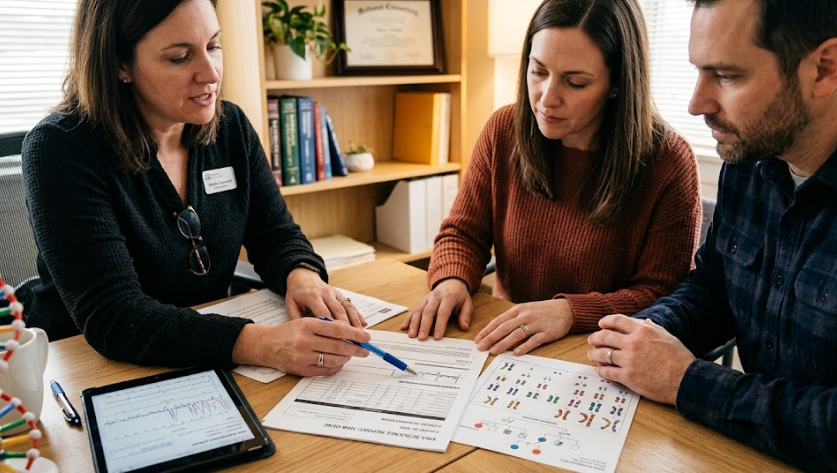
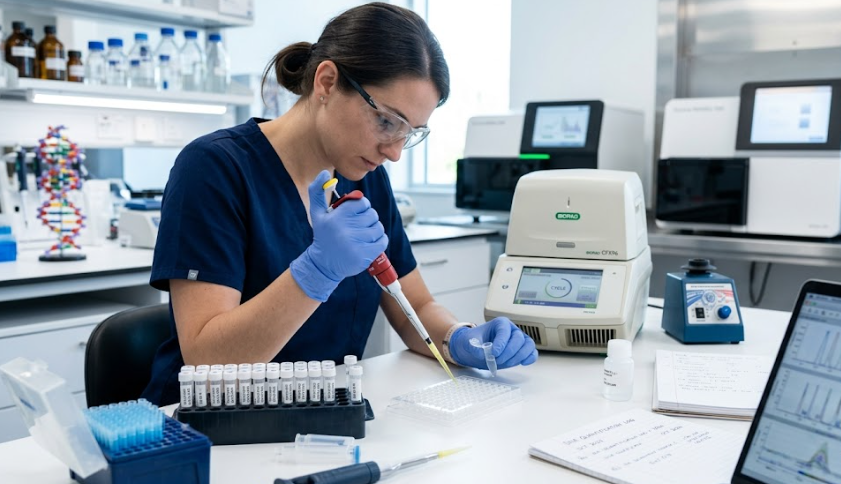
CMA is the first-line genetic test recommended for autistic individuals. It scans the entire genome for copy number variants (CNVs) — deletions or duplications of segments of chromosomes that are too small to be seen under a standard microscope but large enough to affect gene dosage and brain development.
CMA identifies a clinically significant CNV in approximately 10–20% of autistic individuals — a diagnostic yield substantially higher than older tests like standard karyotyping, which detects larger chromosomal abnormalities visible under a microscope but misses the smaller CNVs most commonly found in autism.
Fragile X Testing
Fragile X syndrome — caused by a mutation in the FMR1 gene on the X chromosome — is the most common single-gene cause of autism and intellectual disability. It is present in approximately 1–3% of autistic individuals. Because it follows an X-linked inheritance pattern with implications for female carriers across generations, Fragile X testing is recommended as first-line alongside CMA for all autistic individuals, particularly males.
Whole Exome Sequencing (WES)
WES sequences all protein-coding regions of the genome — capturing single-gene mutations that CMA misses. It identifies clinically significant variants in approximately 8–15% of autistic individuals who have already had a normal CMA result. As costs have declined significantly over the past decade, WES is increasingly offered as a second-tier test or, in some clinical settings, as first-line.
Whole Genome Sequencing (WGS)
WGS sequences the entire genome — including non-coding regions. It is the most comprehensive test available and is increasingly accessible, though it remains more commonly used in research settings than clinical practice. As interpretation of non-coding variants improves, WGS is likely to become more central to clinical genetic evaluation in autism.
How Autism IS Actually Diagnosed
If genetic testing does not diagnose autism, what does? The answer is a comprehensive clinical evaluation conducted by trained professionals who specialize in developmental assessment.
Autism is diagnosed based on observed behavior and developmental history evaluated against the DSM-5 criteria for autism — specifically, persistent differences in social communication and interaction, combined with restricted and repetitive behaviors or interests, present across multiple settings and not better explained by another condition.
The gold-standard assessment tools are:
ADOS-2 (Autism Diagnostic Observation Schedule, Second Edition): A structured observational assessment in which a trained clinician administers a series of activities and social presses — opportunities to communicate, share attention, and engage — and codes the individual’s responses. The ADOS-2 has multiple modules calibrated for different language levels, from minimally verbal to fully fluent adults. It is the most widely used direct observation measure in autism research and clinical practice.
ADI-R (Autism Diagnostic Interview-Revised): A structured interview administered to parents or caregivers covering early developmental history — language milestones, social development, play, repetitive behaviors — across the three domains relevant to autism diagnosis. Particularly useful for establishing that features were present in early childhood even when the current evaluation occurs later.
Comprehensive developmental history: A detailed account of the child’s development from birth, including milestone timelines, regression, behavioral patterns, school performance, and family history.
Standardized cognitive and adaptive behavior assessment: To establish the full functional profile, including intellectual ability, language level, and adaptive skills — which inform the support level designation under the DSM-5.
The evaluation is typically conducted by or under the supervision of a developmental pediatrician, child psychiatrist, pediatric neurologist, or licensed psychologist with training in autism assessment. For complex presentations — very young children, high-IQ individuals who mask effectively, or adults seeking late diagnosis — evaluation by a specialist team is most likely to produce an accurate result.

When Genetic Testing Is Recommended — and What to Do With the Results
The AAP recommends that all children with an autism diagnosis be offered genetic evaluation. The recommendation applies regardless of whether autism appears to be “genetic” in an obvious sense — no family history is required for genetic testing to be informative.
The recommended pathway:
- Autism diagnosis established through clinical evaluation
- First-tier genetic testing: chromosomal microarray (CMA) + Fragile X testing (FMR1)
- If CMA and Fragile X are unremarkable: consider whole exome sequencing (WES), particularly if intellectual disability is co-occurring, if multiple family members are affected, or if there are unusual physical features suggesting a syndrome
- Genetic counseling to interpret results, explain implications, and discuss recurrence risk
A negative genetic test result does not mean autism is not present. It means the specific genetic abnormalities that current tests look for were not found. The majority of autism cases — estimated at 60–75% — do not have an identifiable genetic cause on current testing. Negative results are informative, not dismissive.
A positive result — finding a CNV, Fragile X, or pathogenic variant — adds a layer of clinical information that informs management and family planning. It does not change the autism diagnosis or the behavioral intervention approach, but it does open additional medical and genetic counseling conversations.
Common Misconceptions About Genetic Testing and Autism
“A negative genetic test means my child doesn’t have autism.” A genetic test cannot rule out autism, just as it cannot confirm it. Autism is a behavioral diagnosis. Many autistic people have normal genetic test results. The two types of assessment answer entirely different questions.
“A positive CNV means my child definitely has autism.” Some CNVs significantly increase autism risk without causing it in every carrier. CNVs are risk factors, not deterministic diagnoses. A child with a known autism-associated CNV still requires a clinical behavioral evaluation to receive an autism diagnosis.
“Genetic testing is only useful if autism runs in the family.” De novo (new) mutations — not inherited from either parent — account for a meaningful proportion of autism cases. A family with no autism history can still have a child with a causative de novo variant identifiable through genetic testing.
“Prenatal genetic testing can tell me if my baby will be autistic.” Current prenatal genetic tests — including amniocentesis, chorionic villus sampling (CVS), and cell-free DNA screening — can identify chromosomal conditions like Down syndrome and certain CNVs. They cannot predict autism. Even if a CNV associated with autism is identified prenatally, the outcome for any individual child is not deterministic.
“Genetic testing tells us what caused the autism, which tells us how to treat it.” Knowing the genetic underpinning of a child’s autism does not yet translate into genotype-specific treatments in most cases. The exception is certain specific conditions — some Fragile X research, for example, has explored targeted pharmacological approaches. For most identified variants, the clinical intervention approach — behavioral therapy, speech therapy, OT — remains the same regardless of genetic finding.
Practical Framework: Navigating Genetic Evaluation After an Autism Diagnosis
Step 1: Pursue the clinical autism diagnosis first Genetic evaluation is recommended after — not instead of — a behavioral autism diagnosis. The clinical diagnosis establishes what support your child needs now. Genetic testing adds information; it does not replace the diagnostic process.
Step 2: Request a referral to a medical geneticist or genetics clinic Not all pediatricians are equipped to order and interpret autism-relevant genetic panels. A medical geneticist or a genetics counselor embedded in a developmental pediatrics program will order the appropriate first-tier tests, interpret results in context, and explain what findings do and do not mean.
Step 3: Understand the yield expectations before testing Going in with realistic expectations matters. Most families — 60–75% — will receive genetic test results that do not identify a specific cause. That is a normal and expected outcome, not a failure of the testing process.
Step 4: Get genetic counseling with results A genetic counselor translates results into language families can actually use — explaining what a finding means, what it does not mean, what the recurrence risk is for future children, and whether other family members should be tested.
Step 5: Integrate genetic findings into the broader clinical picture — but keep the focus on current support needs A genetic result is one piece of information. The most actionable priority remains connecting your child with evidence-based behavioral and developmental support as early as possible. Early ABA therapy, speech therapy, and OT produce the most meaningful outcomes — and their value does not depend on knowing the genetic underpinning. Families across Northern Virginia can access that support through ABA therapy in Vienna, VA and ABA therapy in Gainesville, VA.

Conclusion
Genetic testing cannot detect autism — but that does not make it irrelevant to the autism diagnostic and medical process. For families who have received a clinical autism diagnosis, genetic evaluation is medically recommended and can reveal important information about underlying causes, associated medical risks, and recurrence probability for future children.
What genetic testing cannot do is replace the comprehensive behavioral evaluation that produces the diagnosis in the first place, or predict autism before it is clinically apparent. Autism is diagnosed by trained clinicians who observe, interview, and assess — not by a laboratory.
For families navigating both the diagnostic process and its aftermath, the most important parallel priority is this: do not wait for genetic answers before pursuing early intervention. The evidence for early, evidence-based behavioral support is robust and time-sensitive. Genetic findings inform the clinical picture; they do not determine when support should begin. That answer is always: now.
Dream Bigger ABA provides individualized ABA therapy for autistic children and their families across Northern Virginia — delivered by experienced clinicians who understand the full complexity of autism across profiles, presentations, and support levels. If your child has received a diagnosis or you have developmental concerns, our team is ready to help. Connect with us to explore services in Vienna, VA and Gainesville, VA.
Frequently Asked Questions
Can you tell if someone has autism by genetic testing?
No. There is currently no genetic test that can diagnose autism. Autism is a clinical diagnosis made through behavioral observation, developmental history, and standardized assessment — not through a blood draw or gene panel. Genetic testing can identify specific chromosomal abnormalities or gene variants that are associated with increased autism risk, and these are found in approximately 10–25% of autistic individuals. But finding such a variant does not confirm an autism diagnosis, and the absence of a genetic finding does not rule one out. The majority of autistic people have no identifiable genetic abnormality on current testing. Autism’s diagnosis is behavioral; its causes are largely genetic but not reducible to a single testable marker.
How is autism diagnosed?
Autism is diagnosed through a comprehensive clinical evaluation that typically includes structured behavioral observation, a detailed developmental history from parents or caregivers, and standardized assessment tools. The gold-standard instruments are the ADOS-2 (Autism Diagnostic Observation Schedule, Second Edition) — a direct observational assessment involving activities designed to elicit social communication behavior — and the ADI-R (Autism Diagnostic Interview-Revised), a structured parent interview covering early developmental history. The clinician applies the DSM-5 criteria for autism to determine whether the individual meets the diagnostic threshold across the two required domains: social communication differences and restricted, repetitive behavior patterns. Evaluations are typically conducted by developmental pediatricians, child psychiatrists, pediatric neurologists, or licensed psychologists with autism specialization. There is no blood test, brain scan, or genetic test that produces the diagnosis.
What is the 6-second rule for autism?
The 6-second rule is a practical communication guideline used by educators, therapists, and parents of autistic children. It involves waiting at least 6 full seconds after giving an instruction, asking a question, or delivering a prompt — before repeating, adding more language, or assuming the child has not understood. Many autistic individuals have differences in auditory processing speed: the time needed to fully receive, decode, and translate spoken language into a planned response is longer than neurotypical expectation. When a caregiver repeats a direction or adds a second prompt within two or three seconds, they are layering new auditory input on language still being processed — often producing shutdown, confusion, or apparent non-compliance that is actually a processing delay. Implementing consistent wait time is one of the simplest and most effective communication accommodations for autistic individuals, reported to improve response rates significantly by families and classroom teachers.
What are the top 3 signs of autism?
The three core areas that most reliably indicate autism are: (1) Social communication and interaction differences — including reduced or atypical reciprocal conversation, limited joint attention (pointing to share interest, following another’s gaze), differences in eye contact during social engagement, and challenges with the implicit rules of social exchange; (2) Restricted and repetitive behaviors — including motor mannerisms such as hand-flapping or rocking, insistence on sameness and distress at unexpected change, intensely focused interests, and unusual sensory responses; and (3) Sensory processing differences — hyper or hyposensitivity to sound, light, touch, smell, or taste that meaningfully affects daily functioning and comfort. These features must be present across multiple settings and not better explained by another condition. The top 3 signs are observable behavioral patterns, not results of any medical test.
What is the biggest red flag for autism?The single most clinically significant early red flag for autism is the absence of joint attention — specifically, a child who does not point to share interest in things by 12–14 months, does not follow a caregiver’s pointing finger, and does not alternate gaze between a person and an object to share an experience. Joint attention is one of the foundational building blocks of social communication, and its absence in the first 12–18 months is the most reliable early predictor of autism in the research literature. Additional major red flags include: no babbling by 12 months, no single meaningful words by 16 months, no two-word spontaneous phrases by 24 months, loss of previously acquired language or social skills at any age (regression — covered in depth at skill regression in autism), and consistent failure to respond to their own name despite normal hearing. Any of these signs warrants immediate developmental evaluation — not a wait-and-see approach.