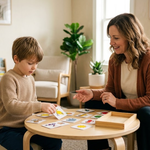
Imagine your child learning to share not in a therapy room, but while passing blocks back and forth with their sibling. Or practicing communication not with flashcards, but by asking for their favorite snack at the kitchen table.
That’s the heart of Natural Environment Teaching (NET) an ABA strategy that turns everyday moments into powerful learning opportunities. As a professional ABA therapist, I’ve seen firsthand how NET can transform not only therapy sessions but entire family routines. For many parents, this becomes the missing piece they’ve been searching for in their child’s journey.
What Is Natural Environment Teaching (NET)?
A Parent-Friendly Definition
Natural Environment Teaching (NET) is simply teaching skills in the real-life settings where your child will actually use them. Instead of only practicing at a therapy table, children learn during daily routines, play, and family activities.
For example:
● Practicing colors while coloring with crayons.
● Learning “turn-taking” during board games.
● Strengthening communication while asking for a favorite toy.
The goal? Skills aren’t just learned, they’re lived.
How NET Fits Into ABA Therapy
Think of NET as the flexible, real-world side of ABA. Structured teaching methods (like Discrete Trial Training at a table) are important for introducing new skills. But NET makes sure those skills don’t stay locked in the therapy room.
A child may learn to label “juice” on a flashcard, but in NET, they practice actually asking for juice at snack time and that’s where real independence begins.
Why Parents Love NET (And Kids Do Too)
Learning Feels Natural, Not Forced
Many parents tell me they worry therapy will feel “too clinical.” NET helps ease that concern because the teaching happens through everyday fun.
One mom I worked with said her son, who resisted tabletop tasks, lit up when we taught him to request “ball” during backyard play. For him, learning finally felt like playtime, not “work.”
Skills Generalize Faster
A common frustration in ABA is when a child can perform a skill with their therapist but struggles outside of sessions. NET solves this by teaching in the same settings where the skill will be used.
For instance, a child who learns greetings with their therapist at home is much more likely to use “hi” and “bye” at school, the playground, or with grandparents.
Builds Stronger Parent Involvement
NET naturally invites parents into the process. You don’t need special training or flashcards just your family’s daily routines.
I love showing parents how snack time can become a mini-language lesson, or how brushing teeth can turn into a sequencing activity. It empowers parents to feel confident reinforcing skills without turning into “teachers.”
7 Life-Changing Benefits of NET for Kids with Autism
1. More engagement – Children are more motivated when learning involves their favorite toys, games, or activities.
2. Faster skill retention – Practicing in real-life situations makes skills stick longer.
3. Social growth – Play-dates, siblings, and community outings become learning opportunities.
4. Communication gains – Kids learn to ask, comment, and share during real interactions.
5. Daily living skills – Dressing, chores, and hygiene become teachable moments.
6. Reduced frustration – Therapy feels fun and flexible instead of rigid.
7. Confidence boost – Every success in a natural setting builds independence and self-esteem.
When NET Works Best
Ages and Stages
NET can be adapted for toddlers, school-age children, and even teens.
● Toddlers: learning to request snacks or toys.
● Children: practicing conversation skills while playing board games.
● Teens: building independence with cooking, shopping, or community activities.
The key is tailoring activities to your child’s developmental level and goals.
Home vs. School
NET thrives in familiar, everyday environments:
● Home: meal prep, chores, sibling play.
● Community: grocery store, playground, library.
● School: classrooms, hallways, lunchtime.
With NET, the world becomes your child’s classroom.
FAQs About Natural Environment Teaching
“Is NET enough on its own, or does my child need other ABA methods too?”
NET works best when combined with structured teaching. Tabletop learning helps introduce new concepts, while NET helps children apply those concepts in real life. Think of it as two sides of the same coin.
“How is NET different from just playing at home?”
Great question! The difference is intention. A therapist embeds goals into play. For example, while building blocks, the therapist may be targeting “turn-taking,” “requesting,” or “problem- solving.” It looks like play, but there’s strategy behind every interaction.
“What if my child struggles with focus?”
That’s actually one of the strengths of NET. By using highly motivating activities like bubbles, favorite snacks, or games, therapists keep children engaged. And if something doesn’t work, we adapt quickly.
How Parents Can Get Started with NET
Work with Your ABA Therapist
If your child is already receiving ABA therapy, ask your therapist how much NET is included. A balanced plan should combine both structured and natural teaching.
Simple NET Ideas Parents Can Try at Home
● Snack time: Encourage your child to request what they want (juice, cookie, apple).
● Game night: Practice turn-taking and good sportsmanship.
● Shopping trips: Have your child help find items on the list or name objects.
● Bedtime routine: Work on sequencing (pajamas → brush teeth → story → bed).
Even small shifts like this can create powerful, lasting learning opportunities.
The Dream Bigger ABA Difference
At Dream Bigger ABA, we believe every child deserves to learn in ways that feel natural, joyful, and effective. That’s why we incorporate Natural Environment Teaching into our programs across Virginia and Oklahoma.
Our therapists don’t just teach skills, we help your child practice them where they matter most: at home, at school, and in the community. And we make sure parents feel supported and confident every step of the way.
Learn more about our ABA Therapy Services or call us today at 571-666-6674 to see how NET can help your child thrive.
Conclusion
When learning feels natural, kids don’t just practice skills – they live them. That’s the power of Natural Environment Teaching.
Whether it’s asking for a snack, joining in a family game, or greeting a friend at school, every NET moment builds toward something bigger: independence, confidence, and a brighter future.
As therapists and as parents, that’s the future we’re all dreaming bigger for. ABA therapy in Virginia: Arlington, Alexandria, Fairfax, Springfield, Annandale, Reston, Chantilly, Manassas, Suffolk, Virginia Beach.
Service Areas:
In Hampton Roads, we offer ABA therapy in Virginia Beach and support families in Suffolk. Our clinicians deliver ABA therapy in Reston, Chantilly, and Manassas, with options for home, school, and community settings.
Families looking for ABA therapy in Alexandria, Fairfax, or Springfield can start services with our team.
We provide ABA therapy in Arlington and across Northern Virginia.